Considering that you can pickup free portable chargers at trade shows, they must cost next to nothing to source. The LED adds a little bit more to the price but again not much. The whole package is very cheap wholesale and can probably be marked with whatever brand you want if you ask an Alibaba vendor. The $20 comes into play when it reaches the store. The store has already bought them from some company that bought them from China so there's already a slight markup there and then the store adds a little more. They know people will buy them and depending on what kind of store it is, can charge a little more if they know their customers well. A Walmart-like store isn't going to be able to sell them for too much above cost but a specialty bike shop can mark them up more since their customers are already spending higher prices. A specialty bike shop might even order them with custom branding, adding a little more to the final price.
As for something like the Ikea bulb in the article, it includes an RF module that isn't that cheap. It costs about $7 per 1000 pieces. Maybe they get it for $5 or $6. Add in the slightly more expensive housing, it look like a halogen bulb but is LED, and then add in the cost of a quality RBG LED and the rest of the components and markup to get $15. Ikea does win out compared to other store for things like this because Ikea is buying the units from themself. The Ikea Sonos speaker is the only thing I've ever seen there that wasn't a pure Ikea product. They really have mastered horizontal and vertical integration.
If you are salaried, your 40 hours a week is just the minimum. Some employers respect the 40 hours, some expect you to work well past that number until the job is done.
Some people I work with have made very complex Excel "machines" that have been in use by many people for decades. One of the new engineers spent about six months porting one over to MATLAB and there were all kinds of magic numbers in the formulas that turns out were there to account for some bugs in some test equipment we bought 20 years ago. We had purchased a new system that would output data that wasn't compatible with his old model so the new engineer ported it over and now we get clean, consistent results. This is for antenna measurements so there's really been little advances in decades in the fields. The advances only really exist for antenna simulations.
The restore CDs that the OEM included with the computer still had all the crap baked into it. You needed a retail copy of Windows and hopefully someone hadn't ripped the OEM key sticker off the computer.
An A-Z character string written inside random page a book stored at a relative's house is a super easy way to secure a physical backup of your private key. You could even get clever and encrypt the key using some memorable passage of another book. Since the book passage is unknown to anyone else and be selected from a near infinite pool of paragraphs from the entirety of all published books, it would be impossible for someone to bruteforce even if they found the book where you stored the encrypted key. This would be an easy enough process to generate the ciphertext and store it in the event that you totally lost access to all of your electronics, online accounts, and home.
In VA, if you want an alcohol license for your restaurant, you are required to print an ad in a local newspaper stating that you intend to get a license. I'm guessing it's so some prohibitionist can call up the ABC and complain? It's completely ridiculous. I wondering what will happen when print newspaper ceases to exist.
“all-synthetic aerosol to replace tobacco smoke, if
necessary … I know this sounds like a wild programme, but
I’ll bet that the first company to produce a cigarette
claiming a substantial reduction in tars and nicotine …
will take the market.” (Philip Morris,1958)
It's interesting that idea is exactly what we are talking about today.
RJR tried doing smokeless cigarettes in the 80s and 90s but they apparently tasted like a fart. They still sold them up until 2015. It seems to work somewhat like a hookah, a hot carbon tip is used to heat air before it passes over the tobacco. Supposedly these kinds of cigarettes were the only ones you could still consume in the RJR office.
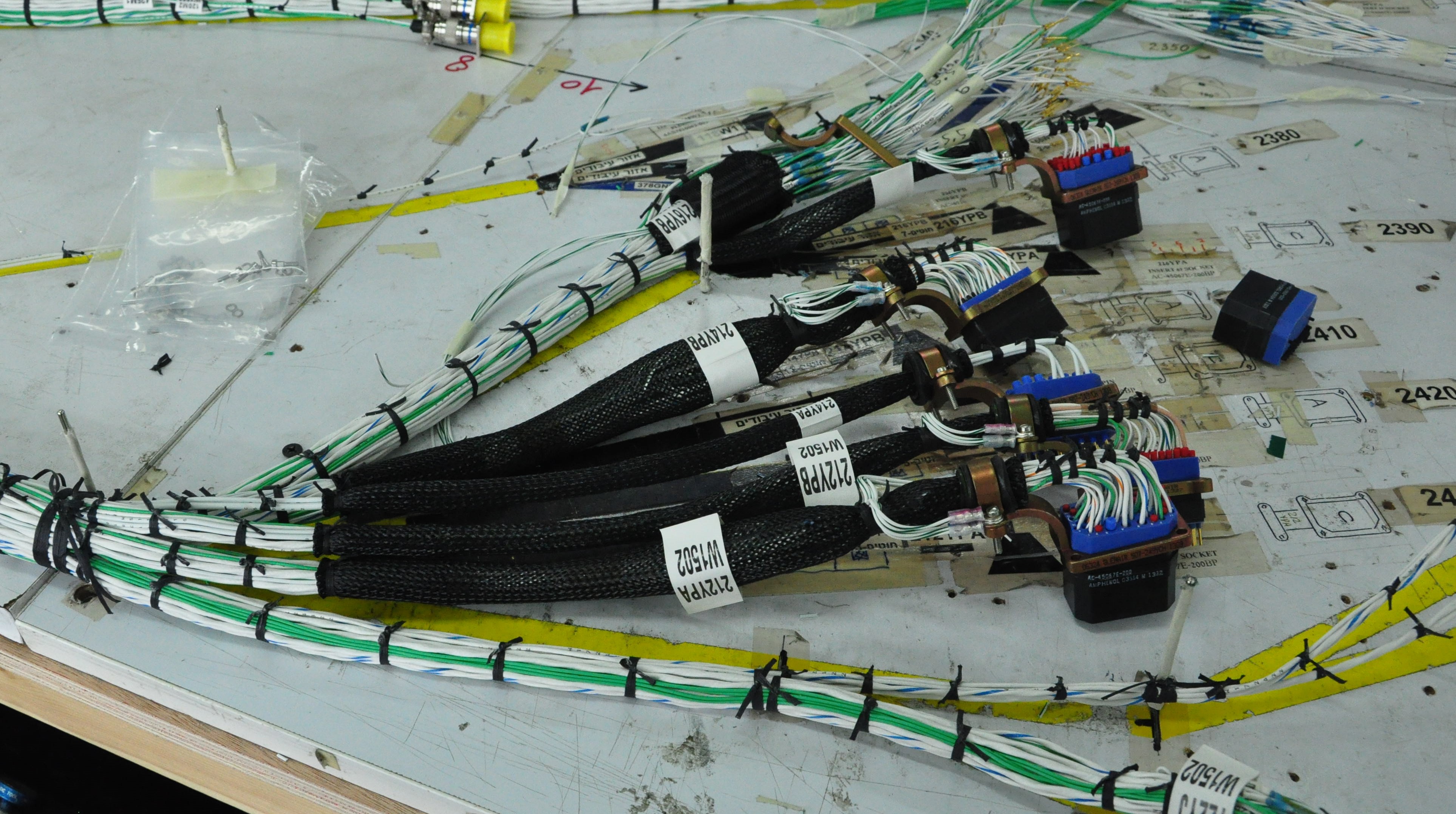
The black ties is the lacing cord. Sometimes its just small pieces that bundle the wire every few inches, sometimes its a long continuous piece that is looped at those intervals. The black nylon overbraid is for any wiring harness that is exposed or handled routinely. They typically don't use it on anything that gets tucked away. Also notice the heavy harness supports on those connectors. This is thick gauge cable and a lot of it. Large aerospace companies have shops and techs dedicated to making these all day long.
There's nothing wrong with digital modes. It really is the next evolution for ham. But there is something wrong with proprietary, blackbox encoders that only allow people with specific radios or licensed software to use it.
The world got onboard with 802.11g (and even 802.11b but that sucked). That was a massive movement towards the proliferation of wireless devices. While the standard costs $178 from IEEE, you can find copies of it scattered all over the internet. I don't know why hams have adopted these closed standards, I'm guessing it's because at one point the hobby was dominated by elmers too old to figure out anything but the newest expensive shiny thing from Icom or Yaesu (too much money, not enough sense...) Nowadays you can pull up GNU Radio and start using any sort of open standard mode you want because of how accessible everything is.
The first part is totally reasonable. If the company wants to change policies and you don't agree to those policies (and are in no way able to change them), why should they let you stay? Why should you let yourself stay? If a new policy is that egregious that you would rather possibly lose your job than sign in agreement, why would you even want to stay there? At that point, it's in everyone's best interests to part ways before it becomes a real issue.
If the company actually cares about keeping you and they have any sort of leeway as to changing the policy, they will listen to why you can't agree to it.
Are you asking why anyone needs an RTOS? It provides a very robust solution that sits somewhere between running a plain old OS like Linux and running baremetal C on a microprocesser. You get the speed benefit of baremetal but also get a scheduler and a whole bunch of multiprocessing structure to run lots of applications at once without worrying about manually switching or trying to create a massive main.c to do everything. VxWorks specifically runs on lots of industrial computers such that tasks can get done in a timely manner with little overhead.
VxWorks powers the Mars Rovers Sojourner, Spirit, Opportunity, Curiosity, Mars Reconnaissance Orbiter, and SpaceX Dragon. VxWorks also powers BMW iDrive, the Apache Longbow helicopter, and the Apple Airport Extreme and Linksys WRT54G routers. It's in a lot of things and what it's not in, FreeRTOS is probably the RTOS of choice.
You can just buy counterfeit anti-tamper stickers but if there is a switch inside the unit that flips a bit in some sort of write-once memory, then that would require removal of an entire chip and replacing it with another that may not be 100% the same. You can have a chain of trust in the system where chips will only talk to each other if they all spit out the right hash. Bury the SPI/I2C lines you use for this trust check within the PCB so you can't access it without drilling the card and add a layer of anti-tamper traces that trigger another tamper event if disturbed. Now what was just a quick install has turned into a whole PCB rework job where you are having to swap all the chips with a virgin set, assuming you can't get your hardware in there prior to final assembly.
Use an AES256 key from the factory to hash the chip's burned-in serial number and the time from the RTC. Lock out JTAG interfaces so once the chips are burned, they are inside their own fortress. There are a ton of ways to really lock down the hardware other than a shiny sticker and weird screws. Those keep people from breaking their own hardware, anti-tamper tech in chips keep out bad guys.
You can run just about anything over AX.25 since it's just the data link layer in the OSI model. You could run HTTP on top of IP on top of AX.25 with TLS/SSL message encryption turned off so you don't run afoul of FCC rules. The authentication would still be there but everything would be in the clear. You could also run IPsec with just the authentication field in the header, no encryption. Even if you didn't want to get that deep into the layers, you can always just pgp sign your messages on packet radio. Depending on the signature length, it could take several extra seconds to send the pgp signature at the typical 1.2Kb/s!
Decreasing the complexity of the stack is a good move forward. The speeds of packet radio require a custom protocol that limits overhead but leaves options for authentication and message signing. Some hams have been using packet radio at wifi frequencies which basically creates a wireless WAN with much higher data rates, making any of the authentication methods much quicker.
You aren't going to be able to build a super-fast CPU on an FPGA but there are plenty of other tasks you could give it. You can build a processor for analyze multiple sensors, looking for specific events that you could then feed to the uC or setup a DSP pipeline to filter the sensor data to look for patterns. The nice thing about an FPGA is that there is no interruption when it's running. The uC might be trying to feed data over wifi to the controller station and polling sensors/analyzing sensor data is going to bog things down really quick. Another task for an FPGA would be to act as a switch for a network within the robot. It would sit between all of the sensors/actuators and an ethernet-enabled uC located elsewhere in the robot. The FPGA would read command packets from the uC and translate tasks like "read temperature sensor #5" or "turn 15 degrees" into specific impulses on the pins while also turning sensor and feedback data into packets to send back to the uC. You could even run video feeds from cameras back to the uC over gigabit if the FPGA supports it. This way you can run a cheap, small uC to control things from a higher level while the i/o-plentiful FPGA does all the heavy lifting at 100Mb/s speeds.
You can synthesize a 6502 on an FPGA just fine and can probably do it on this specific chip. There is a project I've seen (https://danstrother.com/fpga-nes/) where someone did synthesize the 6502 along with the rest of the hardware on a Spartan 3 which does have more resources available to it. Looking at the utilization report in the comments on that page, it would be too much for this little Lattice chip. There are other FPGA development cards out there similar in size that would work better for your idea. You would be better off getting a larger development card for designing and then moving to some custom PCB that fit only the components you need at the size you want.
Standardized testing has also restricted teachers to standardized teaching. They must complete X number of units from the binder every Y number of days. This leaves little time for the teacher to come up with their own lesson plans. I think there needs to be a balance between a teacher's autonomy in the classroom and standardization. I've heard many teachers complain while I was in school that they felt like they don't have the time to focus on the things they want to do in class. In my elementry school, the class would go to a different teacher for either STEM or liberal arts. I think this is a good start since because teachers can solely focus on material that is related, they can tie in lesson plans and make sure that the standardized subjects are taught efficiently to leave time for the other topics they want to focus on.
I remember in middle school, I had a couple teachers who would say "ok, this is the standardized stuff I have to say" and then go into a very boring lecture of what we just had been learning except the way we first learned it was interesting and engaging. They were simply dotting their i's to make sure that they did their job in conveying the material the state wanted us to know.
As for something like the Ikea bulb in the article, it includes an RF module that isn't that cheap. It costs about $7 per 1000 pieces. Maybe they get it for $5 or $6. Add in the slightly more expensive housing, it look like a halogen bulb but is LED, and then add in the cost of a quality RBG LED and the rest of the components and markup to get $15. Ikea does win out compared to other store for things like this because Ikea is buying the units from themself. The Ikea Sonos speaker is the only thing I've ever seen there that wasn't a pure Ikea product. They really have mastered horizontal and vertical integration.