The Atlantic president explains Scientology advertorial ‘screw-up’(jimromenesko.com)
jimromenesko.com
The Atlantic president explains Scientology advertorial ‘screw-up’
http://jimromenesko.com/2013/01/19/the-atlantic-president-explains-the-scientology-advertorial-screw-up/
18 comments
Well this is a cynical take...
>> "We ran a “native advertising” campaign for a new advertiser..."
> We ran ads that look like genuine content...
... yet clearly marked as advertising...
>> "...that, while properly labeled as Sponsor Content, was in my opinion inconsistent with the strategy and philosophy for which this program is intended."
> ...and we thought you wouldn't notice, or care, but clearly I was wrong and we look like giant douches.
That's an unfair characterization. Another way of looking at this is that they did, indeed, realise they were wrong and looked terrible, and so realized they had made a mistake and suspended the program.
>> "In this case, we did not adequately work with the advertiser to create a content program that was in line with our brand."
> It's the advertisers fault.
What part of "we did not adequately work with the advertiser" turns this sentence into an accusation against the advertiser?
>> "In addition, because we had not fully thought through the issues around commenting on Sponsor Content, we made some mistakes trying to moderate the commenting thread."
> It's the commenter's fault.
What part of "we had not fully thought through the issues around commenting" and "we made some mistakes" turns this sentence into an accusation against commenters?
>> "The general media climate also played a role here."
> It's the media climate's fault.
Fair comment, this does seem to be a deflection towards the "general media climate". Very unnecessary, it was The Atlantic, and The Atlantic only who solely made this mistake.
>> "Once these issues came to light and I had the opportunity to assess the campaign, I made the decision to suspend it pending further review."
> When the shit hit the fan, I panicked.
Possibly. Or he could have realised that they had made a massive mistake, not implemented very well and did the responsible thing which was to pull down the campaign.
What would you have had him do? Keep the campaign running?
>> "To be clear, our decision to pull the campaign should not be interpreted as passing judgment on the advertiser as an organization."
> Don't fear, we'll still run ads for anyone...
As he says below, he believes the way that they ran the campaign was at fault here, and had nothing to do with the advertiser. The fact that the advertiser was the Church of Scientology had nothing to do with their decision. Seems like a fair comment to me.
>> "Where I believe we erred was in the execution of the campaign."
> It's probably our fault.
It's sort of funny how above you say that he's blaming: the media climate, the advertisers and the commenters, yet here you see that he is claiming responsibility.
>> "We then issued a statement to the press admitting we were at fault. When we make a mistake, we admit it."
> See, I admitted it before. I get kudos for that.
Well... yes! There are plenty of organizations I've seen who have tried to spin it that it wasn't entirely their fault. He sure does get kudos for admitting fault - that's not easy to do. Many organizations won't do it (witness Carmen Ortiz's non-apology apology).
>> "Our highest priority is The Atlantic’s reputation and credibility. That’s why so many readers trust us and why advertisers want to work with us."
> We're willing to sell out our reputation and credibility, as long as it doesn't backfire.
Oh come on! They tried something they hadn't done before to get some advertising dollars, they totally stuffed the execution and now you are saying they are total sell-outs? I think that's a bit much, really.
>> "Why did it happen? Quite simply, we did not have clearly established digital advertising guidelines and policies in place..."
> It's management's fault.
Well... yes! However, he's saying here the specific areas where they erred. I think that's constructive and reasonable. It also shows that they have identified the areas in which they need to improve so the problem doesn't occur again.
Unless they admit fault, and work out where things went wrong, then they can't exactly improve on where they made bad judgement calls and errors.
>> "...and when you’re innovating in a new territory without standardized guidelines (we’re not alone in the industry on this issue, by the way), mistakes can happen."
> It's "innovation's" fault.
Uh, no. He's saying that this wasn't something they had done before, it was untried and untested and they made a lot of mistakes as they were, simply put, inexperienced.
>> "One important note for everyone: casting blame on any group or any individual is both unfair and simply not what we do at The Atlantic."
> It's not my fault.
That is extremely unfair. I actually thought this was a remarkable ethos, given the number of companies I've seen that are willing to find a scapegoat when things go bad.
There's no point in pointing fingers at any one person at The Atlantic, because it's not constructive. While you may characterize this as insulating Scott Havens from criticism, more likely he is publicly defending the entire team from unnecessary blame.
>> "And we most certainly should not speak to the press or use social media to attack our organization or our colleagues. We are a team that rises and falls together."
> Be quiet about it.
He's saying that as an organization, they aren't going to publicly air their dirty laundry or have insiders leak criticism to attack one another. Fair enough, don't you think? Or do you think that employees should go at each other in the public arena?
>> "What is our plan going forward? We are currently finalizing new policies and guidelines to govern advertising overall, with a specific focus on Sponsor Content."
> We're figuring out just how far we can push when lying to customers.
Or they are trying to work towards tightening their advertising policies to more clearly distinguish between sponsor content and content from The Atlantic. In other words, this debacle has caused them to review what went wrong, identify areas that aren't working or are broken, and then to fix those policies and guidelines.
Sounds like a reasonable thing to me!
>> "Very shortly, we’ll publish these new policies, and I’ll be discussing them publicly with the press."
> Hopefully this will blow over soon.
What? They are going to publicly publish their advertising policies and discuss them fully. That's called "transparency", the direct opposite of "Hopefully this will blow over soon".
>> "My hope is that we’ll turn this issue into a moment where, as a leader in digital advertising, we will help move the industry to a better place."
> If I can spin this, it'll look great on my CV.
Given your responses, you seem to be pretty good at twisting the words of others yourself.
>> "If you have ANY questions or potential concerns about something you’re working on, please don’t hesitate to push it up the chain. Push it up to me—and if I think I need to, I will include Justin and David, not to mention Linda, Natalie, Bruce, Aretae (our new deputy general counsel), etc."
> We're watching our collective arses closely now.
Or he is asking for input from employees and is willing to take on board feedback.
>> "It seems fitting to quote one of our founders, Ralph Waldo Emerson, who once said “Our greatest glory is not in never failing, but in rising up every time we fail.” This isn’t the first, nor the last time that WE will make mistakes..."
> WE
Yes, "WE". The Atlantic's ethos appears to be to run as a unified team. I would hazard a guess, but I'd say there were many people who came up with the advertising campaign.
>> "..., but what is important is how we handle them and what we learn from these moments."
> I'm not going anywhere.
I didn't read that at all. He said that when mistakes happen, which they will, they will handle them appropriately and make adjustments as necessary.
>> "I am available at any time (including this weekend) should you wish to discuss any aspects of this week in further depth."
> I'm so contrite, I'm even working this weekend.
This was an internal memo. Yes, he does appear to be working on the weekend and is making himself available to employees who are concerned. That's called "leadership" - you know, the sort of thing you exhibit when you have a crisis, which is what this was.
>> "We ran a “native advertising” campaign for a new advertiser..."
> We ran ads that look like genuine content...
... yet clearly marked as advertising...
>> "...that, while properly labeled as Sponsor Content, was in my opinion inconsistent with the strategy and philosophy for which this program is intended."
> ...and we thought you wouldn't notice, or care, but clearly I was wrong and we look like giant douches.
That's an unfair characterization. Another way of looking at this is that they did, indeed, realise they were wrong and looked terrible, and so realized they had made a mistake and suspended the program.
>> "In this case, we did not adequately work with the advertiser to create a content program that was in line with our brand."
> It's the advertisers fault.
What part of "we did not adequately work with the advertiser" turns this sentence into an accusation against the advertiser?
>> "In addition, because we had not fully thought through the issues around commenting on Sponsor Content, we made some mistakes trying to moderate the commenting thread."
> It's the commenter's fault.
What part of "we had not fully thought through the issues around commenting" and "we made some mistakes" turns this sentence into an accusation against commenters?
>> "The general media climate also played a role here."
> It's the media climate's fault.
Fair comment, this does seem to be a deflection towards the "general media climate". Very unnecessary, it was The Atlantic, and The Atlantic only who solely made this mistake.
>> "Once these issues came to light and I had the opportunity to assess the campaign, I made the decision to suspend it pending further review."
> When the shit hit the fan, I panicked.
Possibly. Or he could have realised that they had made a massive mistake, not implemented very well and did the responsible thing which was to pull down the campaign.
What would you have had him do? Keep the campaign running?
>> "To be clear, our decision to pull the campaign should not be interpreted as passing judgment on the advertiser as an organization."
> Don't fear, we'll still run ads for anyone...
As he says below, he believes the way that they ran the campaign was at fault here, and had nothing to do with the advertiser. The fact that the advertiser was the Church of Scientology had nothing to do with their decision. Seems like a fair comment to me.
>> "Where I believe we erred was in the execution of the campaign."
> It's probably our fault.
It's sort of funny how above you say that he's blaming: the media climate, the advertisers and the commenters, yet here you see that he is claiming responsibility.
>> "We then issued a statement to the press admitting we were at fault. When we make a mistake, we admit it."
> See, I admitted it before. I get kudos for that.
Well... yes! There are plenty of organizations I've seen who have tried to spin it that it wasn't entirely their fault. He sure does get kudos for admitting fault - that's not easy to do. Many organizations won't do it (witness Carmen Ortiz's non-apology apology).
>> "Our highest priority is The Atlantic’s reputation and credibility. That’s why so many readers trust us and why advertisers want to work with us."
> We're willing to sell out our reputation and credibility, as long as it doesn't backfire.
Oh come on! They tried something they hadn't done before to get some advertising dollars, they totally stuffed the execution and now you are saying they are total sell-outs? I think that's a bit much, really.
>> "Why did it happen? Quite simply, we did not have clearly established digital advertising guidelines and policies in place..."
> It's management's fault.
Well... yes! However, he's saying here the specific areas where they erred. I think that's constructive and reasonable. It also shows that they have identified the areas in which they need to improve so the problem doesn't occur again.
Unless they admit fault, and work out where things went wrong, then they can't exactly improve on where they made bad judgement calls and errors.
>> "...and when you’re innovating in a new territory without standardized guidelines (we’re not alone in the industry on this issue, by the way), mistakes can happen."
> It's "innovation's" fault.
Uh, no. He's saying that this wasn't something they had done before, it was untried and untested and they made a lot of mistakes as they were, simply put, inexperienced.
>> "One important note for everyone: casting blame on any group or any individual is both unfair and simply not what we do at The Atlantic."
> It's not my fault.
That is extremely unfair. I actually thought this was a remarkable ethos, given the number of companies I've seen that are willing to find a scapegoat when things go bad.
There's no point in pointing fingers at any one person at The Atlantic, because it's not constructive. While you may characterize this as insulating Scott Havens from criticism, more likely he is publicly defending the entire team from unnecessary blame.
>> "And we most certainly should not speak to the press or use social media to attack our organization or our colleagues. We are a team that rises and falls together."
> Be quiet about it.
He's saying that as an organization, they aren't going to publicly air their dirty laundry or have insiders leak criticism to attack one another. Fair enough, don't you think? Or do you think that employees should go at each other in the public arena?
>> "What is our plan going forward? We are currently finalizing new policies and guidelines to govern advertising overall, with a specific focus on Sponsor Content."
> We're figuring out just how far we can push when lying to customers.
Or they are trying to work towards tightening their advertising policies to more clearly distinguish between sponsor content and content from The Atlantic. In other words, this debacle has caused them to review what went wrong, identify areas that aren't working or are broken, and then to fix those policies and guidelines.
Sounds like a reasonable thing to me!
>> "Very shortly, we’ll publish these new policies, and I’ll be discussing them publicly with the press."
> Hopefully this will blow over soon.
What? They are going to publicly publish their advertising policies and discuss them fully. That's called "transparency", the direct opposite of "Hopefully this will blow over soon".
>> "My hope is that we’ll turn this issue into a moment where, as a leader in digital advertising, we will help move the industry to a better place."
> If I can spin this, it'll look great on my CV.
Given your responses, you seem to be pretty good at twisting the words of others yourself.
>> "If you have ANY questions or potential concerns about something you’re working on, please don’t hesitate to push it up the chain. Push it up to me—and if I think I need to, I will include Justin and David, not to mention Linda, Natalie, Bruce, Aretae (our new deputy general counsel), etc."
> We're watching our collective arses closely now.
Or he is asking for input from employees and is willing to take on board feedback.
>> "It seems fitting to quote one of our founders, Ralph Waldo Emerson, who once said “Our greatest glory is not in never failing, but in rising up every time we fail.” This isn’t the first, nor the last time that WE will make mistakes..."
> WE
Yes, "WE". The Atlantic's ethos appears to be to run as a unified team. I would hazard a guess, but I'd say there were many people who came up with the advertising campaign.
>> "..., but what is important is how we handle them and what we learn from these moments."
> I'm not going anywhere.
I didn't read that at all. He said that when mistakes happen, which they will, they will handle them appropriately and make adjustments as necessary.
>> "I am available at any time (including this weekend) should you wish to discuss any aspects of this week in further depth."
> I'm so contrite, I'm even working this weekend.
This was an internal memo. Yes, he does appear to be working on the weekend and is making himself available to employees who are concerned. That's called "leadership" - you know, the sort of thing you exhibit when you have a crisis, which is what this was.
>... yet clearly marked as advertising...
That's bullshit. If something uses the same font and page layout as editorial content, it will always be mistaken for editorial content. That's the whole point of it.
And using weasel words like "sponsor content" is definitely not 'clearly marked as advertisment'.
That's bullshit. If something uses the same font and page layout as editorial content, it will always be mistaken for editorial content. That's the whole point of it.
And using weasel words like "sponsor content" is definitely not 'clearly marked as advertisment'.
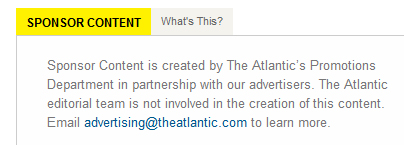
To be fair, it was a giant yellow box that gave an explanation of the words "sponsor content" when you hovered over it. Also the box isn't always yellow or that big, sometimes it's light tan, small and blends into the page; so they at least attempted to make it more noticeable in this instance. Not saying they should have put the ad up, for obvious reasons, but people need to pay attention to what they're reading as well.
http://www.washingtonpost.com/blogs/erik-wemple/files/2013/0...
Pop Up Message: "Sponsor content is created by The Atlantic’s Promotions Department in partnership with our advertisers. The Atlantic editorial team is not involved in the creation of this content. Email [email protected] to learn more."
http://www.poynter.org/wp-content/uploads/2013/01/sponsorcon...
I wonder if this would have even been an issue if it wasn't an article about Scientology, especially since this style of advertising has been happening on that site for at least the last two years and elsewhere since newspapers have been in existence.
http://www.washingtonpost.com/blogs/erik-wemple/files/2013/0...

Pop Up Message: "Sponsor content is created by The Atlantic’s Promotions Department in partnership with our advertisers. The Atlantic editorial team is not involved in the creation of this content. Email [email protected] to learn more."
http://www.poynter.org/wp-content/uploads/2013/01/sponsorcon...
I wonder if this would have even been an issue if it wasn't an article about Scientology, especially since this style of advertising has been happening on that site for at least the last two years and elsewhere since newspapers have been in existence.
When I first visited it, it was a plain white text box at the end of the article.
In this interpretation, those reading are both attuned to font and layout consisitencies between pages and oblivious to the content of what they're reading. I disagree.
So long as there's reasonable transparency, I'd give readers, especially, a bit more credit and latitude here. IMO, the "sponsor content" label is reasonable transparency.
So long as there's reasonable transparency, I'd give readers, especially, a bit more credit and latitude here. IMO, the "sponsor content" label is reasonable transparency.
When I read "sponsor content", I read "paid advertising". I don't think it's "bullshit" to say that this is clearly marked as advertising.
Perhaps I can spot this more easily than you can, I don't know.
Perhaps I can spot this more easily than you can, I don't know.
> "Well this is a cynical take..."
Passing off SoC advertorials as content was pretty cynical too. Most of your responses just re-state the original nothing-speak.
Tellingly, the memo is gone and the words "sorry" or "apology" don't appear once in the original.
Passing off SoC advertorials as content was pretty cynical too. Most of your responses just re-state the original nothing-speak.
Tellingly, the memo is gone and the words "sorry" or "apology" don't appear once in the original.
Gave me my first laugh of the day - very nice!
"In this case, we did not adequately work with the advertiser to create a content program that was in line with our brand."
It's disturbing to see that The Atlantic believes that it could have reconciled Scientology with its "brand" if it had only worked a bit harder. They're only digging themselves into a deeper hole with this corporate mumbo jumbo.
It's disturbing to see that The Atlantic believes that it could have reconciled Scientology with its "brand" if it had only worked a bit harder. They're only digging themselves into a deeper hole with this corporate mumbo jumbo.
It really is a bizarre mess of vague, meaningless, and confusing statements.
> The general media climate also played a role here.
...what?
> To be clear, our decision to pull the campaign should not be interpreted as passing judgment on the advertiser as an organization.
We don't actually think there's anything wrong with Scientology.
> Very shortly, we’ll publish these new policies, and I’ll be discussing them publicly with the press.
We're sure that everyone will forget about this in a week or two, when we'll quietly publish more platitudes about the incident tucked away in a corner somewhere.
> The general media climate also played a role here.
...what?
> To be clear, our decision to pull the campaign should not be interpreted as passing judgment on the advertiser as an organization.
We don't actually think there's anything wrong with Scientology.
> Very shortly, we’ll publish these new policies, and I’ll be discussing them publicly with the press.
We're sure that everyone will forget about this in a week or two, when we'll quietly publish more platitudes about the incident tucked away in a corner somewhere.
Some day, I'm going to get a job as CEO of The Smithsonian. I don't care what salary they pay me, but I'll make damn sure my bonus compensation package is tied to profitability.
Then, for the next two years, I'll sell off the museum's collections to the highest bidders, and then leave, having had the two most profitable years ever.
As far as I can tell, this is what passes for genius in today's corporate environment.
Then, for the next two years, I'll sell off the museum's collections to the highest bidders, and then leave, having had the two most profitable years ever.
As far as I can tell, this is what passes for genius in today's corporate environment.
> From: Havens, Scott
> Date: January 18, 2013, 6:08:51 PM EST
Remember kids, the best time to post non-explanations or non-apologies is as late as possible on a Friday to minimize anyone actually seeing it or acting on it or anything changing at all, really.
> Date: January 18, 2013, 6:08:51 PM EST
Remember kids, the best time to post non-explanations or non-apologies is as late as possible on a Friday to minimize anyone actually seeing it or acting on it or anything changing at all, really.
Here's the original ad archived: http://www.webcitation.org/6Do5yGrId
Edit: Ha, the images from the ad are still in The Atlantic's CDN: http://cdn.theatlantic.com/static/mt/assets/sponsored/0.%20M...
Edit: Ha, the images from the ad are still in The Atlantic's CDN: http://cdn.theatlantic.com/static/mt/assets/sponsored/0.%20M...

This response destroys the Atlantic’s reputation: blame dodging, inability to see why Scientology is an inappropriate advertiser, and self-aggrandising behaviour are all on display. What a pathetic magazine.
It would be great to see the Atlantic covering the Fishman affidavit, Karin Spaink and xs4all against Scientology in one of their upcoming articles.
The world needs a periodic reminder of what Scientology really is and I think the Atlantic is now morally obliged to be the vehicle for that reminder.
http://en.wikipedia.org/wiki/Fishman_Affidavit
The world needs a periodic reminder of what Scientology really is and I think the Atlantic is now morally obliged to be the vehicle for that reminder.
http://en.wikipedia.org/wiki/Fishman_Affidavit
This somehow prompted me to check out the Scientology website. I don't buy into scientology at all (and am pretty against some of the abuses), but wow, they are really good at marketing.
We ran ads that look like genuine content...
> "...that, while properly labeled as Sponsor Content, was in my opinion inconsistent with the strategy and philosophy for which this program is intended."
...and we thought you wouldn't notice, or care, but clearly I was wrong and we look like giant douches.
> "In this case, we did not adequately work with the advertiser to create a content program that was in line with our brand."
It's the advertisers fault.
> "In addition, because we had not fully thought through the issues around commenting on Sponsor Content, we made some mistakes trying to moderate the commenting thread."
It's the commenter's fault.
> "The general media climate also played a role here."
It's the media climate's fault.
> "Once these issues came to light and I had the opportunity to assess the campaign, I made the decision to suspend it pending further review."
When the shit hit the fan, I panicked.
> "To be clear, our decision to pull the campaign should not be interpreted as passing judgment on the advertiser as an organization."
Don't fear, we'll still run ads for anyone...
> "Where I believe we erred was in the execution of the campaign."
It's probably our fault.
> "We then issued a statement to the press admitting we were at fault. When we make a mistake, we admit it."
See, I admitted it before. I get kudos for that.
> "Our highest priority is The Atlantic’s reputation and credibility. That’s why so many readers trust us and why advertisers want to work with us."
We're willing to sell out our reputation and credibility, as long as it doesn't backfire.
> "Why did it happen? Quite simply, we did not have clearly established digital advertising guidelines and policies in place..."
It's management's fault.
> "...and when you’re innovating in a new territory without standardized guidelines (we’re not alone in the industry on this issue, by the way), mistakes can happen."
It's "innovation's" fault.
> "One important note for everyone: casting blame on any group or any individual is both unfair and simply not what we do at The Atlantic."
It's not my fault.
> "And we most certainly should not speak to the press or use social media to attack our organization or our colleagues. We are a team that rises and falls together."
Be quiet about it.
> "What is our plan going forward? We are currently finalizing new policies and guidelines to govern advertising overall, with a specific focus on Sponsor Content."
We're figuring out just how far we can push when lying to customers.
> "Very shortly, we’ll publish these new policies, and I’ll be discussing them publicly with the press."
Hopefully this will blow over soon.
> "My hope is that we’ll turn this issue into a moment where, as a leader in digital advertising, we will help move the industry to a better place."
If I can spin this, it'll look great on my CV.
> "If you have ANY questions or potential concerns about something you’re working on, please don’t hesitate to push it up the chain. Push it up to me—and if I think I need to, I will include Justin and David, not to mention Linda, Natalie, Bruce, Aretae (our new deputy general counsel), etc."
We're watching our collective arses closely now.
> "It seems fitting to quote one of our founders, Ralph Waldo Emerson, who once said “Our greatest glory is not in never failing, but in rising up every time we fail.” This isn’t the first, nor the last time that WE will make mistakes..."
WE
> "..., but what is important is how we handle them and what we learn from these moments."
I'm not going anywhere.
> "I am available at any time (including this weekend) should you wish to discuss any aspects of this week in further depth."
I'm so contrite, I'm even working this weekend.