United States loses AAA credit rating from S&P(reuters.com)
reuters.com
United States loses AAA credit rating from S&P
http://www.reuters.com/article/2011/08/06/usa-downgrade-sp-idUSN1E7741TJ20110806
259 comments
The true shame is not loosing some arbitrary rating from some arbitrary organization, but that this action still matters even after said organization was shown, conclusively, to behave in a completely arbitrary and ultimately self-serving way.
[deleted]
This is the beginning of the end of the dollar as the worlds reserve currency, its bad for the rest of the world and only good for the US, its imbalanced.
I am not so sure most Americans are ready for what the world will be like when it happens, because unless the need for a regular deficit is reduced and reliance for imported oil curbed, it will be very painful indeed.
I am not so sure most Americans are ready for what the world will be like when it happens, because unless the need for a regular deficit is reduced and reliance for imported oil curbed, it will be very painful indeed.
THere is a simple solution to the Social Security "crisis". Right now only income up to 100,000 is subject to social security taxes. Anything over 100,000 is not taxed for social security. If we raised taxable income to 150,000 or 200,000 even we'd have plenty of money.
I'd love if some of the downvoters could explain 1) why I'm wrong or 2) what an alternative would look like?
Raise the taxes on the rich! Jesus Christ!
All the seemingly smart guys here, producing stupid arguments. Stop thinking how to cut children's lunch and start thinking how to get a 2nd job!
The debt is not the problem.
THer
Has the US ever not had a AAA credit rating from S&P (until now)?
from the press release:
"The political brinksmanship of recent months highlights what we see as America's governance and policymaking becoming less stable, less effective, and less predictable than what we previously believed. "
"The political brinksmanship of recent months highlights what we see as America's governance and policymaking becoming less stable, less effective, and less predictable than what we previously believed. "
There has been a complete lack of leadership from the Congressional Democrats on this issue. They haven't produced a budget plan in nearly three years, while borrowing 40 cents of every dollar spent during that time.
I'm not a partisan-- George Bush's runaway spending contributed a great deal to the current predicament. But the basic Congressional oversight and operating under a budget hasn't happened the last couple of years.
I'm not a partisan-- George Bush's runaway spending contributed a great deal to the current predicament. But the basic Congressional oversight and operating under a budget hasn't happened the last couple of years.
There has been a complete lack of leadership from the Congressional Democrats on this issue. They haven't produced a budget plan in nearly three years, while borrowing 40 cents of every dollar spent during that time.
Uh, you are merely parroting inaccurate GOP talking points, and I think we can be a little more accurate than that here.
First of all, the House and Senate easily passed Obama’s first budget on the president’s 100th day in office. That budget measure, however, did not include a single GOP vote, a harbinger of the lack of bipartisanship to come. From 2009 to January 2011, Republicans forced more than 90 “cloture” votes, which require 60 senators to agree to limit debate (ie stop a filibuster) on a measure.
Pretending that there was no Democrat "budget plan" for 2010 is disingenuous at best. Ongoing Democrat "plans" were continuously on the docket:
http://frwebgate.access.gpo.gov/cgi-bin/getdoc.cgi?dbname=11...
Democrats did not have anything like a filibuster-proof majority in the Senate, and Republican Senators were quite open with their threat to filibuster any legislation until the “Bush-tax cuts” were extended.
http://www.nationaljournal.com/congress/gop-will-filibuster-...
"We write to inform you that we will not agree to invoke cloture on the motion to proceed to any legislative item until the Senate has acted to fund the government and we have prevented the tax increase that is currently awaiting all American taxpayers,” said the letter, which was sent to Senate Majority Leader Harry Reid this morning."
“The true effect of this letter is to prevent the Senate from acting on many important issues that have bipartisan support,” Reid said this morning on the Senate floor. He said the letter codifies a GOP strategy of delaying action “on critical matters, then blaming the Democrats for not addressing the needs of the American people. Very cynical, but very obvious, very transparent.”
And imagine that, here we are in 2011....
Of course, filibuster has been used by both parties, but these tactics by Republicans accelerated drastically when Dems took over Congress late in Bush's presidency. As even the conservative American Enterprise Institute noted, Republican filibusters were used increasingly to obstruct legislation:
http://tpmdc.talkingpointsmemo.com/2010/01/the-rise-of-clotu...
"It is the most striking in history," American Enterprise Institute resident scholar Norm Ornstein told TPM.
"What happened, Ornstein says, is that during the last two years of President George W. Bush's second term, Republicans offered "no initiatives to speak of."
"The initiatives were coming from the Democrats, and the Republicans wanted to kill 'em, or slow things down. Republican filibuster threats, Ornstein said, were "like throwing molasses in the road."
"Still, Ornstein largely attributes the stark rise in cloture motions in the 110th Congress to Republican delay and obstruction tactics."
Uh, you are merely parroting inaccurate GOP talking points, and I think we can be a little more accurate than that here.
First of all, the House and Senate easily passed Obama’s first budget on the president’s 100th day in office. That budget measure, however, did not include a single GOP vote, a harbinger of the lack of bipartisanship to come. From 2009 to January 2011, Republicans forced more than 90 “cloture” votes, which require 60 senators to agree to limit debate (ie stop a filibuster) on a measure.
Pretending that there was no Democrat "budget plan" for 2010 is disingenuous at best. Ongoing Democrat "plans" were continuously on the docket:
http://frwebgate.access.gpo.gov/cgi-bin/getdoc.cgi?dbname=11...
Democrats did not have anything like a filibuster-proof majority in the Senate, and Republican Senators were quite open with their threat to filibuster any legislation until the “Bush-tax cuts” were extended.
http://www.nationaljournal.com/congress/gop-will-filibuster-...
"We write to inform you that we will not agree to invoke cloture on the motion to proceed to any legislative item until the Senate has acted to fund the government and we have prevented the tax increase that is currently awaiting all American taxpayers,” said the letter, which was sent to Senate Majority Leader Harry Reid this morning."
“The true effect of this letter is to prevent the Senate from acting on many important issues that have bipartisan support,” Reid said this morning on the Senate floor. He said the letter codifies a GOP strategy of delaying action “on critical matters, then blaming the Democrats for not addressing the needs of the American people. Very cynical, but very obvious, very transparent.”
And imagine that, here we are in 2011....
Of course, filibuster has been used by both parties, but these tactics by Republicans accelerated drastically when Dems took over Congress late in Bush's presidency. As even the conservative American Enterprise Institute noted, Republican filibusters were used increasingly to obstruct legislation:
http://tpmdc.talkingpointsmemo.com/2010/01/the-rise-of-clotu...
"It is the most striking in history," American Enterprise Institute resident scholar Norm Ornstein told TPM.
"What happened, Ornstein says, is that during the last two years of President George W. Bush's second term, Republicans offered "no initiatives to speak of."
"The initiatives were coming from the Democrats, and the Republicans wanted to kill 'em, or slow things down. Republican filibuster threats, Ornstein said, were "like throwing molasses in the road."
"Still, Ornstein largely attributes the stark rise in cloture motions in the 110th Congress to Republican delay and obstruction tactics."
The Democrats controlled the Senate, the House and the White House until a lot were booted out of the House. They still control the Senate and the White House and yet the S&P downgrade in your mind is due to the Republicans?
House republicans threatened to force a default, which is clearly the reason for the downgrade. Read the quote in the first post of the thread.
This really should be a call for both parties to start working together but it will most likely turbo charge the blame game.
We can expect this to not impact how the parties work against each in the least. The ratings agencies said up front what they were expecting to see in the debt deal and congress didn't come close.
It's definitely going to be the blame game, especially with Obama's re-election campaign coming up.
sigh
sigh
Sadly, both parties will see this as an advantage going into the 2012 election.
Correct, and it's already begun:
http://tpmdc.talkingpointsmemo.com/2011/08/gop-tries-to-shif...
http://tpmdc.talkingpointsmemo.com/2011/08/gop-tries-to-shif...
My favourite thing about that link is how it functions both ways. It describes an example of Republicans trying to shift blame onto Democrats, and it is an example of Democrats trying to shift blame onto Republicans.
I wonder what would have happened if S&P dropped the rating during the trading day, and not after the markets closed. We probably would have seen another -500 point drop on the DJI.
They wait until late friday to make big changes to give the officaldom/industry a weekend to scramble/grab parachutes. They actually didnt release today until after the SPY stopped trading.
I wonder if they, the parachutes, will be golden this time around.
Or perhaps the drop happened because a lot of the big banks knew that the downgrade was coming. Is it insider trading if everyone knows?
[deleted]
So it begins.
A quote: "The outlook on the new U.S. credit rating is negative, S&P said in a statement, a sign that another downgrade is possible in the next 12 to 18 months."
I.e., things are going to get a lot worse before they get worse.
Time to bring this back to a hacker's perspective. Is there any way to "hack" the system so as to get government finances to within commuting distance of sanity? Or have recent events already answered that question?
A quote: "The outlook on the new U.S. credit rating is negative, S&P said in a statement, a sign that another downgrade is possible in the next 12 to 18 months."
I.e., things are going to get a lot worse before they get worse.
Time to bring this back to a hacker's perspective. Is there any way to "hack" the system so as to get government finances to within commuting distance of sanity? Or have recent events already answered that question?
Letting the Bush tax cuts expire next year, and winding down operations in Iraq and Afghanistan would go a long way to balancing the Federal budget.
As far as reducing the deficit goes, I have less insight into this. Except that making the Federal government's budget revenue-neutral is a critical first step.
As far as reducing the deficit goes, I have less insight into this. Except that making the Federal government's budget revenue-neutral is a critical first step.
+1 for that. Expiring the tax cuts and reducing foreign military expenditures is our best option. We have an obligation to keep our current military personel employed but I would rather they be spending their salaries in local businesses here. Military cuts can occur by shutting down foreign bases and drastically reducing the recruitment of new military personel.
It would be funny, if it were not so serious: a lot of my conservative friends harp on the need to stay in the middle east, but refuse to pay for it with taxes.
It would be funny, if it were not so serious: a lot of my conservative friends harp on the need to stay in the middle east, but refuse to pay for it with taxes.
> would go a long way to balancing the Federal budget
> as reducing the deficit goes, I have less insight into this
Balancing the budget is exactly reducing the deficit. It's the debt I suspect you have less insight into.
Frankly it's an embarrassment that they could only agree lower the deficit by less than 10%. They are a long way from addressing the debt.
> as reducing the deficit goes, I have less insight into this
Balancing the budget is exactly reducing the deficit. It's the debt I suspect you have less insight into.
Frankly it's an embarrassment that they could only agree lower the deficit by less than 10%. They are a long way from addressing the debt.
Yes, you are correct. Long day and I'm confusing terms :)
The terms of the debt ceiling deal look like it will force one/the other/both:
http://www.editedforclarity.com/2011/08/01/debt-ceiling-deal...
http://www.editedforclarity.com/2011/08/01/debt-ceiling-deal...
I listened to an NPR segment on this topic and it seems like Congress has several ways around doing the things that journalists think can be forced through. I'm an immigrant to the US so this a learning exercise for me, perhaps someone else can explain in more detail.
I'm guessing "This is just a law. They can of course, just pass a different law that disregards the old laws, as new laws have primacy over old".
If the government that produces the reserve currency can't hold up a AAA rating, what can? The idea that anything else should have a AAA rating if the US gov't doesn't seems a little ridiculous to me on face value.
The implication is really the other way around. The USD was the reserve currency in part because of the credibility of the US government's financials (and also because of amount of trade, etc). But obviously, the US has taken a huge beating credibility-wise recently.
After all, Sterling used to be the world's reserve currency : things change.
After all, Sterling used to be the world's reserve currency : things change.
Some other AAA countries: Switzerland, Luxembourg, Norway, Singapore.
To me it seems a little ridiculous that the US and these countries shared the same rating for such a long time. On the other hand, there are AAA countries like UK, France, Germany that do not seem to fit into the same category either.
I have no real opinion if the US deserves the AAA rating, but thinking treasuries are the safest investment in the world seems a bit optimistic.
To me it seems a little ridiculous that the US and these countries shared the same rating for such a long time. On the other hand, there are AAA countries like UK, France, Germany that do not seem to fit into the same category either.
I have no real opinion if the US deserves the AAA rating, but thinking treasuries are the safest investment in the world seems a bit optimistic.
That's one of the MAJOR implications of this, if I'm not mistaken. Of course, bonds denoted in Euro's or other currencies wouldn't be affected.
There are countries who don't use debt payments as political tools. A congressional stalemate that leads to a failure to pay bondholders is entirely possible.
I wonder if the downgrade is because the US might be unwilling to pay its debts or because they feel the people may be unwilling to bailout the banks again?
The downgrade is because the US Gov is spending far more than it's taking in. In other words, it's for the same reason that every other person / business / government gets downgraded. It's important to realize that there's no magic here.
You cannot compare 'person' and 'business' with government. The government has the ability to print money, whereas the other two do not. The only reason they don't print money to pay off all their debts is because it will result in massive inflation.
The reason the European debt crises is so serious is because the adoption of the euro means that no individual contry can print their own money to avoid default.
The reason the European debt crises is so serious is because the adoption of the euro means that no individual contry can print their own money to avoid default.
Inflating your way out of debt is as bad to debt holders as a (partial) default.
I agree that is bad for debt holders, but from a political stand point, it is easier to gradually print money to devalue your debt than it is to default.
you can't assume that printing money here will incur inflation, as money is being just sucked up by the system right now - a lot of it in the form of housing prices falling (and thus falling off the assets sheets of banks)
Does that hold true when you're inflating the reserve currency?
"The reason the European debt crises is so serious is because the adoption of the euro means that no individual contry can print their own money to avoid default."
It's more because each individual country issues bonds. The ECB can't issue debt.
It's more because each individual country issues bonds. The ECB can't issue debt.
I am not sure I agree. The primary difference between pre and post EURO Europe is that, individual EURO countries no longer control their own currency. In times of economic crisis, countries can manipulate their currencies to make their economies more competitive internationally, and/or inflate their way out of a debt crisis. Despite what the media is saying, the U.S. is not in a debt crisis, we have many tools at our disposal to prevent default, including currency manipulation. The EU on the other hand has a handful of countries that are in serious jeopardy of defaulting.
One thing to keep in mind is that many institutional investors, including those in Europe, are required to invest exclusively into triple-A instruments. This downgrade means a major sell-off of US bonds and whatnots currently held by such investors, and that could have an interesting avalanche effect.
Does it? Many institutional investors don't treat U.S. Treasuries as ratable bonds, but a separate category (they aren't lumped in with AAA corporates in investment strategies, for the good reason that they have quite different characteristics).
Based on the slim case studies we have so far, the S&P downgrade of Japan in 2002 had approximately zero impact on Japanese bond rates. It doesn't even show up as a small blip on the 10-year graph; was just completely ignored.
Based on the slim case studies we have so far, the S&P downgrade of Japan in 2002 had approximately zero impact on Japanese bond rates. It doesn't even show up as a small blip on the 10-year graph; was just completely ignored.
That's because Japanese debt (up to this point) has been primarily financed by its own citizens, life insurance and pension funds. These are more likely to accept sub-AAA rated bonds and support their own government than external investors are.
Isn't most of the US debt also financed by its own citizens?
Yes, about 70% of it.
Really?
http://cache.boston.com/bonzai-fba/Globe_Graphic/2011/07/31/...
[EDIT] Sorry, read the original statement wrong. I was thinking the parent said 70% was held foreign, not vice-versa.
http://cache.boston.com/bonzai-fba/Globe_Graphic/2011/07/31/...
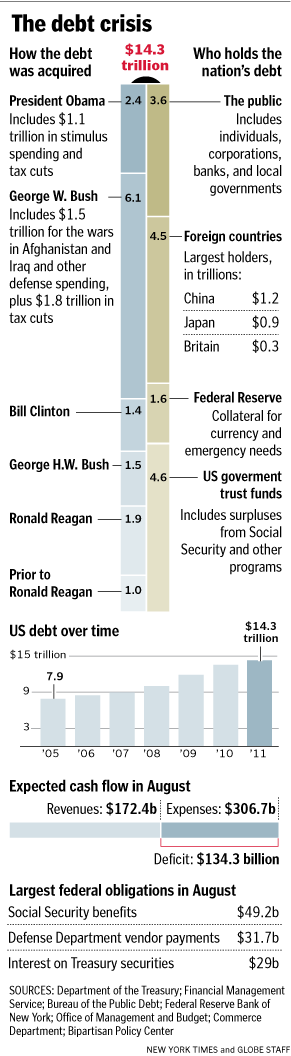
[EDIT] Sorry, read the original statement wrong. I was thinking the parent said 70% was held foreign, not vice-versa.
Yes, really. Did you actually add the numbers up? The non-foreign components are nearly 70%.
Japan has no defense investment. 'nuff said.
Japan spends 3% of its annual budget on defense.
Yet they still have a debt-to-GDP ratio of 225%
You've got to be kidding.
Even as we speak the Euro is breaking apart. Europeans are pouring billions of dollars into U.S. currency, bonds and investments even at a loss, even after the S&P downgrade. Yesterday Bank Of New York Mellon told depositors that they would only accept investment if the investor accepted a _negative_ interest rate!
http://www.24hgold.com/english/news-gold-silver-bank-of-new-...
Why?
Because things are worse in Europe! The Greece financial crisis is ripping the Euro apart. The U.S. remains the best haven in a lousy neighborhood (the world): better than Europe, better than China, better than Asia.
We should obliterate S&P, Fitch and Moody's for their financial crimes during the financial meltdown. More trustworthy firms will rise to replace them. Meanwhile investors will become appropriately wary of investing in financial instruments about which they know nothing.
Even as we speak the Euro is breaking apart. Europeans are pouring billions of dollars into U.S. currency, bonds and investments even at a loss, even after the S&P downgrade. Yesterday Bank Of New York Mellon told depositors that they would only accept investment if the investor accepted a _negative_ interest rate!
http://www.24hgold.com/english/news-gold-silver-bank-of-new-...
Why?
Because things are worse in Europe! The Greece financial crisis is ripping the Euro apart. The U.S. remains the best haven in a lousy neighborhood (the world): better than Europe, better than China, better than Asia.
We should obliterate S&P, Fitch and Moody's for their financial crimes during the financial meltdown. More trustworthy firms will rise to replace them. Meanwhile investors will become appropriately wary of investing in financial instruments about which they know nothing.
I don't think this is correct. Planet Money did a recent podcast on this very subject (Would A Downgrade Matter?)[1], and they concluded that a downgrade from AAA to AA+ doesn't matter very much in the long run. Yes, it's somewhat embarrassing, and interest rates are likely to go up _slightly_, but that's about it.
The big leap is from "investment grade" securities to "junk bonds" ('BB'/'Ba' or less). We're still a long way from there.
[1]: http://www.npr.org/blogs/money/2011/07/28/138721364/
The big leap is from "investment grade" securities to "junk bonds" ('BB'/'Ba' or less). We're still a long way from there.
[1]: http://www.npr.org/blogs/money/2011/07/28/138721364/
Maybe long-term the interest rates don't go up much. But the main impact is a huge rocking-the-boat in the banking system : one of the bedrock ideas has just changed. You wouldn't want to do this if the banking system were strong. Now is really not a good time...
I'm sorry but this seems alarmist to me. Any automated system can make an exception. For your logic to hold these institutional investors would have to not take notice of the U.S. Government having its credit rating dropped. You're arguing they'd treat the United States and "any other investment" and rely on an automated system.
That's not going to happen.
Plus S&P's logic is shaky on this. The whole reason the threat of S&P dropping our rating has had no impact is because their demands were impossible to achieve. Cut $4 trillion from the budget in 10 years when we're expected to add $9 trillion in the next 4? Not possible and everyone knows it.
That's not going to happen.
Plus S&P's logic is shaky on this. The whole reason the threat of S&P dropping our rating has had no impact is because their demands were impossible to achieve. Cut $4 trillion from the budget in 10 years when we're expected to add $9 trillion in the next 4? Not possible and everyone knows it.
I think they sending a clear message to the US government to get their financial house in order. The fact this has never happened (to either democratic or republican presidents in the history of the country) is a major issue.
Imagine if we actually passed the balanced budget amendment back in 1997 - things would be a LOT different.
Imagine if we actually passed the balanced budget amendment back in 1997 - things would be a LOT different.
Is S&P in the business of politics (re: sending a message), or accurately stating whether the US would be able to pay its debts?
In the most recent Planet Money podcast they claimed that a downgrade from AAA to AA would have no effect on investors. This is way out of my area of expertise but they seemed quite certain on this point.
This is by far the biggest problem. I don't think anybody realizes how huge a sell-off that's going to be if the institutions apply their rules about AAA debt to US bonds (a big if, as others have noted).
A sell-off of bonds would make it more expensive for the government to borrow money, which would further accelerate the expansion of the deficit. The deficit is the primary driver of the downgrade, so an acceleration would trigger further downgrades.
A sell-off of bonds would make it more expensive for the government to borrow money, which would further accelerate the expansion of the deficit. The deficit is the primary driver of the downgrade, so an acceleration would trigger further downgrades.
Treasuries act as a money store for large institutions that I think would be hard for them to replace in practice. They use T-bills in particular as more or less a jumbo-sized version of an FDIC-insured bank account. Where would they move that money to? I.e., who else provides a similarly safe account where you can deposit $50 billion? Can't be to a bank account, because all the major banks have even lower ratings. There aren't enough AAA-rated corporates to move all that money. Eurozone bonds aren't looking too hot, and may also have institutional rules on proportion of the investment that can go into foreign bonds. I suppose they could buy large quantities of gold and physically store it in vaults, but many institutional investors also have rules on how much they can put into commodities. Perhaps giant suitcases of dollar bills? You can't pull money out of an instrument without putting it somewhere else!
You could, for example, move your money to Canadian treasuries, which are AAA rated, couldn't you?
I am admittedly learning much of this as I read, but it seems to me that a large concern would be the amount of money that might simply shift out of our economy to economies with better (safer) credit ratings.
I am admittedly learning much of this as I read, but it seems to me that a large concern would be the amount of money that might simply shift out of our economy to economies with better (safer) credit ratings.
Perhaps; it depends on whether investors have rules about percentage of foreign holdings (many do). You'd also need to find countries with AAA ratings that still have big enough outstanding debts that the markets are sufficiently liquid even for large transactions. For example, Canada has $550 billion in total outstanding bonds, so you couldn't easily move $50 billion there, since that'd require buying up 10% of the entire market. Even moving $5 billion there is buying up 1%, which the liquidity may or may not support.
Everybody's missing the point here.
The credit rating agencies (S&P, Moody's and Fitch) don't know what they are doing! They enabled the financial meltdown. Their ratings are not useful. Their numbers are bad. They are either corrupt, inaccurate or both.
It would be nice and easy to believe that, since S&P puts a "AAA" beside a company's name, that the company is solid. We now know that is false.
Pay attention to Nicholas Taleb's writings: the financial models commonly in use don't work - don't trust them. Use more conservative measures. Avoid markets where you cannot quantify risk.
The credit rating agencies (S&P, Moody's and Fitch) don't know what they are doing! They enabled the financial meltdown. Their ratings are not useful. Their numbers are bad. They are either corrupt, inaccurate or both.
It would be nice and easy to believe that, since S&P puts a "AAA" beside a company's name, that the company is solid. We now know that is false.
Pay attention to Nicholas Taleb's writings: the financial models commonly in use don't work - don't trust them. Use more conservative measures. Avoid markets where you cannot quantify risk.
I think at least one of the issues is that other AAA countries/entities simply don't produce enough debt. It' not just that we're AAA, it's that we produce so much AAA paper. The AAA bond market gets so much smaller is the issue. That's my understanding, but I'm no expert.
I think that is largely why this won't have that much of an effect, there isn't a replacement for that much money that is AAA. The "cure" (crowding into what is left) would be more painful to the bond market than the "disease" (us).
I think that is largely why this won't have that much of an effect, there isn't a replacement for that much money that is AAA. The "cure" (crowding into what is left) would be more painful to the bond market than the "disease" (us).
[deleted]
[deleted]
It would be interesting if they make a financial vehicle that turns US AA+ debt (along with something else) into AAA.
Damn you, but the boys at Goldman Sachs are probably on it, right now. Take a pile of T-bills. Siphon off the income from them into a pie. Cut the pie into tranches. The first tranch or two are guaranteed to be AAA. Just look at the math that the quants derived...
We can all lipsync this tune.
We can all lipsync this tune.
Heh if only they could pretend that the performance of one T-Bill could be assumed to be uncorrelated to that of another T-Bill...
[deleted]
What about China bailing. How bad does it need to get before they decide to pull out?
Old joke: If you owe the bank a thousand dollars and you can't pay it back, then you have a problem. If you owe the bank a billion dollars and you can't pay it back, then the bank has a problem.
I think the original joke was a million dollars not a billion dollars, but I guess with inflation...
It'd have to get very bad for China to pull out. If China pulls out and damages our economy, our imports will dry up, their exports will dry up and their economy will dry up. I understand that China and the US might not be the best of friends right now, but their interests are generally aligned on US debt.
They would do that without hesitation. The problem (at the moment) is they have nowhere else to put that much money.
Its really not. If what you say was true they wouldn't still be actively buying U.S. Debt.
Their hesitation is they wouldn't get all their money back. If China pulled even 25% of its investments out of the U.S. the dollar would free fall. They wouldn't be able to cash out before most of the dollars value was inflated away.
China continues to buy our debt because they don't want the value of their current investment to collapse
Their hesitation is they wouldn't get all their money back. If China pulled even 25% of its investments out of the U.S. the dollar would free fall. They wouldn't be able to cash out before most of the dollars value was inflated away.
China continues to buy our debt because they don't want the value of their current investment to collapse
that's not the only reason, they also need to keep buying it for as long as we're a sizable portion of their export market. We still are, for now..
us government bonds have more recently been excluded from this rule.
Naive question: the money that gets de-invested will be reinvested where? France? UK?
I don't think de-invest is an actual word, but I will role with you on this. Investors treat U.S. Treasury bonds like cash. A lot of financial transactions are actually done with Treasury notes, because they are considered extremely safe and reliable, and unlike cash, they generate interest payments. If investors don't like the downgrade, then they will sell off their bonds for cash. Cash is theoretically the safest asset you can hold (some would argue that gold is, but that is a different topic). Cash never decreases in value (relative to itself at least, it can change value when compared to other countries currency, and inflation can take it's toll, but once again, this is a different topic), whereas treasury bonds can.
[deleted]
Didn't S&P maintain that Lehman Brothers had a favorable rating up until they collapsed? And in the subsequent congressional hearings the rating agencies simply responded that the rating is their opinion. Why do people put so much faith in these ratings when they have proven to be not very useful in evaluating the risk associated with investing in an institution?
People put faith in them because not everyone can hire an army of experts to evaluate all possible investments. S&P supplies their ratings to life insurance companies, pensions funds and even municipal governments. These entities don't have the resources to employ that expertise in-house, so they rely on companies like S&P and Moody's to give them guidance.
S&P and Moody's don't exactly employ an "army of experts" either. It's a few analysts making a rather subjective judgment and voting. (Literally, a few).
And the investors who are actually buying US debt don't rely on ratings agencies to give them guidance, and do in fact have expertise in-house to evaluate these things.
As has been mentioned elsewhere on this thread, institutional investors don't treat US bonds like any other, subject to triggers and rules like AAA-only. It's an exceptional case that is treated differently than the others, and one rating agency's opinion is not going to make as big an impact as people seem to think.
It comes down to this: where else would they put their money?
And the investors who are actually buying US debt don't rely on ratings agencies to give them guidance, and do in fact have expertise in-house to evaluate these things.
As has been mentioned elsewhere on this thread, institutional investors don't treat US bonds like any other, subject to triggers and rules like AAA-only. It's an exceptional case that is treated differently than the others, and one rating agency's opinion is not going to make as big an impact as people seem to think.
It comes down to this: where else would they put their money?
The interesting part is who is paying the credit rating companies... usually, it's the emitter of the bonds[1]. The emitter can be a state, a local region or some other organization. The emission of the bound is quite often managed by a financial organization. So the interface between the bond, the credit rating company and the state is "a financial organization". Of course, they don't have any conflicting roles in working in the field...
[1] http://en.wikipedia.org/wiki/Credit_rating_agencies#CRA_busi...
[1] http://en.wikipedia.org/wiki/Credit_rating_agencies#CRA_busi...
thematt says
"so they rely on companies like S&P and Moody's to give them guidance."
And those companies fabricate data and sell it to them.
Perhaps not everyone should invest in areas where they have no possibility of understanding the risks.
"so they rely on companies like S&P and Moody's to give them guidance."
And those companies fabricate data and sell it to them.
Perhaps not everyone should invest in areas where they have no possibility of understanding the risks.
"Perhaps not everyone should invest in areas where they have no possibility of understanding the risks."
You just managed to sum up the vast majority of economics problems. Humans are dumb though. Not much you can do.
You just managed to sum up the vast majority of economics problems. Humans are dumb though. Not much you can do.
You have a point, but the downgrading has symbolic value. Don't denigrate that symbolic value, either. Confucius say: "Signs and symbols rule the world, not words or laws."
As another comment on this thread pointed out, if the sole maker of the world reserve currency cannot keep a AAA rating, then who really deserves it? As the recent budget fight showed, the US government cannot make more than token attempts to improve its finances. The current debt is about one-fifth of the annual world GDP. Well-nigh invincible power blocs guard the biggest line-items on the budget. Tax increases are off the table and of doubtful effectiveness in this economy even if they were passed.
What confidence should such a government inspire?
As another comment on this thread pointed out, if the sole maker of the world reserve currency cannot keep a AAA rating, then who really deserves it? As the recent budget fight showed, the US government cannot make more than token attempts to improve its finances. The current debt is about one-fifth of the annual world GDP. Well-nigh invincible power blocs guard the biggest line-items on the budget. Tax increases are off the table and of doubtful effectiveness in this economy even if they were passed.
What confidence should such a government inspire?
You're making the assumption that the dollar remains the world reserve currency. Now there's a huge additional argument for moving to a trade-weighted basket of currencies. Besides, there are EUR issuers that are still AAA.
This illustrates one of the risks of hostage-taking and the mistaken assumption of Republican leadership that the "hostage" (their words, not mine) wouldn't be harmed
see quote from Senate minority leader below
From http://www.washingtonpost.com/politics/in-debt-deal-the-triu...
But at the Capitol, behind the four doors and the three receptionists and the police guard, McConnell said he could imagine doing this again. "I think some of our members may have thought the default issue was a hostage you might take a chance at shooting," he said. "Most of us didn’t think that. What we did learn is this - it’s a hostage that’s worth ransoming. And it focuses the Congress on something that must be done."
[edit]: Interesting to see all the downvotes, but my comment had a direct quote from the GOP senate leader. Can anyone explain why they downvoted it.
As for temphn's point below. Has any Nobel laureate defended the "hostage taking" ?
Congress already controls both spending and taxation. So they can start fixing the deficit problem by cutting down on pork, cutting tax loopholes etc. Threatening to force a default is not the answer.
see quote from Senate minority leader below
From http://www.washingtonpost.com/politics/in-debt-deal-the-triu...
But at the Capitol, behind the four doors and the three receptionists and the police guard, McConnell said he could imagine doing this again. "I think some of our members may have thought the default issue was a hostage you might take a chance at shooting," he said. "Most of us didn’t think that. What we did learn is this - it’s a hostage that’s worth ransoming. And it focuses the Congress on something that must be done."
[edit]: Interesting to see all the downvotes, but my comment had a direct quote from the GOP senate leader. Can anyone explain why they downvoted it.
As for temphn's point below. Has any Nobel laureate defended the "hostage taking" ?
Congress already controls both spending and taxation. So they can start fixing the deficit problem by cutting down on pork, cutting tax loopholes etc. Threatening to force a default is not the answer.
The question is whether you believe the issue would have become an issue even if the Republicans hadn't raised it now. Many people look at this as an intervention; if the US is addicted to oil, we are even more addicted to borrowing. I suppose it really comes down to whether you find multiplier/countercyclical spending arguments persuasive or not; Nobel Laureates come down on both sides.
The Republicans raising the issue was good and healthy for us. The clusterfuck that emerged in the months afterwards because of them refusing to pass any bill that didn't fall neatly into their little new imaginary rules was the problem.
These are the same guys who rated subprime mortgage backed bonds AAA. How the rating agencies still have any credibility is completely incomprehensible to me. I hope someone in the press has the wherewithal to make this point.
So are you saying that the US shouldn't have been AAA? Or that S&P should be regulated so that its hands are tied behind its back?
While the {S&P, Moodys, Fitch} sub-prime department obviously got completely ahead of itself modelling-wise, the corporate and sovereign departments have a lot of credibility : partly because they haven't been trying to assign values to 'a whole new way of doing things (this time it's different, etc)'.
While the {S&P, Moodys, Fitch} sub-prime department obviously got completely ahead of itself modelling-wise, the corporate and sovereign departments have a lot of credibility : partly because they haven't been trying to assign values to 'a whole new way of doing things (this time it's different, etc)'.
So you think the US has had inflated ratings for years just like with subprimes? And should be even lower rated?
Took those lazy rating agencies a while.
- 1.6 Trillion budget deficit
- 14 Trillion national debt
- 55 Trillion US total debt
- 115 Trillion Unfunded liabilities
- 17% U6 unemployment
- 45.8 Million Americans on Food Stamps
- 52 Million Americans without health insurance
- 1/2 of mortgages are underwater
- 63% labor participation rate, lowest since early 80s
- -5% in Real medium household income in the last 10 years
- 25% of US households have zero or negative net worth
- 1 out of every 45 households was hit with foreclosure
- average length of unemployment is now 40 weeks
- 1.6 Trillion budget deficit
- 14 Trillion national debt
- 55 Trillion US total debt
- 115 Trillion Unfunded liabilities
- 17% U6 unemployment
- 45.8 Million Americans on Food Stamps
- 52 Million Americans without health insurance
- 1/2 of mortgages are underwater
- 63% labor participation rate, lowest since early 80s
- -5% in Real medium household income in the last 10 years
- 25% of US households have zero or negative net worth
- 1 out of every 45 households was hit with foreclosure
- average length of unemployment is now 40 weeks
The S&P rating is only an assessment of risk in the US Treasury bonds, not a general rating of entire US economy.
In particular, their statement seems to claim that it's almost entirely due to their view that the U.S. might choose not to pay back its bonds, not that it couldn't; when explaining what's changed since previous assessments, their statement mainly focuses on the political will to service debt.
That's wrong, the GDP and expected GDP is a big part of the rating-- known as the "capacity to repay".
Doesn't the phrase "capacity to repay" make it clear that GDP matters only to the extent that it is a risk factor?
Listen to the Planet Money podcast. Lots of factors are considered, including political ones.
... and now all the random crap financial code out there that simply hard-codes "AAA" as the US credit rating will have problems. I bet a lot of people will be bug testing this change over the weekend.
EDIT: This seems to sum it up: http://lostechies.com/johnpetersen/2011/07/16/the-impact-of-...
EDIT: This seems to sum it up: http://lostechies.com/johnpetersen/2011/07/16/the-impact-of-...
"Sorry, boss. Our positions are busted because we hard-coded AAA as the T-bill credit rating. Look on the bright side, everyone's got bigger things to worry about."
I am totally flabbergasted that media and governments would give one-shits-worth of consideration to what the credit ratings agencies have to say. The same agencies that gave high ratings to the sour derivatives market which eventually collapsed our economy. The ratings agencies are Wall Street shills. Lowering US Debt ratings will result in the US having to pay higher interest rates, which go into the pockets of the major financial firms. Government et al playing right into the hands of the banks.
For those who aren't sure why this matters there are two things to note.
First, interest will go up. US Bonds are now considered riskier than they were before. This means investors in US Bonds will expect to collect more interest due to the greater risk they are taking. Instead of paying China and Japan 3% (for example) on $1 trilion (each), the US will now have to pay 3.5% (and climbing). Of course, the higher the interest rate, the harder it is to pay back (the quicker a new ceiling is reached), the likelier this happens again.
There could be some pretty massive dumping of US bonds. A number of foreign investors can only carry AAA risk. (It's kinda unclear where they'll run to though, since I think all the other AAA countries combined don't issue as much debt as the US). So, the economy might take a pretty big hit by losing all those investors.
Now, generally you need 2 of the big 3 rating agencies to trigger any of this. So it remains to be seen whether Moody or Fitch will follow. I think they both will.
Also worth mentioning is that Canada recently came back from a downgrade (by S&P) mostly by tightening their spending belt. Took 10 years (1992-2002). Australia did it too, though it took 7 years longer.
First, interest will go up. US Bonds are now considered riskier than they were before. This means investors in US Bonds will expect to collect more interest due to the greater risk they are taking. Instead of paying China and Japan 3% (for example) on $1 trilion (each), the US will now have to pay 3.5% (and climbing). Of course, the higher the interest rate, the harder it is to pay back (the quicker a new ceiling is reached), the likelier this happens again.
There could be some pretty massive dumping of US bonds. A number of foreign investors can only carry AAA risk. (It's kinda unclear where they'll run to though, since I think all the other AAA countries combined don't issue as much debt as the US). So, the economy might take a pretty big hit by losing all those investors.
Now, generally you need 2 of the big 3 rating agencies to trigger any of this. So it remains to be seen whether Moody or Fitch will follow. I think they both will.
Also worth mentioning is that Canada recently came back from a downgrade (by S&P) mostly by tightening their spending belt. Took 10 years (1992-2002). Australia did it too, though it took 7 years longer.
Again this is based on the same logic that people will treat the U.S. Government the same way they'd treat any other person and that's just not going to happen.
If the U.S. falls back into recession we'll take everyone with us. Other countries know this. Banks know this. Institutional Investors know this.
Increase the interest rate on the U.S. and you'll trigger an increase on the U.S. consumer while exacerbating the U.S. debt crisis (which is the whole reason for the downgrade). That would guarantee a recession and would bring every investment down.
Finally everyone knows what S&P is up to. You said it yourself. They aren't happy with U.S. policy and they've been able to bully other governments into austerity in the past. So they think they can do it here. But S&P's opinion of U.S. policy isn't going to be enough to convince investors to willingly create another recession
(Please note I'm in favor of austerity and think we're already headed into a recession I'm just realistic about S&P's limited power)
If the U.S. falls back into recession we'll take everyone with us. Other countries know this. Banks know this. Institutional Investors know this.
Increase the interest rate on the U.S. and you'll trigger an increase on the U.S. consumer while exacerbating the U.S. debt crisis (which is the whole reason for the downgrade). That would guarantee a recession and would bring every investment down.
Finally everyone knows what S&P is up to. You said it yourself. They aren't happy with U.S. policy and they've been able to bully other governments into austerity in the past. So they think they can do it here. But S&P's opinion of U.S. policy isn't going to be enough to convince investors to willingly create another recession
(Please note I'm in favor of austerity and think we're already headed into a recession I'm just realistic about S&P's limited power)
Some institutions are obligated (by charter or contract) to only buy AAA rated bonds. That's why it's a big deal... Now that being said, I have no idea how this would work in practice.
Ratings are a factor in financial-industry regulations and in internal policies at financial institutions. But almost all of these regulations and policies treat a AAA rating the same as a AA rating. So a downgrade from AAA to AA would trigger little or no forced selling, Arora said. An official at Vanguard, the big mutual fund company, told me this week that "a downgrade from AAA would not trigger any events inside our funds."
From Planet Money's blog, http://www.npr.org/blogs/money/2011/07/27/138738198/3-reason...
The full podcast, "Would a downgrade matter?", is an excellent listen: http://www.npr.org/blogs/money/2011/07/28/138721364/the-tues...
From Planet Money's blog, http://www.npr.org/blogs/money/2011/07/27/138738198/3-reason...
The full podcast, "Would a downgrade matter?", is an excellent listen: http://www.npr.org/blogs/money/2011/07/28/138721364/the-tues...
I'm sorry but that's bull. Anything can be changed. Contracts can be revised and even charters can be updated by a Board of Directors. If you hold a significant amount of U.S. Bonds you aren't going to ditch them on S&P's say so. You're going to call a meeting of the Board of Directors or Trustees or whoever and decide based on your own judgement.
The whole point of a rating agency is to provide you with research that you couldn't get based on your available resources. But every economist in the world is a resource on the U.S. Government's viability. You can turn on CNBC and get 24 hour coverage of it.
So the U.S. is a special case and the ratings agencies don't mean all that much in regards to it.
The whole point of a rating agency is to provide you with research that you couldn't get based on your available resources. But every economist in the world is a resource on the U.S. Government's viability. You can turn on CNBC and get 24 hour coverage of it.
So the U.S. is a special case and the ratings agencies don't mean all that much in regards to it.
You are assuming that enough people have an actual interest in letting the U.S. remain in the position it is now or that a recession in the U.S. will affect the rest of the world enough to matter.
While that may have been true a couple of years or may be even months ago, I'd say that this is anything but certain. There are a lot of people and government through out the world who would like to see the U.S. weakened.
While that may have been true a couple of years or may be even months ago, I'd say that this is anything but certain. There are a lot of people and government through out the world who would like to see the U.S. weakened.
There is a lot of hope in your post.
Investors will just move money to another country and there are enough who have much better grow rates. (China / India).
Or entities who will bet on the downfall of the U.S and there will be countries who have a high interest in this.
On Monday you can short every major company the downfall will be significant. This will be very interesting to watch the next world recession is on our doorsteps.
Money does not care who you are or what you do.
On Monday you can short every major company the downfall will be significant. This will be very interesting to watch the next world recession is on our doorsteps.
Money does not care who you are or what you do.
Well, you might be surprised. Japan's market rallied 3% the day after their downgrade.
That's probably because the market thought they hit rock bottom. Markets like uncertainty less than bad news, so they are much happier knowing about the downgrade.
p.s. To your earlier point, the '40 ACT details investment requirements for Money Market Funds [can't think of them now, but you are right, there are numerous statutory requirements related to the grade of security certain bodies may invest in]:
http://taft.law.uc.edu/CCL/InvCoRls/rule2a-7.html
http://taft.law.uc.edu/CCL/InvCoRls/rule2a-7.html
Those don't come into play because Moody's and Fitch maintained their AAA ratings for US treasuries.
[deleted]
Now that being said, I have no idea how this would work in practice.
That's the problem. No one else knows either. Monday is not going to be a good day.
That's the problem. No one else knows either. Monday is not going to be a good day.
Flux happens.
People mention that a lot, but what specific institutions have that requirement? And haven't they developed some more coherent requirements ever since subprime mortgage bonds proved the system could be gamed?
One example that comes to my mind is that Indian IPOs can be subscribed by foreign institutional investors using AAA bonds (they just show this as backing instead of paying the full price in cash before getting any shares allocated). I think now investors can only use the bonds of others countries.
> Again this is based on the same logic that people will treat the U.S. Government the same way they'd treat any other person and that's just not going to happen.
It's not a matter of how "people" treat it. Many funds are prohibited from holding anything other than AAA. Those folks will now be selling bonds.
For those that haven't looked at the math of bonds: When the price of a bond goes down (as it does when there are many sellers), the yield goes up. That yield is what the US Govt will be paying on future issued bonds, more or less.
Good luck to us all. We're gonna need it.
It's not a matter of how "people" treat it. Many funds are prohibited from holding anything other than AAA. Those folks will now be selling bonds.
For those that haven't looked at the math of bonds: When the price of a bond goes down (as it does when there are many sellers), the yield goes up. That yield is what the US Govt will be paying on future issued bonds, more or less.
Good luck to us all. We're gonna need it.
It's a little more complicated than that. Treasury bonds are actively traded on secondary markets. The 'price goes down, yield goes up' generally refers to secondary markets. The concern for the U.S. govt isn't the secondary market. It is the primary market where they auction off bonds to raise money to fund operations. In the primary market, the U.S. treasury issues a certain number of bonds in order to raise a specified amount of money. Investors bid on the bonds, and the best bid (i.e. lowest interest rate) wins. With a credit rating downgrade, there will be a lot fewer bidders, hence higher interest rates.
> The 'price goes down, yield goes up' generally refers to secondary markets.
No. It also refers to the bidding process when the US Govt goes to initiate the sale of bonds.
Regarding the rest: Yes, that is why I included "more or less" in my original post. The bidding for new bonds and the pricing of old bonds is quite close in most circumstances. (If they are not close, then there is usually trouble.)
> With a credit rating downgrade, there will be a lot fewer bidders, hence higher interest rates.
Regardless of the details above, we both get to the same place.
No. It also refers to the bidding process when the US Govt goes to initiate the sale of bonds.
Regarding the rest: Yes, that is why I included "more or less" in my original post. The bidding for new bonds and the pricing of old bonds is quite close in most circumstances. (If they are not close, then there is usually trouble.)
> With a credit rating downgrade, there will be a lot fewer bidders, hence higher interest rates.
Regardless of the details above, we both get to the same place.
US government doesnt sell bonds to fund operations, it is never revenue constrained (because the US dollar is a non-commodity backed, floating exchange rate, fiat currency). It sells bonds to remove dollars from the system.
> US government doesnt sell bonds to fund operations
Yes it does.
> It sells bonds to remove dollars from the system.
No. The Fed is in charge of the money supply, and when they sell bonds, dollars are removed from the system.
The US Govt selling bonds actually increases various measures of the money supply.
Yes it does.
> It sells bonds to remove dollars from the system.
No. The Fed is in charge of the money supply, and when they sell bonds, dollars are removed from the system.
The US Govt selling bonds actually increases various measures of the money supply.
I was under the impression that there were funds that were legally required to not anything lower than a certain value, but those values were much lower than AAA (AA or AA-).
Which funds cannot hold anything lower than AAA, and are they really big enough to dump enough US bonds to make a difference?
Which funds cannot hold anything lower than AAA, and are they really big enough to dump enough US bonds to make a difference?
Some funds strictly cannot hold anything lower than AAA, but most have "investment grade" requirement which is BBB (Baa in moody's ratings)
That type of downgrade is very unlikely
That type of downgrade is very unlikely
The only ones I can find that are strictly AAA are either all-corporate to begin with, or explicitly say that they invest in "AAA-rated U.S. Treasury and agency securities" or similar language. Which is awkward if there is no such thing, but it's not clear it'd require them to sell off, since there's nothing eligible to move to.
Checked on BB. It looks like $80B of invested assets across bond funds with any reported information would be affected (which is paltry, considering the full run of US treasuries far exceeds $10T)
Don't think it this really matters. The US still has the strongest economy of pretty much anyone (even with recession).
There isn't going to be a massive dumping of US bonds.
The AAA credit rating is helpful, but is only used by certain investors, and those big enough to make a real difference have their own assessors of risk.
I think the cutoff for the smaller guys to be legal to invest in is something like AA-. We aren't in danger of that. We'll probably be like AA+ or something.
Hopefully the US will quit spending so much on military and raise taxes on the ultra-rich to even things out, but who knows.
There isn't going to be a massive dumping of US bonds.
The AAA credit rating is helpful, but is only used by certain investors, and those big enough to make a real difference have their own assessors of risk.
I think the cutoff for the smaller guys to be legal to invest in is something like AA-. We aren't in danger of that. We'll probably be like AA+ or something.
Hopefully the US will quit spending so much on military and raise taxes on the ultra-rich to even things out, but who knows.
Even if you tax the hell out of the rich, it still leaves this country TRILLIONS in debt.
It's a fact - you don't tax your way out of a recession and you sure as hell don't tax people to create jobs. It simply doesn't work.
And yeah, great idea. Let's cut military funding while we're fighting a war on terror in three countries. Apparently you don't remember Clinton's military cuts which removed almost 300,000 people from the federal payroll. When you make military cuts, you're not just removing tanks and guns. You're also sending a lot of people to the unemployment line.
It's a fact - you don't tax your way out of a recession and you sure as hell don't tax people to create jobs. It simply doesn't work.
And yeah, great idea. Let's cut military funding while we're fighting a war on terror in three countries. Apparently you don't remember Clinton's military cuts which removed almost 300,000 people from the federal payroll. When you make military cuts, you're not just removing tanks and guns. You're also sending a lot of people to the unemployment line.
>It's a fact - you don't tax your way out of a recession and you sure as hell don't tax people to create jobs. It simply doesn't work.
If it is a fact, where is the data?
Economies are stimulated by people spending money.
A tax cut to someone making 50,000 dollars a year is going to have a greater percentage of it spent than a tax cut to someone making 5,000,000 a year. Conversely, a 5-10% tax increase isn't going to drastically change the spending habits of someone making 5,000,000 a year, where as it might make the person making 50,000 a year cut back on a number of things.
The important part is that money finds its way back into the market. The rich have 90% of the money. It would make sense to either tax the rich and spend it on infrastructure (or stuff like scientific research and education). Or tax the rich and spend it on the poor (who will actually spend the money).
I hope we cut down on military spending because I think war is bad. We should stop having it. I can't imagine justifying fighting 3 wars on the basis of possible unemployment.
If it is a fact, where is the data?
Economies are stimulated by people spending money.
A tax cut to someone making 50,000 dollars a year is going to have a greater percentage of it spent than a tax cut to someone making 5,000,000 a year. Conversely, a 5-10% tax increase isn't going to drastically change the spending habits of someone making 5,000,000 a year, where as it might make the person making 50,000 a year cut back on a number of things.
The important part is that money finds its way back into the market. The rich have 90% of the money. It would make sense to either tax the rich and spend it on infrastructure (or stuff like scientific research and education). Or tax the rich and spend it on the poor (who will actually spend the money).
I hope we cut down on military spending because I think war is bad. We should stop having it. I can't imagine justifying fighting 3 wars on the basis of possible unemployment.
You take the Keynesian view. It's difficult to discuss this in more than a soundbite, but the Hayekian view is well explained by these two videos:
In short, the opposite/Hayekian view contends that taxation is seizure of resources from profitable/efficient entities and redistribution towards unprofitable/inefficient entities. We saw this in extremis in the bank bailout, and more controversially in microcosm with individual redistribution.
If you accept this -- that "profitable" correlates with "efficient", and conversely, though the correlation is not perfect -- then taxation is not a Robin Hood sort of thing that increases well being, but rather a move that ties the legs of the efficient sectors of the economy -- those that can post a profit even in tough times -- to those that are already underwater.
  http://www.youtube.com/watch?v=d0nERTFo-Sk
  http://www.youtube.com/watch?v=GTQnarzmTOc
In short, the opposite/Hayekian view contends that taxation is seizure of resources from profitable/efficient entities and redistribution towards unprofitable/inefficient entities. We saw this in extremis in the bank bailout, and more controversially in microcosm with individual redistribution.
If you accept this -- that "profitable" correlates with "efficient", and conversely, though the correlation is not perfect -- then taxation is not a Robin Hood sort of thing that increases well being, but rather a move that ties the legs of the efficient sectors of the economy -- those that can post a profit even in tough times -- to those that are already underwater.
The Hayekian view here seems patently false according to Moody's research firm, which determined in 2008 that the most cost effective stimulus was food stamps and the least effective was business incentives such as tax breaks for buying new equipment.
http://money.cnn.com/2008/01/29/news/economy/stimulus_analys...
http://money.cnn.com/2008/01/29/news/economy/stimulus_analys...
Sure, but you are arguing for short-term spending vs long term capital investment. Basically you are arguing that you don't need to get more sleep, you'll just have a red-bull tonight. So the red-bull is better than getting more sleep in general.
If you take all the money (100%) from people who build and make things and give it to people who don't have jobs to spent, in the short term things will be bought and everything thing will appear stimulated. In the long run your entire economy will collapse as your capital base erodes. The basic Keynesian error is to not distinguish between purely consumptive (why don't create jobs to build ships, fill them full of gold and new technology, and then drive them into the Pacific and sink them?) and productive goods which actually build economic wealth and raise the standard of living.
If you take all the money (100%) from people who build and make things and give it to people who don't have jobs to spent, in the short term things will be bought and everything thing will appear stimulated. In the long run your entire economy will collapse as your capital base erodes. The basic Keynesian error is to not distinguish between purely consumptive (why don't create jobs to build ships, fill them full of gold and new technology, and then drive them into the Pacific and sink them?) and productive goods which actually build economic wealth and raise the standard of living.
Oh yeah, reference Moody's, they did such an awesome job rating mortgage securities a few years ago.
My own wholly unfounded reasoning goes as this: give a broke guy some food stamps, he'll spend it on food. So the government is essentially buying this guy food. Food and groceries happen to be some of the the lowest-margin sectors of the economy - Safeway's operating margin hovers a little under 3%. So yeah, the guy will spend it right away, but you're not making much money out of this. The broke guy just wants to feed himself.
Give that same money to someone who's actively trying to make more money out of it (e.g, a business), they have much more incentive to use it efficiently.
I'm a SF liberal, I totally believe feeding the poor should have government support. But it makes a poor economic argument to me.
My own wholly unfounded reasoning goes as this: give a broke guy some food stamps, he'll spend it on food. So the government is essentially buying this guy food. Food and groceries happen to be some of the the lowest-margin sectors of the economy - Safeway's operating margin hovers a little under 3%. So yeah, the guy will spend it right away, but you're not making much money out of this. The broke guy just wants to feed himself.
Give that same money to someone who's actively trying to make more money out of it (e.g, a business), they have much more incentive to use it efficiently.
I'm a SF liberal, I totally believe feeding the poor should have government support. But it makes a poor economic argument to me.
What does margin have to do with it?
Why is using the money efficiently important?
What is your definition of efficiency?
Lets assume he is dirt poor, rather than broke. Everyone needs food and groceries. If he spends the food-stamps on food, he will likely spend the money that he would have spent on groceries on something else. By giving food stamps, you've given him a surplus of money, so he'll buy something that he needs but can do without, or a luxury good that he wants.
Lets assume now he is rich. We give him a tax break equivalent to the food-stamps (or even the same food stamps). He's already buying everything he wants and putting some in the bank. With the food stamps, he is able to put more in the bank. If the money is in the bank, it can be loaned to the poor guy, but it is actually (eventually) taking money out of the economy when it is loaned... the poor guy has to eventually pay it back to the bank with a few % interest.... it isn't actually getting 'spent' on anything.
Lets assume he is dirt poor, rather than broke. Everyone needs food and groceries. If he spends the food-stamps on food, he will likely spend the money that he would have spent on groceries on something else. By giving food stamps, you've given him a surplus of money, so he'll buy something that he needs but can do without, or a luxury good that he wants.
Lets assume now he is rich. We give him a tax break equivalent to the food-stamps (or even the same food stamps). He's already buying everything he wants and putting some in the bank. With the food stamps, he is able to put more in the bank. If the money is in the bank, it can be loaned to the poor guy, but it is actually (eventually) taking money out of the economy when it is loaned... the poor guy has to eventually pay it back to the bank with a few % interest.... it isn't actually getting 'spent' on anything.
If Safeway makes 3% on everything this guy buys, that's 3% additional wealth that wouldn't otherwise be there, right?
Meanwhile if you give it to a more profitable business, they'll make much more out of it. We're not pissing around stimulus dollars to feed poor people or make them richer. We want to increase the total amount of value in the economy.
Your now-he-can-buy-luxuries argument is bullshit. Great, let the government subsidize iPads, that'll get the economy going.
Meanwhile if you give it to a more profitable business, they'll make much more out of it. We're not pissing around stimulus dollars to feed poor people or make them richer. We want to increase the total amount of value in the economy.
Your now-he-can-buy-luxuries argument is bullshit. Great, let the government subsidize iPads, that'll get the economy going.
I think your reasoning is unfounded.
Safeway's doesn't have a huge margin, but so what? They employ people directly and indirectly: cashiers, truckers, stock clerks, people who work in canneries, farmers, chemists who formulate fertilizers, etc. It isn't as if a dollar spent at Safeway's ends up in an incinerator while a dollar spent at Apple mates with another dollar to make change.
Safeway's doesn't have a huge margin, but so what? They employ people directly and indirectly: cashiers, truckers, stock clerks, people who work in canneries, farmers, chemists who formulate fertilizers, etc. It isn't as if a dollar spent at Safeway's ends up in an incinerator while a dollar spent at Apple mates with another dollar to make change.
Sure, but the study tries to find the most cost-effective way of providing stimulus. If you don't care how efficiently that money is used then we might as well just employ a fuck-ton of people building bridges to Hawaii.
That's just completely divorced from reality. There are so many areas of the economy that could not reasonably be directly profitable on their own, but magnify the profit of the overall economy. Many of these things are funded by taxes.
The problem with the Hayekian view is that it's one-size fits all. People who think Keynesian economics works in certain situations have the great depression to back them up. And they're likely to sympathize with a Hayek type view during good times when there's no need for the government to stimulate demand.
> If it is a fact, where is the data?
Play Sim City and try to win. Check into the facts that Sim City was built upon.
> I hope we cut down on military spending because I think war is bad
All reasonable people think this. When the rest do then we will have autonomous world peace. Until then, we need peacemakers.
Play Sim City and try to win. Check into the facts that Sim City was built upon.
> I hope we cut down on military spending because I think war is bad
All reasonable people think this. When the rest do then we will have autonomous world peace. Until then, we need peacemakers.
Trillions in debt is perfectly fine for an economy as large as America's. It's tens of trillions where you have a problem long-term.
I agree that you should just run the short-term deficits. That said, if we have to cut short-term deficits (which I don't think is a wise strategy), it is significantly better to tax the rich than cut benefit programs.
Finally on military, I'd feel it'd be a better use of resources to transfer the 300,000 people to infrastructure projects. The ROI on the investment is much better than the wars where we have ground-troops.
I agree that you should just run the short-term deficits. That said, if we have to cut short-term deficits (which I don't think is a wise strategy), it is significantly better to tax the rich than cut benefit programs.
Finally on military, I'd feel it'd be a better use of resources to transfer the 300,000 people to infrastructure projects. The ROI on the investment is much better than the wars where we have ground-troops.
>> Trillions in debt is perfectly fine for an economy as large as America's.
No it's not. Wouldn't it be much better to not have to constantly pay billions to simply pay the debt's interest? We aren't even reducing the principal, which is why we have to keep raising the debt ceiling.
That's like saying it's perfectly fine to maintain a large credit card debt because you have a high income.
Just because you can handle it, doesn't make it wise.
No it's not. Wouldn't it be much better to not have to constantly pay billions to simply pay the debt's interest? We aren't even reducing the principal, which is why we have to keep raising the debt ceiling.
That's like saying it's perfectly fine to maintain a large credit card debt because you have a high income.
Just because you can handle it, doesn't make it wise.
>Because of those low rates, the amount the U.S. government pays to service its debt is, relative to the size of the economy, less than it was paying throughout the boom years of the 1980s and 1990s and for most of the last decade. The Congressional Budget Office estimates that net interest on the debt (which is what the government pays to service it) would be $225 billion for fiscal year 2011. The latest figures put that a bit higher, so let’s call it $250 billion. That’s about 1.6% of American output, which is lower than at any point since the 1970s – except for 2003 through 2005, when it was closer to 1.4%.
http://moneyland.time.com/2011/07/15/the-u-s-is-not-drowning...
Yes, we should do what we can as a matter of course to pay down the national debt, but we really weren't any worse off in our ability to pay than we've been in decades.
At the very least, manufacturing a crisis out of the matter -- and this one was completely manufactured by the GOP -- that has resulted in making it harder to pay down the debt we already have was a completely daft move.
http://moneyland.time.com/2011/07/15/the-u-s-is-not-drowning...
Yes, we should do what we can as a matter of course to pay down the national debt, but we really weren't any worse off in our ability to pay than we've been in decades.
At the very least, manufacturing a crisis out of the matter -- and this one was completely manufactured by the GOP -- that has resulted in making it harder to pay down the debt we already have was a completely daft move.
The US pays a very low interest rate on its debt. If you made $250k per year had a 3% interest rate mortgage of $200k, would you pay it off any faster than you had to? Of course not. You'd spend the money on things that would give you a much better return.
There is absolutely no need for the US to pay down inflation. GDP growth will naturally reduce the effective value of the principal. The problem is the run-away increase in the debt over GDP ratio that we've been seeing.
There is absolutely no need for the US to pay down inflation. GDP growth will naturally reduce the effective value of the principal. The problem is the run-away increase in the debt over GDP ratio that we've been seeing.
I agree with you for the most part, particularly about the run-away increase of debt.
I even agree that I would not payoff 3% debt while I could earn higher elsewhere. However, the government isn't doing that. They aren't delaying payback so they can earn a higher rate somewhere else, they are delaying payback and spending the funds.
I even agree that I would not payoff 3% debt while I could earn higher elsewhere. However, the government isn't doing that. They aren't delaying payback so they can earn a higher rate somewhere else, they are delaying payback and spending the funds.
you sure as hell don't tax people to create jobs
vs
military cuts ... sending a lot of people to the unemployment line.
so, you don't tax people to sustain jobs, yet you don't cut jobs to lower spending. That is paradoxical.
so, you don't tax people to sustain jobs, yet you don't cut jobs to lower spending. That is paradoxical.
First of all I fail to see how taxing people sustains jobs. As a business, if you're having to give more money to the government, and putting less of it back into your business, it would seem you're actually creating an incentive to lay people off as opposed to hiring more. It makes it harder to grow and hire more people if your business is taking in less money. I know it's obvious but. . .
There are a million ways to cut spending. Taking Obama's 2.5 TRILLION dollar "Obama Care" would be a great start. Take out his TRILLION dollar stimulus which was an epic failure and guess what? You just saved 3.5 TRILLION dollars without cutting any jobs.
There are a million ways to cut spending. Taking Obama's 2.5 TRILLION dollar "Obama Care" would be a great start. Take out his TRILLION dollar stimulus which was an epic failure and guess what? You just saved 3.5 TRILLION dollars without cutting any jobs.
First of all I fail to see how taxing people sustains jobs.
You said it, "When you make military cuts, you're not just removing tanks and guns. You're also sending a lot of people to the unemployment line." So, to fund the military, you have to either sell bonds or levy taxes. Playing World Police for 60 years has been fun, but it's getting a little expensive.
I know it's obvious but... It's not obvious. What if those tax dollars were reinvested in universal health care? A small business wouldn't have to incur the cost of insuring its full-time employees. That would help stimulate growth, as it would cost less to hire each employee.
The premise that your argument stems from--lower taxes means more jobs--has been, time and time again, false in practice. Trickle-down economics are theoretically sound, but in 30 years of attempted trickle, nothing statistically significant has come down.
I know it's obvious but... It's not obvious. What if those tax dollars were reinvested in universal health care? A small business wouldn't have to incur the cost of insuring its full-time employees. That would help stimulate growth, as it would cost less to hire each employee.
The premise that your argument stems from--lower taxes means more jobs--has been, time and time again, false in practice. Trickle-down economics are theoretically sound, but in 30 years of attempted trickle, nothing statistically significant has come down.
I doubt it will be that significant. Japan has been at AA- from all rating agencies forever (and has vastly higher debt) and pays lower rates than the US. Besides, as you pointed out there are so few large countries with AAA from all agencies.
Besides, there's no new information released today, other than what some analysts at S&P think.
Besides, there's no new information released today, other than what some analysts at S&P think.
Japan is a nation of savers and has a massive domestic pool of savings. Also, Japan will drop below investment grade within the next ten years as those savers retire.
America, on the other hand, needs to borrow internationally.
America, on the other hand, needs to borrow internationally.
Japan's famous savings rate, just like its famous work ethic, is nothing but a myth anymore. It stands now at 2% in 2009. (and its famous work ethic...no more. 30% of its working population is part-time. look up 'freeter')
http://belfercenter.ksg.harvard.edu/publication/20397/japans...
http://belfercenter.ksg.harvard.edu/publication/20397/japans...
Exactly. The big banks do their own research, so what S&P thinks is largely irrelevant. We have an entire division devoted only to US treasuries.
Beyond that, I'm not sure why any of these agencies has any real credibility anymore, since they were giving AAA ratings to the "toxic" CDOs up until they collapsed.
This also triggers the automatic review of the debt rating for various states and hundreds of small towns across America. A lot of cities across the US are going to lose their ability to borrow cheap money because of this, not just the federal government.
But the most important aspect is on the banking industry, where there are huge positions that look like (X-X0). X0 may rise, which is a problem, but the bigger issue is that the overall size of this type of bet can be enormous, because it's overall AAA. Suddenly, a fundamental assumption underlying a lot of these trades has been shattered, and will force people to unwind losing positions... And the banking system wasn't a picture of health before.
It's interesting the Treasury Department Issued this statement after the downgrade news basically saying, for all practical purposes we still consider the debt to be AAA regardless of what S&P thinks.
http://www.occ.treas.gov/news-issuances/news-releases/2011/n...
http://www.occ.treas.gov/news-issuances/news-releases/2011/n...
Federal interest rates will not go up because interest rates are controlled endogenously. They will go wherever the fed wants them to go.
I am not American, and here's what I don't get: America can borrow money right now at 1.5% for five years. Why is there such a clamour to stop? I would hope that the government would be able to get better than 1.5% return with the money - if the CEO of any company chose not to take on debt at this rate they'd get fired. It seems like all of the media coverage is glossing over this.
The real problem is that the republicans are zealots of the church of voodoo economics.
The reality is that demand-side economics has stronger and more intelligent underpinnings (give money to individuals --> they spend --> increase demand --> hiring). Giving more cash to companies doesn't induce hiring; demand for products induces hiring.
The reality is that demand-side economics has stronger and more intelligent underpinnings (give money to individuals --> they spend --> increase demand --> hiring). Giving more cash to companies doesn't induce hiring; demand for products induces hiring.
You are absolutely correct here. When people have more money they tend to spend more and sales at corporations increase and thus the invest and hire more employees to meet the increased demand. How do we get more money in hand? Full payroll tax holiday + New deal 2.0.
We couldn't even pass New Deal 0.3b today, man. Can dream, though...
This economic crisis isn't about economics, it's about politics. When the GOP goes off on "cutting spending", they're not being fiscally responsible. Ideally, they would literally like to cut every dollar that isn't going to the Pentagon. "Spending cuts" is a dog whistle for the idea that the Federal government shouldn't exist at all.
It doesn't matter if borrowing and spending (some might call it "investing") money is good fiscal policy— "spending" is just wrong.
It doesn't matter if borrowing and spending (some might call it "investing") money is good fiscal policy— "spending" is just wrong.
"Spending cuts" is a dog whistle for the idea that the Federal government shouldn't exist at all.
Please. The government spent far less during Clinton's administration (the last vaguely fiscally responsible president), and I don't recall having to step over that many starving homeless people to get to work.
Please. The government spent far less during Clinton's administration (the last vaguely fiscally responsible president), and I don't recall having to step over that many starving homeless people to get to work.
Um, yes? We could certainly be spending less and providing more social services. That's not what the tea partiers mean when they say "cut spending", though.
There's a lot that doesn't make any sense. As you say, interest rates are low. Plenty of people are out of work. To me, that says, "perfect time to build and repair infrastructure!"
Whether you believe FDR's New Deal helped or hindered recovery from the Great Depression, the simple, business-oriented financials of it would seem to indicate that right now is the time to be building roads, trains, dams, nuclear plants, etc.
Instead, we cut funding to things which may pay off later in order to funnel money into which have an inevitable negative rate of return, like imprisoning people, security theater, and killing people on the other side of the globe.
Whether you believe FDR's New Deal helped or hindered recovery from the Great Depression, the simple, business-oriented financials of it would seem to indicate that right now is the time to be building roads, trains, dams, nuclear plants, etc.
Instead, we cut funding to things which may pay off later in order to funnel money into which have an inevitable negative rate of return, like imprisoning people, security theater, and killing people on the other side of the globe.
That's exactly what I thought the response would have been. Cheap money, low employment - hire lots of people to do stuff. But it seems like the public opinion is that this debt is bad, and I'm don't understand why entirely. I mean, I see a lot of comparisons to credit card debt, so is it just lack of education/understanding?
If I could get a credit card that charged 1.5% interest, I would start borrowing to make my own damn roads.
Why do you think borrowed money is "cheap"?
We're not paying it back. Any of it. At best we can cover the interest payments.
Why do you think this won't blow up in our faces?
We're not paying it back. Any of it. At best we can cover the interest payments.
Why do you think this won't blow up in our faces?
Interest has not become a huge issue, but in any case - so what? They got the money for cheap, it has (presumably) fueled growth. Beating 1.5% over five years is not difficult - the idea is to borrow money to accelerate growth - increase prosperity of America, which would return more than 1.5%. Not all debt is bad.
This requires allowing the government to consider tax income as a revenue stream, which isn't playing well politically right now. We're supposed to think of taxes as money the government had no right to collect in the first place, and which the only right thing for it to do with is give it back.
Having a free floating fx sovereign currency issuing regime such as the US,UK,Japan. The federal debt is equal to the private sector savings. Paying of the debt eliminates our savings. This would throw us into great depression ii. We should have perpetual deficits.
An answer to the question we're all wondering- "What happens now" answered well in a planet money from a couple of weeks ago:
http://www.npr.org/2011/07/18/138164761/what-happens-if-u-s-...
TL;DR - "I'm not sure it will have any impact. When you look at the bond market — 10-year U.S. Treasuries, for example — where is it today? In the light of all this hype about debt ceilings and possible defaults, it's at 2.93 today, so this is an extremely low interest rate in both nominal and real terms. It means that everyone in the world is willing to hold these bonds and is not the least bit worried about the possibility of a default. So, investors haven't changed their view of the creditworthiness of the United States at all, and I don't think they're likely to in the foreseeable future." -Mark Weisbrot, co-director of the Center for Economic and Policy Research
TL;DR - "I'm not sure it will have any impact. When you look at the bond market — 10-year U.S. Treasuries, for example — where is it today? In the light of all this hype about debt ceilings and possible defaults, it's at 2.93 today, so this is an extremely low interest rate in both nominal and real terms. It means that everyone in the world is willing to hold these bonds and is not the least bit worried about the possibility of a default. So, investors haven't changed their view of the creditworthiness of the United States at all, and I don't think they're likely to in the foreseeable future." -Mark Weisbrot, co-director of the Center for Economic and Policy Research
The reason yields have been so low is because a) there is no other 'safe haven' for investors to flock to, and b) the markets generally didn't anticipate a downgrade.
A downgrade, even if the markets don't raise Yields, can be catastrophic because many financial institutions (mutual funds, insurance companies, unit trusts, etc.) can only hold AAA rated securities in their portfolios - and some central banks can only hold AAA rated securities as collateral in some situations.
So, legally, they will not be able to hold on to American gov't debt, even if they wanted to. The mere fact that a ton of people will be flooding the market with debt, will push up yields and that will lead to other catastrophic consequences.
I expect that the Fed will buy a ton of bonds to push down yields and keep the Treasuries Interest costs low - but they will have to print a ton of money to do that....which will lead to inflation, which leads to higher yields which leads to higher interest costs, and creates a crazy cycle.
You get the idea.
However, that's just theory - in a perfectly balanced global economy that's not fragile. In this global economy, I suspect that there might be a concerted effort to loosen standards to prevent a mass exodus out of US Treasuries, but at least this sends a strong signal that the ratings agencies are serious.
A downgrade, even if the markets don't raise Yields, can be catastrophic because many financial institutions (mutual funds, insurance companies, unit trusts, etc.) can only hold AAA rated securities in their portfolios - and some central banks can only hold AAA rated securities as collateral in some situations.
So, legally, they will not be able to hold on to American gov't debt, even if they wanted to. The mere fact that a ton of people will be flooding the market with debt, will push up yields and that will lead to other catastrophic consequences.
I expect that the Fed will buy a ton of bonds to push down yields and keep the Treasuries Interest costs low - but they will have to print a ton of money to do that....which will lead to inflation, which leads to higher yields which leads to higher interest costs, and creates a crazy cycle.
You get the idea.
However, that's just theory - in a perfectly balanced global economy that's not fragile. In this global economy, I suspect that there might be a concerted effort to loosen standards to prevent a mass exodus out of US Treasuries, but at least this sends a strong signal that the ratings agencies are serious.
How does this play out with the multiple ratings firms though?
Good question...I think the actual legal rules are probably something like you have to maintain AAA from 2 out of the 3 rating agencies or something of that nature.
They do account for multiple ratings agencies having different opinions.
They do account for multiple ratings agencies having different opinions.
I just got a NYTimes news alert that S&P is in fact holding off on downgrading the US based on the math error that was discovered.
Did anyone else see that come through? Is NYT just behind a little?
Did anyone else see that come through? Is NYT just behind a little?
If so it might be an interesting political tactic on S&P's part. Issue a downgrade to show you're serious, but include a 'math error' that justifies an almost-immediate retraction.
If a ratings agency feels that it's necessary to use scare tactics, that's scary enough in itself.
If a ratings agency feels that it's necessary to use scare tactics, that's scary enough in itself.
S&P's report is here: http://www.standardandpoors.com/servlet/BlobServer?blobheade...
I love to hear them tell it like it is, all matter-of-fact like that. S&P ought to run as a 3rd-party presidential candidate in 2012.
It's about time somebody brought down the cluebat.
It's about time somebody brought down the cluebat.
End of the day, these are the same jokers who were rating junk assets as AAA and completely missed every problem in this financial crisis.
And the fact that moody's still maintains Aaa means that there's a nonzero chance it will have no effect. I hope.
And the fact that moody's still maintains Aaa means that there's a nonzero chance it will have no effect. I hope.
Yeah, the US deserves a downgrade. What pisses me off is that my wife and I have savings, live within our means, and if you believe Harvard economist Kenneth Rogoff (which I do), there is going to be 5% to 10% yearly inflation for a good while that takes money from savers and basically gives it to debtors.
I am actually sympathetic to some debt forgiveness - it is not the people in need that I am pissed off at. Anyway, it is a mess, and everyone who is worth less than many millions of dollars is going to feel some pain.
I expected this economic collapse to happen after the 2030s - suddenly, after a few years of W. Bush's presidency I realized that the grand plan was to cause the collapse to happen much sooner.
I am actually sympathetic to some debt forgiveness - it is not the people in need that I am pissed off at. Anyway, it is a mess, and everyone who is worth less than many millions of dollars is going to feel some pain.
I expected this economic collapse to happen after the 2030s - suddenly, after a few years of W. Bush's presidency I realized that the grand plan was to cause the collapse to happen much sooner.
> What pisses me off is that my wife and I have savings, live within our means, and... inflation ... takes money from savers and basically gives it to debtors.
Well, it takes money from lenders (or cash holders) and gives it to debtors. If you don't like that, stop being a lender or cash holder: move out of cash and bonds into, say, stocks, commodities, or real estate. If you're really confident that that inflation is going to happen, go short cash: build up a huge credit card balance at the current low interest rate, while pouring all of your earnings into non-cash holdings. (Danger: if you go short and you're wrong, you're fucked.)
Well, it takes money from lenders (or cash holders) and gives it to debtors. If you don't like that, stop being a lender or cash holder: move out of cash and bonds into, say, stocks, commodities, or real estate. If you're really confident that that inflation is going to happen, go short cash: build up a huge credit card balance at the current low interest rate, while pouring all of your earnings into non-cash holdings. (Danger: if you go short and you're wrong, you're fucked.)
If you're expecting sustained inflation then don't hold debt. Take your cash and buy rental properties with the crazy-low mortgage rates we have now. If we get sustained inflation then rental rates will go up while your fixed-interest mortgage payments will stay the same. Profit.
So buy Canadian Bonds or Chilean Bonds or Gold or Silver or Apple stock.
You can't just quit the game.
You bought gold, which conserves your wealth ... and the government takes 15% to 50% of your "profit" (depending on your circumstances). Debasing by the fed together with the tax systems guarantees there's nothing you can do against it.
You bought gold, which conserves your wealth ... and the government takes 15% to 50% of your "profit" (depending on your circumstances). Debasing by the fed together with the tax systems guarantees there's nothing you can do against it.
That's a good news and a wake up call.
This downgrade may just be the first sign of real problems to come. For detailed coverage of the coming US financial storm see the documentary I.O.U.S.A. from former U.S. Comptroller General David Walker (I've seen it on Netflix streaming).
http://www.iousathemovie.com
http://www.iousathemovie.com
The real story is that S&P thinks downgrading the US debt will provide political cover against investigations into their role in the mortgage securities debacle by the SEC and Justice. They were determined to downgrade no matter what. Their original justification is the US didn't make their $4 trillion cut target. When Treasury showed them a $2 trillion dollar error in their arithmetic, they changed the justification to political gridlock. Time for a perp walk.
One minor elephant in the room that only a few seem to be mentioning is the 500+ point selloff on Thursday.
On Thursday evening, the economist talking-heads expressed some confusion about what was driving that sell-off on that particular day. There was vague talk of problems in Europe, although there has been worse news out of the Eurozone for months without that kind of drop.
On Friday, we get the S & P announcement of a decision that may impact markets. One can only imagine when this particular decision was actually made.
What drove the sell-off on Thursday?
On Thursday evening, the economist talking-heads expressed some confusion about what was driving that sell-off on that particular day. There was vague talk of problems in Europe, although there has been worse news out of the Eurozone for months without that kind of drop.
On Friday, we get the S & P announcement of a decision that may impact markets. One can only imagine when this particular decision was actually made.
What drove the sell-off on Thursday?
Someone in S&P leaked the downgrade ahead of time?
Unlikely, there's a reasonable chance you could face jail time if you were caught doing such a thing and probably wouldn't be able to work in the financial industry ever again.
So your upside would essentially have to be a huge amount of money, but of course you're much more likely to get caught if you're moving around such a large sum.
So your upside would essentially have to be a huge amount of money, but of course you're much more likely to get caught if you're moving around such a large sum.
The potential implosion of EU, caused by Italy
or
The rich is alerted the downgrade first, naturally.
or
The rich is alerted the downgrade first, naturally.
Yep. I'm more than a bit suspicious that it's your option 2, given that it's been "Greece"..."Italy"..."Ireland"..."Greece"...Euro-disaster talk for months now without the kind of precipitous one-day decline that just happened to precede this announcement.
Well, just before the precipitous fall on the markets there were letters between various parties in Europe (European Commission President, European Central Bank President and the German Chancellor) which showed that they had some fundamental disagreements about what to do - vastly scale up or not - with the European sovereign bailout fund. That seems to have spooked the markets somewhat.
[deleted]
Wanted to check out Krugman's take on this:
http://krugman.blogs.nytimes.com/2011/08/05/sp-and-the-usa/
TLDR:
1) The 'madness of the right' holding the debt-ceiling hostage cost us the confidence of investors (and S&P).
2) The ratings agencies have shown they aren't qualified to rate anything, much less sovereign debt.
3) S&P miscalculated the downgrade by $2T before going ahead with it anyway.
4) S&P's magic number for averting a downgrade was $4T deficit reduction over the next decade. The Congressional deal failed to reach that, but according to Krugman that number is barely relevant to the US debt costs and should not effect the credit rating. The real downgrade risk is with long-term unfunded healthcare liabilities, which S&P seems to have ignored here.
http://krugman.blogs.nytimes.com/2011/08/05/sp-and-the-usa/
TLDR:
1) The 'madness of the right' holding the debt-ceiling hostage cost us the confidence of investors (and S&P).
2) The ratings agencies have shown they aren't qualified to rate anything, much less sovereign debt.
3) S&P miscalculated the downgrade by $2T before going ahead with it anyway.
4) S&P's magic number for averting a downgrade was $4T deficit reduction over the next decade. The Congressional deal failed to reach that, but according to Krugman that number is barely relevant to the US debt costs and should not effect the credit rating. The real downgrade risk is with long-term unfunded healthcare liabilities, which S&P seems to have ignored here.
Mindboggling. Does the S&P understand that the U.S. debt is all denominated in a currency that the U.S. government can print at will? If the U.S. government doesn't have an AAA rating, what does an AAA rating even mean?
At the moment, the national "debt" is over $10 trillion dollars, while the total supply of currency is about $2 trillion, and total government profits are about negative $1.5 trillion. If we assume that the government will not use it's powers as fiat-currency-creator to back the national debt, than the proper credit rating of the U.S. is F. There is no way it could possibly pay back the debt. The debt is five times greater than the total supply of dollars. It's debt to profits ratio is way worse than many bankrupt companies. On the other hand, if we assume that the government will continue to use its power of fiat to back the debt, then the rating is AAA. It's safer in nominal terms than any other sort of debt. It is the baseline, the reference point. No other dollar-denominated debt can possibly be safer.
So you have two possibilities for the U.S. "debt" - AAA or F. Rating it anything else just demonstrates extraordinary ignorance.
At the moment, the national "debt" is over $10 trillion dollars, while the total supply of currency is about $2 trillion, and total government profits are about negative $1.5 trillion. If we assume that the government will not use it's powers as fiat-currency-creator to back the national debt, than the proper credit rating of the U.S. is F. There is no way it could possibly pay back the debt. The debt is five times greater than the total supply of dollars. It's debt to profits ratio is way worse than many bankrupt companies. On the other hand, if we assume that the government will continue to use its power of fiat to back the debt, then the rating is AAA. It's safer in nominal terms than any other sort of debt. It is the baseline, the reference point. No other dollar-denominated debt can possibly be safer.
So you have two possibilities for the U.S. "debt" - AAA or F. Rating it anything else just demonstrates extraordinary ignorance.
http://en.wikipedia.org/wiki/Fractional-reserve_banking
Fractional-reserve banking might be a good topic to review. It is entirely possible for more debt than currency to exist. Suppose you deposit $100 at a bank, which lends $80 of it to Alice. She deposits her $80 in another bank which lends $60 to Bob. So that's a perfectly legit scenario where more debt ($140) exists than currency ($100). And it doesn't mean that the debt can never be paid back.
> So you have two possibilities for the U.S. "debt" - AAA or F. Rating it anything else just demonstrates extraordinary ignorance.
Did you just call the entirety of Standard & Poor's, a leading financial firm for over 150 years, extraordinarily ignorant? What basis can you demonstrate that you understand the world and national economies and credit markets better than a few thousand really smart economists? There certainly does exist a spectrum between being the safest investment in the world and currently actually in default (which is what an F actually means.)
That said, it's true that S&P changing their rating doesn't have much concrete meaning. S&P didn't actually make the government any weaker than yesterday. Nobody knows what's going to happen next. S&P is guessing like the rest of us, although the guess is built on the strength of some very sophisticated financial models and analytical tools.
Fractional-reserve banking might be a good topic to review. It is entirely possible for more debt than currency to exist. Suppose you deposit $100 at a bank, which lends $80 of it to Alice. She deposits her $80 in another bank which lends $60 to Bob. So that's a perfectly legit scenario where more debt ($140) exists than currency ($100). And it doesn't mean that the debt can never be paid back.
> So you have two possibilities for the U.S. "debt" - AAA or F. Rating it anything else just demonstrates extraordinary ignorance.
Did you just call the entirety of Standard & Poor's, a leading financial firm for over 150 years, extraordinarily ignorant? What basis can you demonstrate that you understand the world and national economies and credit markets better than a few thousand really smart economists? There certainly does exist a spectrum between being the safest investment in the world and currently actually in default (which is what an F actually means.)
That said, it's true that S&P changing their rating doesn't have much concrete meaning. S&P didn't actually make the government any weaker than yesterday. Nobody knows what's going to happen next. S&P is guessing like the rest of us, although the guess is built on the strength of some very sophisticated financial models and analytical tools.
History shows that fractional reserve banking is incredibly unstable with that degree of leverage. As soon as there is the slightest hint of fear of bankruptcy, everyone hoards cash, no one can repay loans, and thousands of banks go bankrupt. See for reference every single recession and depression before the creation of the FDIC.
The only reason fractional reserve works now is because there is an FDIC and Federal Reserve who will create new money any time there is excessive demand for people to convert deposits into cash. Fractional reserve only works because of the fiat powers of the government. So my point stands - if you assume the U.S. is using its fiat powers, then the debt is AAA. If you assume the U.S. is not using its fiat powers, then the U.S. should have the debt rating of an over-leveraged, 1929 private bank - ie, extremely low.
Did you just call the entirety of Standard & Poor's, a leading financial firm for over 150 years, extraordinarily ignorant?
Yes I did. And why shouldn't I? Maybe the S&P was glorious a hundred years ago. But the last few years their track record has been dismal. See for reference the entire subprime fiasco.
What basis can you demonstrate that you understand the world and national economies and credit markets better than a few thousand really smart economists?
All I have his my own brain, and my use of reason, logic and evidence. You either buy my arguments or you don't. If you're not willing to use your own reason, and base your views entirely on appeals to authority, then there really is not any point in further discussion.
If you wish to see my arguments laid out in further detail, I do have a blog. Here are some general thoughts on the economy: http://intellectual-detox.com/assorted-thoughts-on-the-econo... It's only been nine months since I posted that article, but so far my predictions have been spot on.
Here is a post I wrote about the national debt: http://intellectual-detox.com/why-the-national-debt-is-non-p...
The only reason fractional reserve works now is because there is an FDIC and Federal Reserve who will create new money any time there is excessive demand for people to convert deposits into cash. Fractional reserve only works because of the fiat powers of the government. So my point stands - if you assume the U.S. is using its fiat powers, then the debt is AAA. If you assume the U.S. is not using its fiat powers, then the U.S. should have the debt rating of an over-leveraged, 1929 private bank - ie, extremely low.
Did you just call the entirety of Standard & Poor's, a leading financial firm for over 150 years, extraordinarily ignorant?
Yes I did. And why shouldn't I? Maybe the S&P was glorious a hundred years ago. But the last few years their track record has been dismal. See for reference the entire subprime fiasco.
What basis can you demonstrate that you understand the world and national economies and credit markets better than a few thousand really smart economists?
All I have his my own brain, and my use of reason, logic and evidence. You either buy my arguments or you don't. If you're not willing to use your own reason, and base your views entirely on appeals to authority, then there really is not any point in further discussion.
If you wish to see my arguments laid out in further detail, I do have a blog. Here are some general thoughts on the economy: http://intellectual-detox.com/assorted-thoughts-on-the-econo... It's only been nine months since I posted that article, but so far my predictions have been spot on.
Here is a post I wrote about the national debt: http://intellectual-detox.com/why-the-national-debt-is-non-p...
>What basis can you demonstrate that you understand the world and national economies and credit markets better than a few thousand really smart economists?
OK, let's take the financial crisis, where S&P, Moody's, and Fitch rated thousands of CDOs as AAA. In return for the fabricated ratings, S&P et al received billions of dollars. Years later, the credit rating firms downgraded all those CDOs and they went belly up.
The credit rating firms have been under investigation for years now and the Senate has called for criminal investigations by DOJ. Its time your "smart economists" took a perp walk.
These firms should be smashed by the SEC and their officers branded on their foreheads with a giant letter "E". There are other more reliable companies in the industry that will rise to replace them. They have caused the loss of so much money, they have misled so many, they would not be missed.
OK, let's take the financial crisis, where S&P, Moody's, and Fitch rated thousands of CDOs as AAA. In return for the fabricated ratings, S&P et al received billions of dollars. Years later, the credit rating firms downgraded all those CDOs and they went belly up.
The credit rating firms have been under investigation for years now and the Senate has called for criminal investigations by DOJ. Its time your "smart economists" took a perp walk.
These firms should be smashed by the SEC and their officers branded on their foreheads with a giant letter "E". There are other more reliable companies in the industry that will rise to replace them. They have caused the loss of so much money, they have misled so many, they would not be missed.
Paying back creditors in severely devalued dollars isn't exactly meeting obligations. Presumably the ratings would take this into account.
That said, I agree these ratings don't have much basis in reality. As others have commented, look at how S&P and similar organizations rated subprime debt. They're part of the Wall Street club. They might nibble a bit on the hand that feeds them for political reasons, but they certainly aren't going to bite it off.
It's pretty clear that a AA+ rating for US debt is as much of a joke as AAA. The token 'downgrade' gesture just adds to the absurdity.
That said, I agree these ratings don't have much basis in reality. As others have commented, look at how S&P and similar organizations rated subprime debt. They're part of the Wall Street club. They might nibble a bit on the hand that feeds them for political reasons, but they certainly aren't going to bite it off.
It's pretty clear that a AA+ rating for US debt is as much of a joke as AAA. The token 'downgrade' gesture just adds to the absurdity.
Issuing currency to back the "debt" is not a devaluation. Imagine you hold $100k in treasury bonds. The Federal reserve then prints a bunch of money, buys those bonds from you, and gives you cash. Are you then going to be willing to pay twice as much for a car, twice as much for a loaf of bread, etc? No. Your financial position has not changed. No change in your financial page, no inflation, no devaluation. All buying back debt with currency does is replace one piece of paper backed by the US Gov with another piece of paper backed by the government.
See my post here for a more in depth explanation: http://intellectual-detox.com/why-the-national-debt-is-non-p...
See my post here for a more in depth explanation: http://intellectual-detox.com/why-the-national-debt-is-non-p...
"The Federal reserve then prints a bunch of money, buys those bonds from you, and gives you cash. Are you then going to be willing to pay twice as much for a car, twice as much for a loaf of bread, etc?"
It doesn't matter if you're "willing" to pay more for things or not. If the Fed monetizes debt, more money enters the system, there are more dollars bidding for the same amount of goods, prices rise, and creditors will get less for their money. Simple supply and demand.
If you were right, the Fed could just write checks for the whole $14.5 trillion debt in one go and we'd have a balanced budget overnight. Do you think that would be a good idea? Hell, why not create a quadrillion or two more on top of that and make us all millionaires??
It doesn't matter if you're "willing" to pay more for things or not. If the Fed monetizes debt, more money enters the system, there are more dollars bidding for the same amount of goods, prices rise, and creditors will get less for their money. Simple supply and demand.
If you were right, the Fed could just write checks for the whole $14.5 trillion debt in one go and we'd have a balanced budget overnight. Do you think that would be a good idea? Hell, why not create a quadrillion or two more on top of that and make us all millionaires??
[deleted]
Just because the government has the printing press doesn't mean it won't default. When China downgraded US ratings last week they said it's because "neither the Democratic Party nor Republican Party has shown any consideration for the general interest in order to argue for their own partisan interest; they had a hard time making the correct choice in a timely manner"
Right, the only risk of default is political risk. But the S&P's rating is still absurd. The peak of political risk was one week ago. Now the risk of a politically-caused default is much lower than it was one week or one month ago. So they should have cut the rating a few months ago, and raised it after the debt ceiling deal was passed.
You are correct in everything you've said. The national "debt" clock should be thought of more as a national "savings" clock...
Please note that there are two other credit rating agencies, Moody’s and Fitch, and both of them have stated that they have no current plans to downgrade US debt from AAA, although one of them did place a negative outlook on the US. So, generally as long as one of the three agencies has a AAA rating the debt is usually fine for most investment / trust purposes.
But now S&P has provided the others 'cover' for downgrading.
Since part of the reasoning of S&P was that US politicians were willing to play chicken with events of default, I don't see that this is an easy hole for the US to dig out of. The fact that politicians in the US were openly discussing 'how bad would a default really be' sums up why the AAA rating was no longer deserved.
IMHO, 80% likely that the other agencies will follow within a couple of weeks.
Since part of the reasoning of S&P was that US politicians were willing to play chicken with events of default, I don't see that this is an easy hole for the US to dig out of. The fact that politicians in the US were openly discussing 'how bad would a default really be' sums up why the AAA rating was no longer deserved.
IMHO, 80% likely that the other agencies will follow within a couple of weeks.
This is a non-issue and further proof of the incompetency and worthlessness of Wall Street. The ratings agencies are out of macro-economic paradigm. The US federal government can meet any and all financial USD obligations because it is an issuer of currency as opposed to a user of currency such as Euro-zone states or US states. Of coarse it is possible that politicians refuse to pass the necessary legislation to meet these obligations ( not raising or eliminating the debut ceiling). Read more at www.moslereconomics.com
From Khan Academy last week:
Government's Financial Condition http://www.youtube.com/watch?v=LOiw5aBrm4Y
(Khan was a Hedge fund analyst)
Government's Financial Condition http://www.youtube.com/watch?v=LOiw5aBrm4Y
(Khan was a Hedge fund analyst)
So, anyone know what happened to whoever bet 1bil that we'd lose AAA?
I find that this graph summarizes my thoughts on the US debt in relation to the world economy: http://www.china-mike.com/wp-content/uploads/2011/04/china-w...
The United States produces so much more in terms of GDP than the next largest nations that it's a stretch to compare them. I think the fact that we produce more than 2X what the next largest single nation produces means that debt may function differently for us. The global economy is complex enough that relative position can mean more than short term profit and loss.
Debt is a bad thing. But the debt ceiling we just fought over extending represents 1 year of USD GDP. In everyday terms, someone expected to make $100k per year being $100k in debt. To me that sounds more like a student loan than a national crisis.
Should we make changes, cut spending and increase revenue? Sure. But we should also keep the bigger picture in mind, and look at our debt as it fits into the context of a global economy.
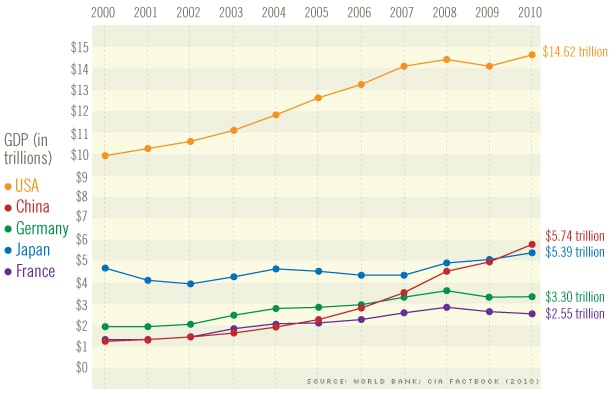
The United States produces so much more in terms of GDP than the next largest nations that it's a stretch to compare them. I think the fact that we produce more than 2X what the next largest single nation produces means that debt may function differently for us. The global economy is complex enough that relative position can mean more than short term profit and loss.
Debt is a bad thing. But the debt ceiling we just fought over extending represents 1 year of USD GDP. In everyday terms, someone expected to make $100k per year being $100k in debt. To me that sounds more like a student loan than a national crisis.
Should we make changes, cut spending and increase revenue? Sure. But we should also keep the bigger picture in mind, and look at our debt as it fits into the context of a global economy.
Debt does function differently for the US; the US up till very recently were paying less interest than Germany, even though all economical indicators say Germany is doing better than the US.
I do not think that is directly because of GDP, though. It is because of the size of the US bond market. If you want to buy or sell US bonds, you can easier find a seller or buyer, the larger the market.
That is why people think Euro bonds (bonds issued by the EU, not by individual EU nations) would benefit even the financially stronger nations. They would create a huge market, and gain interest benefits from it.
I do not think that is directly because of GDP, though. It is because of the size of the US bond market. If you want to buy or sell US bonds, you can easier find a seller or buyer, the larger the market.
That is why people think Euro bonds (bonds issued by the EU, not by individual EU nations) would benefit even the financially stronger nations. They would create a huge market, and gain interest benefits from it.
You cannot compare GDP between countries, as the US for example changes GDP (via the inflation component) every few years. US GDP in general is calculated too high as inflation is calculated too low compared to other countries - e.g. Germany.
[deleted]
(via angriers@reddit)
http://en.wikipedia.org/wiki/List_of_countries_by_credit_rat...
http://en.wikipedia.org/wiki/List_of_countries_by_credit_rat...
"Treasury officials noticed a $2 trillion error in S&P's math that delayed an announcement for several hours." - http://professional.wsj.com/article/SB1000142405311190336650....
Says it all.
Says it all.
from the S&P rationale section of their press release:
"Compared with previous projections, our revised base case scenario now assumes that the 2001 and 2003 tax cuts, due to expire by the end of 2012, remain in place. We have changed our assumption on this because the majority of Republicans in Congress continue to resist any measure that would raise revenues, a position we believe Congress reinforced by passing the act."
"Compared with previous projections, our revised base case scenario now assumes that the 2001 and 2003 tax cuts, due to expire by the end of 2012, remain in place. We have changed our assumption on this because the majority of Republicans in Congress continue to resist any measure that would raise revenues, a position we believe Congress reinforced by passing the act."
I don't care about karma burn; F&$# those damn ignorant republicans
The SEC should criminally prosecute S&P, Fitch and Moody's for their corrupt participation in the financial meltdown. It should have been done sooner (the case was already made). To do so now would look like vengeance. But if vengeance is required then vengeance should be served.
Put their controlling officers in jail and shut down the companies forever.
http://www.housingwire.com/2011/04/14/credit-ratings-agencie...
http://www.huffingtonpost.com/2011/04/13/credit-rating-agenc...
Put their controlling officers in jail and shut down the companies forever.
http://www.housingwire.com/2011/04/14/credit-ratings-agencie...
http://www.huffingtonpost.com/2011/04/13/credit-rating-agenc...
So keep an eye on treasury bonds on monday morning. Rate goes up, people still believe the US is safe, regardless of S&P. Rate goes down, market sentiment mirrors S&P's rating, and that's very very bad.
The chickens will come home to roost. It's just as simple as that.
It's not just US the whole world economy system is screwed. Look what happens in Europe.
People should really make some radical improvements to the way economy and finance system work. The main things: it should be simplified and transparent.
If only a few experts understand what happens how could the system be reliable and secure? Everyone also knows that the more complicated is the system the higher is the failure rate.
People should really make some radical improvements to the way economy and finance system work. The main things: it should be simplified and transparent.
If only a few experts understand what happens how could the system be reliable and secure? Everyone also knows that the more complicated is the system the higher is the failure rate.
> If only a few experts understand what happens how could the system be reliable and secure?
Would you rather fly in a 747, or something from 100 years ago? The latter is far, far simpler and easily understood by non-experts.
Would you rather fly in a 747, or something from 100 years ago? The latter is far, far simpler and easily understood by non-experts.
Regardless how you take this news, S&P just bought themselves a whole bunch of free advertising.
I don't think that was their primary goal but their name is now going to be mentioned on every newscast and in every paper everywhere for weeks.
I don't think that was their primary goal but their name is now going to be mentioned on every newscast and in every paper everywhere for weeks.
S&P is the same agency that rated AAA mortgage backed securities. not exactly a brain trust over there. my guess is they took this route for publicity.
again the same group that rated a bunch of debt AAA when it was junk. what is their motivation?
again the same group that rated a bunch of debt AAA when it was junk. what is their motivation?
So they rated junk as AAA. Do you imply US bonds are junk because they have been rated until now AAA by the agency?
WOW....talk about CAJONES! I must tip my hat to S&P. This one...just WOW.
I mean, I am not a conspiracy theorist by any stretch of the imagination, but I just never imagined that they would be able to pull the trigger.
All it takes is some 'investigation' by the US Treasury into S&P and that's it....game over. Not that I think the US Treasury will retaliate....but WOW. I never thought they would take this step.
Good for them.
Double-dip recession, here we come.
I mean, I am not a conspiracy theorist by any stretch of the imagination, but I just never imagined that they would be able to pull the trigger.
All it takes is some 'investigation' by the US Treasury into S&P and that's it....game over. Not that I think the US Treasury will retaliate....but WOW. I never thought they would take this step.
Good for them.
Double-dip recession, here we come.
Or perhaps something like this - i.e. an attempt to erode the credibility of S&P:
http://www.treasury.gov/connect/blog/Pages/Just-the-Facts-SP...
http://www.treasury.gov/connect/blog/Pages/Just-the-Facts-SP...
[deleted]
“It doesn’t make sense. In Omaha, the U.S. is still Triple-A rated and if there were a Quadruple-A I’d give the U.S. that.” -Warren Buffett
It seems that for the last 40 years we've been in one huge bubble - the 'American bubble.' Overconfidence in the continual growth, recovery and viability of US economics is finally coming to an end, and most of the globe is exposed.
The ensuing blame game and rage depresses me:
http://youropenbook.org/?q=AAA+obama&gender=any
http://youropenbook.org/?q=aaa+republicans&gender=any
http://youropenbook.org/?q=aaa+democrats&gender=any
http://youropenbook.org/?q=AAA+tea+party&gender=any
http://youropenbook.org/?q=aaa+congress&gender=any
http://youropenbook.org/?q=aaa+politicians&gender=any
I have my own opinions as to who's responsible and what amger is well placed, but I think one can draw their own conclusions.
Yes I know these are a limited sample set of people who have set their profiles to public. But still...
http://youropenbook.org/?q=AAA+obama&gender=any
http://youropenbook.org/?q=aaa+republicans&gender=any
http://youropenbook.org/?q=aaa+democrats&gender=any
http://youropenbook.org/?q=AAA+tea+party&gender=any
http://youropenbook.org/?q=aaa+congress&gender=any
http://youropenbook.org/?q=aaa+politicians&gender=any
I have my own opinions as to who's responsible and what amger is well placed, but I think one can draw their own conclusions.
Yes I know these are a limited sample set of people who have set their profiles to public. But still...
Some great non-hair-on-fire conversation here. Whenever I read and note that most folks are not that far apart on things, I keep wondering why the system is so broken. Here's the systemic problem, which has nothing to do with Treasury Bills, tax structures, or political parties.
Phases of political maturity:
1) Apathy. Political parties are like football teams. You pick one and they're your guys. You root for them no matter what. If anything, there might be something wrong about folks who take these things too seriously.
2) Emotion. The other political party is the devil. They are out to destroy America.
3) Enlightenment. The other party is just full of people like me. There are some smart folks, but the problem is that they have all the wrong incentives and conclusions.
4) Understanding. Gee, there are those same bad conclusions and wrong incentives in my favorite party too. Ergo, parties don't matter. There are smart people everywhere. When the system fails, it's a problem of the system, not of the people or parties.
The problem in the U.S. is that the majority of folks are in stage 1 or 2 when we need them to be in 4. So when deep structural conversations come along, they're still either rooting for their team or blaming the other guys, when they should be talking about principles that need to be changed for the entire system to work better, no matter what the actual goals of any party.
There is another problem that helps create deadlock -- an understanding of where the money comes from. I think many folks view the economy as something the government grows so that it can harvest money in the form of taxes. (This is not a Keynesian discussion, simply a discussion about taxes in general.) Other folks view the government as something the economy grows in order to keep it functioning. These are two deeply conflicting world-views. I'm not sure you'll ever reconcile them. Some put trading first and sharing second. Many put sharing first and trading second. These two camps have come to demonize the others, sadly. (Which takes us back to the observation above)
For this problem to be solved, we need to give up on arguing specific issues or philosophical positions and instead talk about fixing structures so that the budget stays balanced long-term no matter who is in power or what their priorities are. This is a meta conversation, the kind the framers had. I am very doubtful there is anyone around today in power that can handle it. Not a happy outlook. All of the people in political power got that way by playing ideological and rhetorical games and by being fiercely loyal to their party. It's the exact opposite qualifications for folks that would have a chance at actually solving anything.
I think we could talk forever and reach general agreement informally on all number of things, but if the system remains broken, it's all going to be for nothing, sadly. Without an honest look at meta systemic issues, a free-for-all discussion around U.S. policy is all so much activity without results.
Phases of political maturity:
1) Apathy. Political parties are like football teams. You pick one and they're your guys. You root for them no matter what. If anything, there might be something wrong about folks who take these things too seriously.
2) Emotion. The other political party is the devil. They are out to destroy America.
3) Enlightenment. The other party is just full of people like me. There are some smart folks, but the problem is that they have all the wrong incentives and conclusions.
4) Understanding. Gee, there are those same bad conclusions and wrong incentives in my favorite party too. Ergo, parties don't matter. There are smart people everywhere. When the system fails, it's a problem of the system, not of the people or parties.
The problem in the U.S. is that the majority of folks are in stage 1 or 2 when we need them to be in 4. So when deep structural conversations come along, they're still either rooting for their team or blaming the other guys, when they should be talking about principles that need to be changed for the entire system to work better, no matter what the actual goals of any party.
There is another problem that helps create deadlock -- an understanding of where the money comes from. I think many folks view the economy as something the government grows so that it can harvest money in the form of taxes. (This is not a Keynesian discussion, simply a discussion about taxes in general.) Other folks view the government as something the economy grows in order to keep it functioning. These are two deeply conflicting world-views. I'm not sure you'll ever reconcile them. Some put trading first and sharing second. Many put sharing first and trading second. These two camps have come to demonize the others, sadly. (Which takes us back to the observation above)
For this problem to be solved, we need to give up on arguing specific issues or philosophical positions and instead talk about fixing structures so that the budget stays balanced long-term no matter who is in power or what their priorities are. This is a meta conversation, the kind the framers had. I am very doubtful there is anyone around today in power that can handle it. Not a happy outlook. All of the people in political power got that way by playing ideological and rhetorical games and by being fiercely loyal to their party. It's the exact opposite qualifications for folks that would have a chance at actually solving anything.
I think we could talk forever and reach general agreement informally on all number of things, but if the system remains broken, it's all going to be for nothing, sadly. Without an honest look at meta systemic issues, a free-for-all discussion around U.S. policy is all so much activity without results.
Actually, I think there's a stage before all this:
0) Withdrawal. No political party represents me, and the ones in existence represent other groups. There's nothing I can do to change the system, and it's not even worthwhile voting. I'm going to watch Jersey Shore.
In most Western countries, there's a lot of people in stage 0. It's a problem for any putative democracy.
0) Withdrawal. No political party represents me, and the ones in existence represent other groups. There's nothing I can do to change the system, and it's not even worthwhile voting. I'm going to watch Jersey Shore.
In most Western countries, there's a lot of people in stage 0. It's a problem for any putative democracy.
Actually, withdraw may be the last stage (or at least the most logical one). Public choice theory looks at this in depth. Essentially, if your vote doesn't really matter (and statistically it almost never does), then understanding may be too much work with too little payoff. I would say that is why the founders thought limited government was best (although that seems to no longer actually be the case)
Perfect. Obama and Boehner are doing an excellent job of what they are paid to do: transferring the wealth of the USA to Wall Street plutocrats. They've given the sleazeball so-called "rating" agencies the cover they need to demand higher interest rates.
No new taxes. No new jobs. I can't believe that folks who are in their 20s and 30s aren't throwing rocks at people my age (late 50s) for our generational greediness.
By the way, I had a six figure federal tax bill one year, when my cofounders and I sold a startup. Maybe I'm an aberration, but I was proud to be able to chip in that much to the government that paid for ARPA back in the day.
No new taxes. No new jobs. I can't believe that folks who are in their 20s and 30s aren't throwing rocks at people my age (late 50s) for our generational greediness.
By the way, I had a six figure federal tax bill one year, when my cofounders and I sold a startup. Maybe I'm an aberration, but I was proud to be able to chip in that much to the government that paid for ARPA back in the day.