There Probably Have Been Aliens(mobile.nytimes.com)
mobile.nytimes.com
There Probably Have Been Aliens
https://mobile.nytimes.com/2016/06/12/opinion/sunday/yes-there-have-been-aliens.html?WT.mc_id=2016-KWP-MOBILE-AUD_DEV&WT.mc_ev=click&ad-keywords=MOBILEFULLPAGE&kwp_0=298359&kwp_4=1145468&kwp_1=525833&_r=0&referer=
16 comments
One good example is that as far as we can tell multi-cellular life only evolved on Earth once. And while life started up on Earth pretty quickly it took about 600 million years for that life to become multicelluar. It's possible that we'll someday discover life is relatively common but never meet anything but amoebas.
Totally. Not only did multicellular life only evolve once, but eukaryotes themselves seem to have evolved only once. And they are 1000x more complex than their prokaryote predecessors. [edit: without any real evidence of anything convincingly between prokaryote and eukaryote]
It's one thing to say there might have been abiogenesis elsewhere that created something like the simple self-reproducing energy machines that bacteria and archaea are. It's another to claim that there is some inevitable progression from that to complex multicellular life. In my opinion this is a very teleological, very 'progressivist' notion of evolution that implies that one inevitably follows from another, and it is not borne out in the reality of what we know so far about happened on earth and what follows from first principles.
There may be a lot of complex, self-reproducing systems in the universe. It's arrogant to assume that any of them have to look anything like what we call "life" unless by life we mean the simplest single cell organisms. [edit: In fact it looks like simple prokaryotes evolved _twice_ on earth a "short" distance in time apart].
It's one thing to say there might have been abiogenesis elsewhere that created something like the simple self-reproducing energy machines that bacteria and archaea are. It's another to claim that there is some inevitable progression from that to complex multicellular life. In my opinion this is a very teleological, very 'progressivist' notion of evolution that implies that one inevitably follows from another, and it is not borne out in the reality of what we know so far about happened on earth and what follows from first principles.
There may be a lot of complex, self-reproducing systems in the universe. It's arrogant to assume that any of them have to look anything like what we call "life" unless by life we mean the simplest single cell organisms. [edit: In fact it looks like simple prokaryotes evolved _twice_ on earth a "short" distance in time apart].
Multi cellular life has evolved several times. There are several distinct cases of single called organisms promoting conditions which aid others of it's species. Causing a colony to form, and then spawn new colonies.
Now, highly complex multicellular life seems to share common descent. But that likely has more to do with predation than anything else. Further single called organisms preform horizontal gene transfer to both other single called life and multicellular life, making things impossible to trace back.
Now, highly complex multicellular life seems to share common descent. But that likely has more to do with predation than anything else. Further single called organisms preform horizontal gene transfer to both other single called life and multicellular life, making things impossible to trace back.
That's not really known.
Of note life showed up very close to as soon as possible on early earth. So, similar events may have happend 30+ times. However, the first time life shows up it can spread easily, the second time it's likely food.
Of note life showed up very close to as soon as possible on early earth. So, similar events may have happend 30+ times. However, the first time life shows up it can spread easily, the second time it's likely food.
Another take at it is that life here very likely started with RNA chains. That number sounds very low, but 10^-22 < 4^37. That is, if only one chromosome among all of the ones 37 basis long could self reproduce, it would already fit the probabilities cited on the article.
Now, 36 basis is extremely short. I don't think anybody believes there's anything that size that able to reproduce. Last time I checked, the smallest known self-reproducing chromosome had around 160 basis. That is, it had a probability of ~10^-96 of appearing between all 160 basis chromosomes. (And remember, there are ~10^80 atoms on the observable Universe...)
Now, 36 basis is extremely short. I don't think anybody believes there's anything that size that able to reproduce. Last time I checked, the smallest known self-reproducing chromosome had around 160 basis. That is, it had a probability of ~10^-96 of appearing between all 160 basis chromosomes. (And remember, there are ~10^80 atoms on the observable Universe...)
At a minimum there are several right vs left handed molecules which doubles the ways you can get our current ecosystem.
So, really the question is how many possible ways can you get self replication not how complex is the first example.
So, really the question is how many possible ways can you get self replication not how complex is the first example.
Still, the only think we know is that the odds are bigger than 10^-96.
You will need a huge amount of self-replicating chromosomes between 180 and 160 basis to make up for the increased size - it's known that self replication is not common, but I don't think we know that to a 10^-22 certainty either, so all that can still be wrong.
Anyway, there isn't a lot to argue about self-replicating on that context. It means that this chromosome is able to create copies of itself in a RNA-rich ocean. It can require light for that, or a big thermal gradient, but not both. The exact conditions of the ocean are, AFAIK, unknown, but things like your example do not fit.
You will need a huge amount of self-replicating chromosomes between 180 and 160 basis to make up for the increased size - it's known that self replication is not common, but I don't think we know that to a 10^-22 certainty either, so all that can still be wrong.
Anyway, there isn't a lot to argue about self-replicating on that context. It means that this chromosome is able to create copies of itself in a RNA-rich ocean. It can require light for that, or a big thermal gradient, but not both. The exact conditions of the ocean are, AFAIK, unknown, but things like your example do not fit.
[deleted]
I don't think we can define a lower bound as we don't know the size of the universe, or if there is a cycle of previous universes without life.
However, life showed up on earth at a very early stage which suggest it has a relatively high probability over a planets lifespan. Without other information to go on earth is probably topical and life generally shows up within the first 500 million years watter shows up.
However, life showed up on earth at a very early stage which suggest it has a relatively high probability over a planets lifespan. Without other information to go on earth is probably topical and life generally shows up within the first 500 million years watter shows up.
I'm not following the reasoning about a lower bound. I didn't use the size of the universe anywhere.
> However, life showed up on earth at a very early stage which suggest it has a relatively high probability over a planets lifespan.
1 - That's a good explanation. As good as any other.
2 - Alternatively, life's appearance depends on something that only existed in that short timespan (both light and a big temperature gradient at the same place is a great candidate).
3 - Or life requires some time to evolve so intelligence can only appear on planets that life was early.
4 - Or, you can mix #2 and #3 at varying amounts.
> However, life showed up on earth at a very early stage which suggest it has a relatively high probability over a planets lifespan.
1 - That's a good explanation. As good as any other.
2 - Alternatively, life's appearance depends on something that only existed in that short timespan (both light and a big temperature gradient at the same place is a great candidate).
3 - Or life requires some time to evolve so intelligence can only appear on planets that life was early.
4 - Or, you can mix #2 and #3 at varying amounts.
Do you mean base pairs? Bases?
Sorry, I mean bases.
Nucleic acid replication involve them being both dual and single base sequences on different stages. So the difference between "bases" and "base pairs" is meaningless.
Nucleic acid replication involve them being both dual and single base sequences on different stages. So the difference between "bases" and "base pairs" is meaningless.
One of the (to me) most mind-bending arguments about the absence of alien civilizations is the apparent absence of self-replicating interstellar probes. It wouldn't take much more of a tech civilization than we have to launch such a thing, and it would take only one launch event in all of galactic history to quickly and permanently permeate the galaxy with them. So where are they?
> self-replicating interstellar probes
DNA
DNA
Yeah, Bracewell/Von Neuman probes[0]. You create an AI in a probe that can communicate in a variety of ways and replicate itself and send it off into space. IIRC it would conservatively take about a million years for a civilization to blanket the galaxy in them.
[0]https://en.wikipedia.org/wiki/Bracewell_probe
[0]https://en.wikipedia.org/wiki/Bracewell_probe
Communication seems to be optional.
It isn't obvious that communication by such "probes" would take place on a medium that we can currently sense. Which may be what you meant?
Sounds like a good way to turn the galaxy into grey goo.
Maybe there's a highly advanced predictor species that destroys other civilization before they reach that stage.
may be [hopefully] civilizations reach mental maturity preventing such pollution of their galactic neighborhood with self-replicating trash before being able to perform such pollution. "Morris worm" at galactic scale :)
With regards to aliens - i see the Bible as exactly historical document of such an unplanned/unauthorized contact by an alien observer gone rogue. Contains all elements, like medical nanobots, [food]replication, specific lessons that violence is the main obstacle of civilization development, blue light sterilizing the cave with decontamination workers in white overalls and some devices on their backs (angels :), etc... Hunt for the lost sample of the alien's DNA - Holy Grail- which also contains those nanobots.
With regards to aliens - i see the Bible as exactly historical document of such an unplanned/unauthorized contact by an alien observer gone rogue. Contains all elements, like medical nanobots, [food]replication, specific lessons that violence is the main obstacle of civilization development, blue light sterilizing the cave with decontamination workers in white overalls and some devices on their backs (angels :), etc... Hunt for the lost sample of the alien's DNA - Holy Grail- which also contains those nanobots.
What percentage of launch-capable civilizations have their own cautionary fable equivalent to the Slylandro civilization in Star Control 2, or the grey goo of Engines of Creation?
The probes reached their replication limit, then went into hibernation when they phoned home, and subsequently failed to receive a reset signal. Or perhaps they simply propagate too slowly. Imagine if the Morris worm spread only half as fast as the growth of the Internet itself.
The probes reached their replication limit, then went into hibernation when they phoned home, and subsequently failed to receive a reset signal. Or perhaps they simply propagate too slowly. Imagine if the Morris worm spread only half as fast as the growth of the Internet itself.
> we now have enough information to conclude that they almost certainly existed at some point in cosmic history
Is there a term in the Drake Equation for our level of certainty that the Drake Equation isn't missing some terms?
Is there a term in the Drake Equation for our level of certainty that the Drake Equation isn't missing some terms?
One other proposed factor: the laws of physics may vary across the universe, so stars in faraway galaxies may not be eligible. But there's a lot of evidence that the laws of physics are the same as far away as we can see, so this seems unlikely to me.
There are good reasons to believe that intelligent civilizations are short lived (compared to cosmological time scales). So the absence of radio signals from nearby planets doesn't mean it's not worthwhile to send a probe there to see if there are ruins or something.
There are good reasons to believe that intelligent civilizations are short lived (compared to cosmological time scales). So the absence of radio signals from nearby planets doesn't mean it's not worthwhile to send a probe there to see if there are ruins or something.
"So the absence of radio signals from nearby planets"
Whoa there... The SETI people whom are only occasionally telecom engineers have a thing about scanning for the simplest carrier waves and that's it.
Note that we only broadcast vestigial sideband amplitude modulated video signals which had a lovely strong stable carrier for oh maybe 50 years and we don't broadcast analog TV anymore. Lets be honest that the future for broadcast radio/TV doesn't look particularly bright so even if the aliens had the bright idea to use 8VSB modulation when the USA is in view or OFDM when the euros are in view then they still would see total radio silence from us in "a couple years". Terrestrial broadcasting is pretty much done.
You need to add a term to the SETI equation that your average civilization is only going to broadcast "SETI@HOME" compatible radio signals for maybe a century, probably less.
There's a section of Kraus classic radio astronomy textbook indicating that detecting Earth during the peak of the analog TV era would still have been pretty tricky if the aliens used our own "SETI@HOME" modulation.
You feed a baseband thru the wrong demod and you just get distorted noise.
Broadcast seems kinda dead as a concept in a packet switched social media era. The aliens and us are not going to understand each other on some rather fundamental levels making USA 2050 compared to USA 1950 look fairly trivial. Wait... you still use radio waves for communication instead of high frequency short range gravitic waves? You broadcast to a significant fraction of your unified population instead of social media via low power point to point systems? How... retro.
Whoa there... The SETI people whom are only occasionally telecom engineers have a thing about scanning for the simplest carrier waves and that's it.
Note that we only broadcast vestigial sideband amplitude modulated video signals which had a lovely strong stable carrier for oh maybe 50 years and we don't broadcast analog TV anymore. Lets be honest that the future for broadcast radio/TV doesn't look particularly bright so even if the aliens had the bright idea to use 8VSB modulation when the USA is in view or OFDM when the euros are in view then they still would see total radio silence from us in "a couple years". Terrestrial broadcasting is pretty much done.
You need to add a term to the SETI equation that your average civilization is only going to broadcast "SETI@HOME" compatible radio signals for maybe a century, probably less.
There's a section of Kraus classic radio astronomy textbook indicating that detecting Earth during the peak of the analog TV era would still have been pretty tricky if the aliens used our own "SETI@HOME" modulation.
You feed a baseband thru the wrong demod and you just get distorted noise.
Broadcast seems kinda dead as a concept in a packet switched social media era. The aliens and us are not going to understand each other on some rather fundamental levels making USA 2050 compared to USA 1950 look fairly trivial. Wait... you still use radio waves for communication instead of high frequency short range gravitic waves? You broadcast to a significant fraction of your unified population instead of social media via low power point to point systems? How... retro.
Good point: a moderately advanced civilization is likely to have no high-power baseband communication. Only intentional alien interstellar transmissions are likely to be powerful enough and decodable.
Earth has made several intentional transmissions (https://en.wikipedia.org/wiki/Active_SETI) but it's unclear if we'll send any more, because they might attract hostile aliens.
Earth has made several intentional transmissions (https://en.wikipedia.org/wiki/Active_SETI) but it's unclear if we'll send any more, because they might attract hostile aliens.
> there's a lot of evidence that the laws of physics are the same as far away as we can see
This could be a relativistic effect, just like the speed of light appears the same irrespective of frame of reference.
This could be a relativistic effect, just like the speed of light appears the same irrespective of frame of reference.
I don't really see how it could be missing terms. Chance of A. Chance A becomes B. Chance B becomes C. etc. It's intentionally very simple, with very broad terms. It should have no gaps by definition, unless there was a wording error.
If an alien civilization existed, but we can never find any evidence of it existing, does it still count?
The speculation is moot as long as the record of evidence cannot support within a reasonable confidence interval that only one or more alien civilizations could have produced it.
Guessing with the Drake equation only helps to determine just how much time and funding you would like to provide to projects like SETI, that actually watch for and listen for evidence that would refute the null hypothesis (viz. no civilizations anywhere outside of Sol System).
All the article really says is that if SETI has enough resources to watch the entire sky at maximum resolution for an infinite timespan, it will eventually find something. But I'm certainly not going to sink that much time and money into it. I'd rather put that money into generation ships, sleeper ships, robotic seed ships, permanent space habitats, or some combination thereof.
The speculation is moot as long as the record of evidence cannot support within a reasonable confidence interval that only one or more alien civilizations could have produced it.
Guessing with the Drake equation only helps to determine just how much time and funding you would like to provide to projects like SETI, that actually watch for and listen for evidence that would refute the null hypothesis (viz. no civilizations anywhere outside of Sol System).
All the article really says is that if SETI has enough resources to watch the entire sky at maximum resolution for an infinite timespan, it will eventually find something. But I'm certainly not going to sink that much time and money into it. I'd rather put that money into generation ships, sleeper ships, robotic seed ships, permanent space habitats, or some combination thereof.
> Specifically, unless the probability for evolving a civilization on a habitable-zone planet is less than one in 10 billion trillion, then we are not the first.
Obviously, astronomy theories don't know much about these things, as the sheer number of stars with planets, and planets in the habitable zones, have come as a big surprise to everyone.
But still, can we say or guess anything about the age distribution of these stars and planets, compared to our earth and sun? Is our sun among the oldest or youngest of those stars which have earth-like planets?
Obviously, astronomy theories don't know much about these things, as the sheer number of stars with planets, and planets in the habitable zones, have come as a big surprise to everyone.
But still, can we say or guess anything about the age distribution of these stars and planets, compared to our earth and sun? Is our sun among the oldest or youngest of those stars which have earth-like planets?
Envision civilizations tombstone: A automated observatory, which searches for green-zone planets and sends short laser-burst-encoded "Here lies"- messages to the probable locations of tomorrow civilizations.
On some far away planet, a circle of far-travelled pulsing light razes with 30 km/s over the clouds, and is interpreted as a answer to the "Where is everybody?" question, missing the grammatically correct point of a decent interstellar conversation. The Question is.. "Where was everybody (when we where around?)"
On some far away planet, a circle of far-travelled pulsing light razes with 30 km/s over the clouds, and is interpreted as a answer to the "Where is everybody?" question, missing the grammatically correct point of a decent interstellar conversation. The Question is.. "Where was everybody (when we where around?)"
tl;dr The rough estimates of the number of habitable planets in the universe just went from 20 trillion to 100 trillion based on the fact that it looks like almost all stars have planets.
Paraphrasing Sagan: "Great claims, need great evidence". Real evidence is always lacking for aliens.
Evidence isn't really the issue here. We're not trying to answer a definitive question here of whether or not there have been advanced civilizations.
We're trying to reason our way into a statement of probability. Just because it isn't currently provable doesn't mean it isn't a question worth investigating.
Pull the other one, it exists with probability 10^-22.
Please add "(2016)" to the title as this article is from last June.
> In other words, given what we now know about the number and orbital positions of the galaxy’s planets, the degree of pessimism required to doubt the existence, at some point in time, of an advanced extraterrestrial civilization borders on the irrational.
AKA "Yes, there might have been aliens". Interesting article, sensationalist headline.
AKA "Yes, there might have been aliens". Interesting article, sensationalist headline.
Something has always confused me about the Drake equation.
The explanation I have heard repeatedly goes something like:
"This equation shows that there should be [massive number] of alien civilizations in the universe. But where are they?"
This seems to assume that, given the density of civilizations throughout the galaxy we can determine from [massive number], we should be able to observe other advanced civilizations. But is that true? If there was a civilization as advanced as we are somewhere in e.g. Alpha Centauri, would we be able to detect them?
The explanation I have heard repeatedly goes something like:
"This equation shows that there should be [massive number] of alien civilizations in the universe. But where are they?"
This seems to assume that, given the density of civilizations throughout the galaxy we can determine from [massive number], we should be able to observe other advanced civilizations. But is that true? If there was a civilization as advanced as we are somewhere in e.g. Alpha Centauri, would we be able to detect them?
You are describing the Fermi Paradox: https://en.wikipedia.org/wiki/Fermi_paradox - there is a lot of interesting reading on that Wiki page.
The usual response I think is that the timescales and distances involved are simply still too big / spread out that we're still searching for the metaphorical needle in the haystack.
The usual response I think is that the timescales and distances involved are simply still too big / spread out that we're still searching for the metaphorical needle in the haystack.
It's also perfectly conceivable that we do just happen to be the first. Looking less likely with every advance in astronomy, but still possible nonetheless.
I think people tend to push way way too optimistic numbers into the Drake equation. I would gander the jump from "life" to multicellular organisms to be one in a million times that life forms.
I work for the NRAO but I am not a radio astronomer, but my sense of it jibes with yours. Planets are mostly so close to their host star from our perspective that to distinguish signal between the two would require extraordinary sensitivity. But that sensitivity also means that you have to point very precisely. A less precise instrument can cover more sky at once but then you can't pick out individual sources as well and brighter sources (like stars) would swamp weaker sources like terrestrial radio/television signals.
I don't think we have enough information to tune the values in the Drake equation to make meaningful predictions. We'd need observations to do that, but the observations are, as you point out, difficult enough that we don't know if they're absent or we just can't see them yet.
I don't think we have enough information to tune the values in the Drake equation to make meaningful predictions. We'd need observations to do that, but the observations are, as you point out, difficult enough that we don't know if they're absent or we just can't see them yet.
If they use encryption it would be very hard to detect a sinal
UPDATE We have had computers for less than a 100 years, and with i2p we hav already created a technoligy that would hide us from other aliens
UPDATE We have had computers for less than a 100 years, and with i2p we hav already created a technoligy that would hide us from other aliens
Encryption will make a signal look like noise, but first you have to be able to separate that source from the host star, and I think even doing that is difficult. I think that's the more fundamental problem.
Could be but first you have to find a candidate star. And with all radom noise where would you start
I think you're kind of missing the point. According to the Drake equation and what we know about exoplanets now, you start by pointing to any star, any at all. The problem is that you won't be able to distinguish signal from the planet(s) from signal from the star.
Of course, it may be that advanced civilizations, assuming they survive long enough, don't become expansionist or explorist. Imagine a post-scarcity homeworld. People would be happier on that world or in VR or whatever instead of breaking their backs mining some distant planet until their extinction event. Which scenario brings out the most personal satisfaction for hypothetical ET? Why would conscious beings who have reached a high technological development even bother with expansion? That's like asking a cush white collar person to mine coal on the weekends. It doesn't make sense. In his world, the heat comes in via electricity which is taken from a local nuclear power plant. That gives him the most utility and pleasure. Now imagine technology very much past that. Intelligent beings will move towards comfort and safety assuming all other things are provided. Actually considering near killing yourself from labor or risk in a far-off colony only happens when you don't have a satisfying life in your current place.
Its also worth mentioning that FTL travel probably isn't in the cards and even if we consider exploratory advanced civilizations working for billions of years, they most likely would not get far by the time they hit their extinction event anyway. Even an incredible case of E.T. exploring an entire galaxy would be an achievement without peer, but ultimately would leave 2 trillion other galaxies unexplored. Even that would be a stretch considering a galaxy is 100,000 long/wide and in 3 dimensions. Even if you could have a practical 1/10th lightspeed ship, you're looking at 1bn years right there. The universe is only 13bn years old so this civilization could explore maybe 3 or 4 galaxies at most considering inter-galaxy distances.
Its also worth mentioning that FTL travel probably isn't in the cards and even if we consider exploratory advanced civilizations working for billions of years, they most likely would not get far by the time they hit their extinction event anyway. Even an incredible case of E.T. exploring an entire galaxy would be an achievement without peer, but ultimately would leave 2 trillion other galaxies unexplored. Even that would be a stretch considering a galaxy is 100,000 long/wide and in 3 dimensions. Even if you could have a practical 1/10th lightspeed ship, you're looking at 1bn years right there. The universe is only 13bn years old so this civilization could explore maybe 3 or 4 galaxies at most considering inter-galaxy distances.
>Its also worth mentioning that FTL travel probably isn't in the cards and even if we consider exploratory advanced civilizations, they most likely would not get far by the time they hit their extinction event anyway.
Another possibility is that we've simply explored in the wrong directions.
Another possibility is that we've simply explored in the wrong directions.
    ___________________________________________
    |                               Us --> Exploring this direction
    |
    |     [Millions of lightyears of space between Us and Them]
    |
    |             Them
    |                 |
    |                 |
    |                 |
    |                 v
| Exploring this directionIt happens to people in Walmarts. They're a lot smaller. Certainly could happen with races looking for each other in space with the timescale that energy takes to cross it. Another thing that popped in my mind are the nuclear submarines looking for each other while emitting almost no sound or energy. It's just a void with a tiny piece of data here or there that must be assembled into evidence of others' presence. This can happen even when they're fairly close to each other.
Our galaxy is pretty much bounded. If any race started spread a few millions of years ago, they should be exploring (and exploiting) the entire galaxy already.
Did you mean universe? Our galaxy is a spec of dust. Our local galaxy cluster is also just a spec of dust. For how large the universe is - even a supercluster is a spec of dust. The universe is mind boggingly massive.
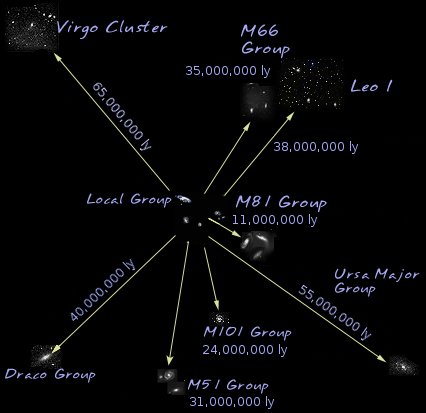
The observable universe has an estimated diameter of 93 billion light-years. A few million years might be enough to explore nearby galaxies. For example, to explore just our Local Supercluster you would need approximately 65,000,000 years [0]. Travelling at the speed of light.
E: Virgo is further than Ursa Major. Updated 55,000,000-->65,000,000.
E2: I always refer people to this video in regards to aliens, space, and time. I forgot to in this post, so here it is now: https://www.youtube.com/watch?v=HPl10L40pBM
[0] https://upload.wikimedia.org/wikipedia/commons/e/e2/Local_su...
The observable universe has an estimated diameter of 93 billion light-years. A few million years might be enough to explore nearby galaxies. For example, to explore just our Local Supercluster you would need approximately 65,000,000 years [0]. Travelling at the speed of light.
E: Virgo is further than Ursa Major. Updated 55,000,000-->65,000,000.
E2: I always refer people to this video in regards to aliens, space, and time. I forgot to in this post, so here it is now: https://www.youtube.com/watch?v=HPl10L40pBM
[0] https://upload.wikimedia.org/wikipedia/commons/e/e2/Local_su...
> Why would conscious beings who have reached a high technological development even bother with expansion? That's like asking a cush white collar person to mine coal on the weekends. It doesn't make sense
What about the people who ride on ships from Southport to the Americas to plant crops or cotton?
But most expansion beyond the solar system would be inter-generational anyway, so it's more like people who are born on a spaceship and told by their parents they're a pioneer to an uninhabited world, and can't turn around.
What about the people who ride on ships from Southport to the Americas to plant crops or cotton?
But most expansion beyond the solar system would be inter-generational anyway, so it's more like people who are born on a spaceship and told by their parents they're a pioneer to an uninhabited world, and can't turn around.
Am I reading this wrong, or is it basically just making a restatement of the Drake equation with updated numbers in place? [Edit: and ignoring some terms to allow for time irrelevance]. I was hoping for something addressing the Fermi paradox or something more than just a refined probabilistic estimate with such a definitive title.
No, that's exactly it. Those numbers will just keep on getting more precise as time goes on, though - we'll never know from the Drake equation alone, but it's the best guideline we have right now.
I suppose, but having more precise terms in the first half doesn't seem to really do much for us given that the terms dealing with the probability of life forming can't even really be estimated. This article is basically saying "surely it's more than 1 in 10^22", but I don't see any hint of why that would be, other than 'it's such a small chance that it had to be written in italics'.
Right. What's happened with the Drake Equation is that the terms related to possibly habitable planets have largely moved to the "almost certainly lots" realm.
But, as you say, with respect to life (or at least complex multi-cellular life), we just don't know. But the Drake Equation encourages thinking like, even it's it's a 1 in a trillion chance effectively zero!, we'd have all these aliens running around. Because 1 in a trillion = 0 is pretty much what we're informed by day-to-day usage and intuition.
But, as you say, with respect to life (or at least complex multi-cellular life), we just don't know. But the Drake Equation encourages thinking like, even it's it's a 1 in a trillion chance effectively zero!, we'd have all these aliens running around. Because 1 in a trillion = 0 is pretty much what we're informed by day-to-day usage and intuition.
> Because 1 in a trillion = 0 is pretty much what we're informed by day-to-day usage and intuition
Avogadro's constant is 6.022 x 10^23 [1]. There are a hundred billion sets of a trillion constituent particles in ever mol of anything. A reaction that happens to water once in a trillion years would occur 20,000 times a second for each 18 mL of water.
[1] https://en.m.wikipedia.org/wiki/Avogadro_constant
Avogadro's constant is 6.022 x 10^23 [1]. There are a hundred billion sets of a trillion constituent particles in ever mol of anything. A reaction that happens to water once in a trillion years would occur 20,000 times a second for each 18 mL of water.
[1] https://en.m.wikipedia.org/wiki/Avogadro_constant
You're being an engineer :-) Yes, I am aware of those things but those sorts of numbers do not correspond to day-to-day usage and intuition of most people (as I said).
Scientist all arround the world is trying to create artificial life. If they are successfull then we have a mesure for level 4
And that's why I think it's a very bad news article: there is no news here. Also: that sensationalistic title.
That's about it. They also don't consider how many alien civilizations might be within communications range.
The other big question is how long technological civilizations last. Ours is less than 200 years old. (A useful starting date is 1830, when the Liverpool and Manchester Railway started carrying paid passengers. That's when powered technology got out of beta.) How long before we run out of cost-effective nonrenewable resources? Probably a few hundred years, tops.
The other big question is how long technological civilizations last. Ours is less than 200 years old. (A useful starting date is 1830, when the Liverpool and Manchester Railway started carrying paid passengers. That's when powered technology got out of beta.) How long before we run out of cost-effective nonrenewable resources? Probably a few hundred years, tops.
> A useful starting date is 1830
I'd consider as the reasonable starting date, when we discuss about the alien civilizations on the distant planets, the day the radio communication starts to exist.
So we're some just for some 110 years capable of sending and receiving any radio message. If we move to the "capable of receiving the faint message from the big distance" it's more like just some 60-something years.
Also note that as we move to using the digital, high-density, compressed and especially encrypted messaging, the transmitted messages look more like the noise than the signal.
I'd consider as the reasonable starting date, when we discuss about the alien civilizations on the distant planets, the day the radio communication starts to exist.
So we're some just for some 110 years capable of sending and receiving any radio message. If we move to the "capable of receiving the faint message from the big distance" it's more like just some 60-something years.
Also note that as we move to using the digital, high-density, compressed and especially encrypted messaging, the transmitted messages look more like the noise than the signal.
Also note that as we move to using the digital, high-density, compressed and especially encrypted messaging, the transmitted messages look more like the noise than the signal.
I made that point to a SETI guy who was giving a talk. They were looking for "carriers". Nobody uses carriers much any more. It's a huge waste of power and bandwidth. There are much more efficient ways to get synchronization. Everything later than analog TV is low-carrier or no-carrier. Unless you have some idea of what to look for, the signal looks like white noise.
I made that point to a SETI guy who was giving a talk. They were looking for "carriers". Nobody uses carriers much any more. It's a huge waste of power and bandwidth. There are much more efficient ways to get synchronization. Everything later than analog TV is low-carrier or no-carrier. Unless you have some idea of what to look for, the signal looks like white noise.
The assumption among the SETI guys is that the messages they are after are made with the only purpose to attract the attention to the senders.
Which doesn't have to be cleverest thing to do, and maybe we should also be worried enough to care.
To make a computing analogy, maybe taking part in the "galactic internet" without the latest "firewalls" and "spam filters" can be really the matter of life and death for the whole planet ("what you didn't know that we send the 'energy beam of death' to those who don't respect the protocol, well the whole galaxy knows, and you won't do it again, heh, heh" even if we avoid other trivial issues like a galaxy "superhighway" which has to be constructed in our neighborhood or simply that humans are maybe very good to be used as food or work animals from the point of the possible invaders). So we should learn about the others but really try to stay as undetected as we can until we know more. And maybe other aliens think like this paragraph argues too.
Which doesn't have to be cleverest thing to do, and maybe we should also be worried enough to care.
To make a computing analogy, maybe taking part in the "galactic internet" without the latest "firewalls" and "spam filters" can be really the matter of life and death for the whole planet ("what you didn't know that we send the 'energy beam of death' to those who don't respect the protocol, well the whole galaxy knows, and you won't do it again, heh, heh" even if we avoid other trivial issues like a galaxy "superhighway" which has to be constructed in our neighborhood or simply that humans are maybe very good to be used as food or work animals from the point of the possible invaders). So we should learn about the others but really try to stay as undetected as we can until we know more. And maybe other aliens think like this paragraph argues too.
It's nice to see this sort of sentiment expressed more scientifically than "well come on, this place is huge and old, so... yeah, probably".
But I think it stands to reason and always has. After all, this place is old and huge, so...
But I think it stands to reason and always has. After all, this place is old and huge, so...
We can use similar logic to "prove" that in fact we are just living in a computer simulation.
https://www.scientificamerican.com/article/are-we-living-in-...
http://www.bbc.co.uk/earth/story/20160901-we-might-live-in-a...
https://www.scientificamerican.com/article/are-we-living-in-...
http://www.bbc.co.uk/earth/story/20160901-we-might-live-in-a...
I'm kind of tired of these sorts of calculations that essentially boil down to "The universe is big and old". The idea that maybe millions of years ago another civilization existed in another galaxy just doesn't seem that important. And while actually encountering an alien species, especially a technology using one, would have a huge impact on our culture, philosophy, and religion one existing in theory doesn't. If you think the only reason that humans exist is because God created us then it doesn't matter how many stars are out there because the probability of life evolving on any of them is 0.
I don't think the religious people would blink even if there were a proof that some other civilization lives somewhere (that is, the probability you mention to be provably not 0). "Only God knows why he does what he does." Etc. Edit: other response here hints at the possible reaction.
I disagree. From the Christian perspective there would be lots of questions to be asked, like if the aliens have original sin and if there is a duty to teach them the Gospel. These questions have already been debated in theory so I would imagine encountering an actual alien civilization would popularize them.
> From the Christian perspective there would be lots of questions to be asked, like if the aliens have original sin and if there is a duty to teach them the Gospel.
So? Why would these Christians be shaken in their belief, when there were already written considerations about the "original sin" and "Gospel" for the aliens?
I don't understand what your disagreement is.
Note: the "World" of the Bible is just a piece of the Mediterranean Sea and the piece of the Near East. Ditto for Quran. Even the whole continent (America) is not known among the people of these books, so these apparently "eternal" books don't know about that fruitful continent either.
But these faiths survived the discovery of the America. And interestingly, the more "fundamentalist" believers actually left Europe and kept their fundamentalism in America and the effects of that we feel even now.
At least the result was that the modern science (trust what is, not what's in the "eternal" books) progressed in the lands that used the "new" resources.
So? Why would these Christians be shaken in their belief, when there were already written considerations about the "original sin" and "Gospel" for the aliens?
I don't understand what your disagreement is.
Note: the "World" of the Bible is just a piece of the Mediterranean Sea and the piece of the Near East. Ditto for Quran. Even the whole continent (America) is not known among the people of these books, so these apparently "eternal" books don't know about that fruitful continent either.
But these faiths survived the discovery of the America. And interestingly, the more "fundamentalist" believers actually left Europe and kept their fundamentalism in America and the effects of that we feel even now.
At least the result was that the modern science (trust what is, not what's in the "eternal" books) progressed in the lands that used the "new" resources.
Sorry for not being clear. I don't think it would necessarily shake people in their beliefs, just that the discovery of alien life would have a big impact on theology, in a way that the theoretical idea that it probably exists can't.
For instance right now people can debate about whether alien life would have original sin or not. Depending on your understanding of the Bible some people argue that original sin, and thus the tendency to sin and the necessity of Jesus is unique to Earth. If we meet aliens this wouldn't just be theoretical anymore, instead how the aliens acted could be used as evidence one way or the other.
There's the possibility that God created life on Earth but it has evolved naturally elsewhere through the same processes by which our created version of life mutates. I haven't seen this argument much, but I could imagine it becoming more popular with the discovery of alien life. This is just a report on our most recent astronomical data, but the existence in life in theory could have a large effect on how much effort we put into searching for it.
If one must attempt to salvage the idea of divine creation in such desultory fashion, why not assume that the aliens are the intentional created creatures of the divine, and we are just the random evolutionary accidents?
That seems as weird as the other way round. Wouldn't it be the simplest explanation to just say God created life on various planets but didn't tell anyone about each other?
Haha I wasn't seriously advocating such a bizarre aition. Rather I was encouraging a reconsideration of parent's proposal, which as you say is "as weird". Perhaps my encouragement was too obliquely ironical, as is often the case.
Today I learned that "aition" was not merely a typo, but rather a new (to me) word! (cool!)
Aition: a tale devised to explain the origin of a religious observance
Aition: a tale devised to explain the origin of a religious observance
If the universe has an intelligent creator of any kind, there's no particular reason to believe that there wouldn't be more than one species in here with us.
Even from the perspective of fundamentalist Christianity, which I'd hazard a guess many people would tend to assume to be the most hostile to the idea, there's no reason to believe there aren't aliens somewhere out there. It gets more complicated if fallen humanity is allowed to interact with those other species, but even then you can argue either way within that axiom set.
Really, I'd say the reason that most of us, religious or otherwise, believe "we are the only life in the universe" (or "observable universe") is because that's the simplest explanation that fits the facts. It may well be wrong, but at the moment, there's not even a whiff of convincing evidence that we are not alone, even as we must also all acknowledge there's plenty of room in the "gaps" for alien life, even intelligent alien life, even intelligent alien life that spans several star systems. It depends on how far away we're talking, but even fairly close to home it could take a Kardashev level 2.3-ish at a minimum for us to be sure. No matter what your ideological disposition may be, there's just a huge "NO DATA" out there right now.
Even from the perspective of fundamentalist Christianity, which I'd hazard a guess many people would tend to assume to be the most hostile to the idea, there's no reason to believe there aren't aliens somewhere out there. It gets more complicated if fallen humanity is allowed to interact with those other species, but even then you can argue either way within that axiom set.
Really, I'd say the reason that most of us, religious or otherwise, believe "we are the only life in the universe" (or "observable universe") is because that's the simplest explanation that fits the facts. It may well be wrong, but at the moment, there's not even a whiff of convincing evidence that we are not alone, even as we must also all acknowledge there's plenty of room in the "gaps" for alien life, even intelligent alien life, even intelligent alien life that spans several star systems. It depends on how far away we're talking, but even fairly close to home it could take a Kardashev level 2.3-ish at a minimum for us to be sure. No matter what your ideological disposition may be, there's just a huge "NO DATA" out there right now.
"God's own planet" - no one in his right mind would ever ...
Actually, it seems like a perfectly logical and totally reasonable idea, given empirical evidence back in the day (e.g. earth seems to be the center of some vast empty expanse of stars, humans seem to be the only intelligent creatures around, etc), and the prior that they already believed in a creator (which makes sense too -- about as much as believing things were there since forever).
>There's the possibility that God created life on Earth but it has evolved naturally elsewhere through the same processes by which our created version of life mutates.
That's a religious argument. It's unprovable and unknowable.
That's a religious argument. It's unprovable and unknowable.
I'm not making any kind of argument for proof of this idea, just stating that the idea of creationism on Earth doesn't reduce the probability of evolution to 0. Some religions even make the claim that God is an alien.
Given the language issues of the time, perhaps it is Biblical that life was created elsewhere and our ancestors arrived on this particular lump of dirt as spores on a meteor. Perhaps the same on the aliens planet. That would make aliens cousins rather than ... independent test tube creations or whatever. I suspect that given proof of alien civilization this would be a fairly popular outlook among existing believers.
> If you think the only reason that humans exist is because God created us then it doesn't matter how many stars are out there because the probability of life evolving on any of them is 0.
Well, if at first you don't succeed, try, try again. Right?
Well, if at first you don't succeed, try, try again. Right?
Did you ever get bored with a game of Spore, and start a new game on a different planet?
We have to assume that any creation-capable deity has to be patient enough to try the cosmic life-evolving minigame at least twice before quitting forever, right?
"This game sucks. I never should have programmed it. After a couple billion years, I always get the atheist bad ending, no matter what I try. One star."
We have to assume that any creation-capable deity has to be patient enough to try the cosmic life-evolving minigame at least twice before quitting forever, right?
"This game sucks. I never should have programmed it. After a couple billion years, I always get the atheist bad ending, no matter what I try. One star."
1 in 10 billion trillion at first seems like such an incomprehensibly low probability that our first gut reaction is, "Well then of course there's no way it could be the case."
But then we must bear in mind that abiogenesis (the creation of life from non-life) might consist of a series of independent events, each of which is improbable. And guess how you figure out the probability of all of those events occurring:
P(A and B) = P(A) * P(B)
So, what's 1 in 10 billion trillion? 10^-22?
Well, if you have a mere eight improbable things that must all occur, and each has a probability of 1 in 1,000, the total probability is now at 10^-24.
Hmm, 10^-22 doesn't seem quite as incomprehensibly low anymore, does it?
Aside from that, we really have to think hard about what probability means in the context of the snippet quoted above.
As statistician to the stars William M. Briggs points out, "There just is no such thing as unconditional probability, or probability without respect to any evidence."
Because we have insufficient evidence to establish what the frequency of abiogenesis is, the quoted snippet basically could be rephrased:
For all we know, the probability of evolving a civilization on a habitable-zone planet could be 10^-22 or 10^-222 or 10^-2222, and if it's less than 10^-22 then we are not the first.
Isn't it strange that in a certain sense, the probability of each of those probabilities being correct is essentially the same, given our current insufficient level of evidence?