Details Emerge on China's 64-Core ARM Chip(nextplatform.com)
nextplatform.com
Details Emerge on China's 64-Core ARM Chip
http://www.nextplatform.com/2016/09/01/details-emerge-chinas-64-core-arm-chip/
6 comments
What the article doesn't mention is that no independent benchmarks will be released, no English documentation exists, and the chip won't be available outside China.
Do Intel and Amd release Chinese documentation?
Intel do:
Chinese
http://www.intel.cn/content/www/cn/zh/processors/architectur...
English
http://www.intel.com/content/www/us/en/processors/architectu...
Chinese
http://www.intel.cn/content/www/cn/zh/processors/architectur...
English
http://www.intel.com/content/www/us/en/processors/architectu...
I downloaded some of them. Only the web page is in chinese, the PDFs are in english.
Right you are, my mistake :( I found what looks to be a collaborative translation of one online, but obviously not official:
http://read.pudn.com/downloads100/doc/project/409708/IA-32%E...
http://read.pudn.com/downloads100/doc/project/409708/IA-32%E...
This is not a fair comparison. English is an international language of science and technology unlike Chinese and other languages.
That doesn't preclude Chinese from being the same, or becoming the same.
"That doesn't preclude Chinese from being the same, or becoming the same."
+ It won't. The international language already English and that won't change (India, North America, Europe - most of Africa, the Middle East are already English as international lang. even China esp. Hong Kong, Singapore) - but Chinese may become a 'sphere of influence' language in surrounding countries - much like Spanish or French. Of course it kind of that already.
+ The issue of not releasing documentation in English is odd, given that English docs would enable them to access maybe a 5x greater market. And for the cost of what? Clearly, it's a strategic decision on their part - there's some kind of impetus behind it. Possibly they don't think it's ready. Who knows? But it's not likely an oversight. It was a decision.
+ It won't. The international language already English and that won't change (India, North America, Europe - most of Africa, the Middle East are already English as international lang. even China esp. Hong Kong, Singapore) - but Chinese may become a 'sphere of influence' language in surrounding countries - much like Spanish or French. Of course it kind of that already.
+ The issue of not releasing documentation in English is odd, given that English docs would enable them to access maybe a 5x greater market. And for the cost of what? Clearly, it's a strategic decision on their part - there's some kind of impetus behind it. Possibly they don't think it's ready. Who knows? But it's not likely an oversight. It was a decision.
You forgot to mention the reason why it won't. The Chinese writing system is too complicated to gain widespread popularity among foreign second language users. It takes years of learning to just get to the level of being able to read a simple newspaper.
Note that this has nothing to do with the various spoken languages in China, most importantly Mandarin, which are relatively easy to learn for foreigners.
Note that this has nothing to do with the various spoken languages in China, most importantly Mandarin, which are relatively easy to learn for foreigners.
This is probably the single biggest hamstring of Chinese culture, historically. It's amazing the levels of literacy that were achieved at times during the pre-modern period, given how complex the writing system is. Imagine what could have been with an alphabetic/syllabic system - you can teach a six-year-old how to read 95%[1] of English words in one year of schooling, since they only need to learn 26 letters and perhaps 100 common groupings of them, most of which do follow similar patterns.
[1] Statistics drawn from that orifice where all off-the-cuff statistics are drawn, but you get the general idea
[1] Statistics drawn from that orifice where all off-the-cuff statistics are drawn, but you get the general idea
> (India, North America, Europe - most of Africa, the Middle East are already English as international lang.
Most of that number only learn English as a second language. Second languages are much more amenable to change than native ones.
Most of that number only learn English as a second language. Second languages are much more amenable to change than native ones.
"Most of that number only learn English as a second language."
In most of these areas, English is not a 'second language', it's a 'second administrative language' with a de-facto official status.
Languages have incredible incumbency, now that English is fairly entrenched in most places, it's not going away.
Unless you think that China will start producing entertainment (TV, films, music), products, services - available only in Chinese - that the rest of the world 'really needs' - it's not going to happen. If China makes anything work well internationally, it's going to have to be in a local language or in English.
Even today - as China is a fairly large economy - there are very, very few people learning to speak Chinese as a second language. Though it is much more common than before - it's still rare.
Here's a hint: in the UK - even though they do most of their business with the continent - almost none of them speak another language. Why? Because there is very low utility - everyone else speaks English. So it's pointless for Brits to speak French, German, Swedish etc..
In most of these areas, English is not a 'second language', it's a 'second administrative language' with a de-facto official status.
Languages have incredible incumbency, now that English is fairly entrenched in most places, it's not going away.
Unless you think that China will start producing entertainment (TV, films, music), products, services - available only in Chinese - that the rest of the world 'really needs' - it's not going to happen. If China makes anything work well internationally, it's going to have to be in a local language or in English.
Even today - as China is a fairly large economy - there are very, very few people learning to speak Chinese as a second language. Though it is much more common than before - it's still rare.
Here's a hint: in the UK - even though they do most of their business with the continent - almost none of them speak another language. Why? Because there is very low utility - everyone else speaks English. So it's pointless for Brits to speak French, German, Swedish etc..
> + It won't.
I believe that's what they said about Latin at some point!
I believe that's what they said about Latin at some point!
The long tail of available English content that is available on the internet will ensure that it remains dominant. Latin never had the sheer quantity of content that English has.
And Greek did not have the sheer content Latin had. Still Latin was replaced.
"I believe that's what they said about Latin at some point!"
When Latin was dominant, there was maybe 5% literacy.
Now, globally we have 90%+ literacy in most nations.
When Latin was dominant, there was maybe 5% literacy.
Now, globally we have 90%+ literacy in most nations.
[deleted]
I agree wholeheartedly.
I don't necessarily understand alienating billions of potential customers on either side, though. Intel and AMD should release mandarin documentation.
I don't necessarily understand alienating billions of potential customers on either side, though. Intel and AMD should release mandarin documentation.
Only from after WWII. Before you would rather have German, French and Russian (learn about Terman and look why Chomsky got funded).
Pardon ? Qu'est ce que le science technologique ?
You could say this now that China has made trillions of dollars doing business with English speaking world. Why didn't you insist then that everyone learn Chinese if they wanted to do business with Chinese companies ?
Because English is world's lingua franca. That's the reason e.g. most open source code is in English: not because of English colonialism, but because practical reasons, so everyone can read it (English is teached as second language almost everywhere, also in China)
P.S. I'm not an English native speaker.
P.S. I'm not an English native speaker.
Is Phytium owned by the Chinese government? Otherwise, why call it China's chip? It's like saying America's Xeon.
I've been thinking about this lately: what's the difference between how China supports companies, and the U.S. giving Intel a big DOE contract?
Honestly not a lot. People who complain about the Chinese government helping Chinese companies need to recognize that the US has been doing similar things for decades. China does seem to give more support to its companies than the US does, but that's a difference of degree, not of kind. In fact, the development of Silicon Valley as a tech hub in the first place was heavily dependent on the military-industrial complex -- Fairchild had considerable military contracts, for example, and the companies that followed have had such contracts as well.
This is a situation where free trade and national security can be in conflict -- it would simply be irresponsible for the US or China to trust non-domestic companies with military projects, satellites, etc. But most of the companies that work on those projects also compete in the consumer market, where government subsidies are considered trade barriers.
This is a situation where free trade and national security can be in conflict -- it would simply be irresponsible for the US or China to trust non-domestic companies with military projects, satellites, etc. But most of the companies that work on those projects also compete in the consumer market, where government subsidies are considered trade barriers.
"Honestly not a lot." and "China does seem to give more support to its companies than the US does, but that's a difference of degree, not of kind."
I'm sorry but this is not true.
Chinese companies are often a direct part of national strategy and are created by, led by, supported by and defended by the state.
The collusion between many Chinese companies often goes far, far beyond 'government contracts'.
It's rational for any government to prefer local companies for strategic purchases, particularly military etc.. Nobody is going to bat an eye if a state related carrier choses to buy planes from their national aerospace entity.
But China will force companies from other countries to give up their IP - then hand it over to state-owned or related companies, then 'hold up' the foreign company in approval processes and other forms of tariff barriers - while the 'state owned' company gets a head start in the local market.
And obviously having direct government ownership in many of these companies means a material intervention far beyond what the US does. The US does not own any piece of Apple or Intel, and makes investments in entities like GM only very reluctantly under negative conditions to keep them alive - not to promote a national strategy.
Finally - because of the heavy state owned banking system and the total political control over monetary policy - issues like lending and financing are also heavily politicized, which is another form of direct state intervention.
The means by which the US or UK intervene are on average completely different from how it's often done in China.
I'm sorry but this is not true.
Chinese companies are often a direct part of national strategy and are created by, led by, supported by and defended by the state.
The collusion between many Chinese companies often goes far, far beyond 'government contracts'.
It's rational for any government to prefer local companies for strategic purchases, particularly military etc.. Nobody is going to bat an eye if a state related carrier choses to buy planes from their national aerospace entity.
But China will force companies from other countries to give up their IP - then hand it over to state-owned or related companies, then 'hold up' the foreign company in approval processes and other forms of tariff barriers - while the 'state owned' company gets a head start in the local market.
And obviously having direct government ownership in many of these companies means a material intervention far beyond what the US does. The US does not own any piece of Apple or Intel, and makes investments in entities like GM only very reluctantly under negative conditions to keep them alive - not to promote a national strategy.
Finally - because of the heavy state owned banking system and the total political control over monetary policy - issues like lending and financing are also heavily politicized, which is another form of direct state intervention.
The means by which the US or UK intervene are on average completely different from how it's often done in China.
I should add that I also speak from direct experience on this issue - working for a F100 firm, we were held up by the Chinese government for years from selling into their market until a state-related entity launched a carbon-copy competitive product.
This all factually correct. Cannot understand reason for downvotes. Also have done business in China for 15 years.
Of course it is. It's pretty well established and public knowledge, there's not controversy in that statement.
But it goes against an emotional kind of a 'morally relativistic' view of other cultures one must have to be politically correct.
A statement that is 'against China', even if factual, will be perceived as some kind of 'bigotry' or 'prejudice' or 'racist sentiment' by those with a social/utopian view of the world.
I find young people are especially like this.
But it goes against an emotional kind of a 'morally relativistic' view of other cultures one must have to be politically correct.
A statement that is 'against China', even if factual, will be perceived as some kind of 'bigotry' or 'prejudice' or 'racist sentiment' by those with a social/utopian view of the world.
I find young people are especially like this.
You wrote that my comment was untrue, but you did not contradict it. You enumerated differences of degree, not of kind. I suspect that's why you got downvoted.
But hey, feel free to have a persecution complex about this whole thing, and blame political correctness and moral relativism.
But hey, feel free to have a persecution complex about this whole thing, and blame political correctness and moral relativism.
"You enumerated differences in degree"
Totally false. I iterated several ways in which the Chinese government intervenes that the US and other countries do not.
In case you had trouble reading:
1) The Chinese government creates many companies companies for strategic purposes. The US does not. Some Euro companies do, in limited situations - mostly around energy, military and aviation.
2) The Chinese government takes a direct financial interest in many industries and companies. The US does not, again, unless it's a reluctant, temporary bailout which is a totally different thing. Even when they do 'bail out' - they don't sit on the board, or give orders - it's just financial.
3) The Chinese government owns the banking system - and government officials require state banks to make investments in specific companies. The US does not do this.
4) The Chinese government has political control over their 'Central Bank' and has currency and capital controls. They use these measures for a lot of things - but one is to create financing for the state banks to make their industrial investments. The US does not do this.
5) The Chinese government requires foreign entities to give up Intellectual Property in order to sell into their market - even for consumer products etc. The US does not do this.
6) The Chinese government uses IP gained from this practice - and from industrial espionage to create state-owned competitors. The US does not do this. (There's little for the US to steal, admittedly, they will do this for military programs - but not commercial ventures).
You must had difficulty reading?
I totally contradicted your comment.
The means by which China intervenes is fundamentally different than the means by which the US and Western countries intervene.
Everybody knows this.
It's not contentious, it's not a secret, it's not a conspiracy theory.
You're arguing against everyone in business.
I'll gather that most Hackernews readers have basically no exposure to these things - that's ok - it's 'hackernews' not 'international business news'.
Totally false. I iterated several ways in which the Chinese government intervenes that the US and other countries do not.
In case you had trouble reading:
1) The Chinese government creates many companies companies for strategic purposes. The US does not. Some Euro companies do, in limited situations - mostly around energy, military and aviation.
2) The Chinese government takes a direct financial interest in many industries and companies. The US does not, again, unless it's a reluctant, temporary bailout which is a totally different thing. Even when they do 'bail out' - they don't sit on the board, or give orders - it's just financial.
3) The Chinese government owns the banking system - and government officials require state banks to make investments in specific companies. The US does not do this.
4) The Chinese government has political control over their 'Central Bank' and has currency and capital controls. They use these measures for a lot of things - but one is to create financing for the state banks to make their industrial investments. The US does not do this.
5) The Chinese government requires foreign entities to give up Intellectual Property in order to sell into their market - even for consumer products etc. The US does not do this.
6) The Chinese government uses IP gained from this practice - and from industrial espionage to create state-owned competitors. The US does not do this. (There's little for the US to steal, admittedly, they will do this for military programs - but not commercial ventures).
You must had difficulty reading?
I totally contradicted your comment.
The means by which China intervenes is fundamentally different than the means by which the US and Western countries intervene.
Everybody knows this.
It's not contentious, it's not a secret, it's not a conspiracy theory.
You're arguing against everyone in business.
I'll gather that most Hackernews readers have basically no exposure to these things - that's ok - it's 'hackernews' not 'international business news'.
I didn't have trouble reading.
> 1) The Chinese government creates many companies companies for strategic purposes. The US does not. Some Euro companies do, in limited situations - mostly around energy, military and aviation.
This is a distiction without a difference. As you said, some European countries do this too. The US has done so also in the past. Even though it does not do so today, that doesn't really change the outcome -- US defense companies are not state-owned, but they promote the state's strategy and interest just as much as they would if they were state-owned. They also get a lot of money from the state, probably far more than any state-owned Chinese companies get.
> 2) The Chinese government takes a direct financial interest in many industries and companies. The US does not, again, unless it's a reluctant, temporary bailout which is a totally different thing. Even when they do 'bail out' - they don't sit on the board, or give orders - it's just financial.
This is another distinction without a difference. The Chinese have influence on companies by taking a direct financial interest, but that's not the only way it can be done. The US has just as much influence on a lot of US companies, and implements its financial interest through government contracts rather than direct investment. These are simply different ways of achieving the same outcome.
> 3) The Chinese government owns the banking system - and government officials require state banks to make investments in specific companies. The US does not do this. 4) The Chinese government has political control over their 'Central Bank' and has currency and capital controls. They use these measures for a lot of things - but one is to create financing for the state banks to make their industrial investments. The US does not do this.
Again, ownership is not required for influence to exist. Anyone who lived through 2008 and TARP in the US cannot possibly claim there is no political influence in the banking system. Yeah, the Chinese do it more than the US does -- but that is a difference of degree.
Your point #5 is factually incorrect. There are problems with Chinese IP law to be sure, but there is not a legal requirement to give up IP rights to do business in China. Companies that register their IP in China are entitled to legal protections, just as they would be in the US. If those protections are not enforced, that's a difference of degree, not of kind.
> 6) The Chinese government uses IP gained from this practice - and from industrial espionage to create state-owned competitors. The US does not do this. (There's little for the US to steal, admittedly, they will do this for military programs - but not commercial ventures).
I'm sure the US does this, and you admitted as much when you said they do this for military programs. Companies with military contracts overlap into the commercial and consumer space quite a bit, so it does affect the commercial market. Yeah, China does more of this -- but that is a difference of degree.
The bottom line is that when both countries do a thing, and one of the countries does more of that thing than the other country, that's a difference of degree.
You seem rather attached to state ownership as some kind of differentiating feature, but it's really not. China exerts influence by ownership and direct investment; the US exerts influence via government contracts, which are a form of indirect investment. The outcome is the same kind of thing -- government influence over companies. China does it more, which is a difference in degree.
You have not identified any fundamental differences here. All you've done is show that China does the same things the US does, but more, and possibly more effectively.
> 1) The Chinese government creates many companies companies for strategic purposes. The US does not. Some Euro companies do, in limited situations - mostly around energy, military and aviation.
This is a distiction without a difference. As you said, some European countries do this too. The US has done so also in the past. Even though it does not do so today, that doesn't really change the outcome -- US defense companies are not state-owned, but they promote the state's strategy and interest just as much as they would if they were state-owned. They also get a lot of money from the state, probably far more than any state-owned Chinese companies get.
> 2) The Chinese government takes a direct financial interest in many industries and companies. The US does not, again, unless it's a reluctant, temporary bailout which is a totally different thing. Even when they do 'bail out' - they don't sit on the board, or give orders - it's just financial.
This is another distinction without a difference. The Chinese have influence on companies by taking a direct financial interest, but that's not the only way it can be done. The US has just as much influence on a lot of US companies, and implements its financial interest through government contracts rather than direct investment. These are simply different ways of achieving the same outcome.
> 3) The Chinese government owns the banking system - and government officials require state banks to make investments in specific companies. The US does not do this. 4) The Chinese government has political control over their 'Central Bank' and has currency and capital controls. They use these measures for a lot of things - but one is to create financing for the state banks to make their industrial investments. The US does not do this.
Again, ownership is not required for influence to exist. Anyone who lived through 2008 and TARP in the US cannot possibly claim there is no political influence in the banking system. Yeah, the Chinese do it more than the US does -- but that is a difference of degree.
Your point #5 is factually incorrect. There are problems with Chinese IP law to be sure, but there is not a legal requirement to give up IP rights to do business in China. Companies that register their IP in China are entitled to legal protections, just as they would be in the US. If those protections are not enforced, that's a difference of degree, not of kind.
> 6) The Chinese government uses IP gained from this practice - and from industrial espionage to create state-owned competitors. The US does not do this. (There's little for the US to steal, admittedly, they will do this for military programs - but not commercial ventures).
I'm sure the US does this, and you admitted as much when you said they do this for military programs. Companies with military contracts overlap into the commercial and consumer space quite a bit, so it does affect the commercial market. Yeah, China does more of this -- but that is a difference of degree.
The bottom line is that when both countries do a thing, and one of the countries does more of that thing than the other country, that's a difference of degree.
You seem rather attached to state ownership as some kind of differentiating feature, but it's really not. China exerts influence by ownership and direct investment; the US exerts influence via government contracts, which are a form of indirect investment. The outcome is the same kind of thing -- government influence over companies. China does it more, which is a difference in degree.
You have not identified any fundamental differences here. All you've done is show that China does the same things the US does, but more, and possibly more effectively.
"You seem rather attached to state ownership as some kind of differentiating feature, but it's really not."
Yes - it is - dude.
Buddy - I'm not arguing wit you.
I'm not trying to make a point.
This is well established stuff.
There is no debate here.
You've painted yourself into a corner, saying that 'night is day'.
You're making a fool of yourself.
Yes - it is - dude.
Buddy - I'm not arguing wit you.
I'm not trying to make a point.
This is well established stuff.
There is no debate here.
You've painted yourself into a corner, saying that 'night is day'.
You're making a fool of yourself.
If you did not want to argue with me, you would not have responded to my posts multiple times with arguments. Nor would you have tracked down my posts in other threads and attacked them, which you have done.
Facts are downvoted quite often on HN. Some of the people around here apparently don't like to hear truth spoken.
Chinese companies often copy and improve on each others' work. U.S. companies often patent and/or copyright the work then sue many with profitable remixes. The U.S. inventions can be like throwing money into a big hole if wrong company ends up with the patent or copyright. I noticed this distinction studying Shenzhen vs US tech sector.
chinese countries get the support of government industrial espionage, protection from competition even if that violates trade rules, the list is endless.
It actually is.
Phytium is a subsidiary of China Electronics Corporation which itself is a state-owned enterprise.
Phytium is a subsidiary of China Electronics Corporation which itself is a state-owned enterprise.
May I introduce to you the concept of metonymy. [1]
[1] https://en.wikipedia.org/wiki/Metonymy
[1] https://en.wikipedia.org/wiki/Metonymy
I wouldn't be surprised if non-Americans called it that.
I don't (I'm from europe) and I don't know anybody that does.
Doesn't the Chinese government own everything in China? I know they're supposedly not communist anymore but I mean really come on a one party system and that party can only legally be the Communist Party? If it quacks like a duck!
That's direct competition for Cavium (american multicore MIPS -max 48 cores/chip on Octeon III SoCs- and ARM -max 48 cores/chip on ThunderX SoCs- chip maker).
If they manage to sell 64-core ARM chips for 50$, even using just 28nm (maximum available on mainland China foundries -AFAIK-), it could hurt Cavium badly and start worrying Intel.
If they manage to sell 64-core ARM chips for 50$, even using just 28nm (maximum available on mainland China foundries -AFAIK-), it could hurt Cavium badly and start worrying Intel.
They aren't going to sell these chips anywhere close to 50$, high end mobile phone SoC's cost 60-100$ these days, even the Chinese SoC's are not that cheap MediaTek's Helio X25/X20 are "cheap" because they aren't Snapdragon 823 Exynos 8893 100$ price parts, but they are around 30-50$ also (and could be even more, since a bargain bin MT6582 MediaTek ARMv7 SoC costs 8-10$).
This isn't going to be fabbed in China, almost none of the chinese SoC's are fabbed locally the foundries are not built for that the process is too old and overall they are not intended to produce such complex silicon, there is much more to a process than just the lithography and even that is not straightforward because you actually need to do tricks to get to sub 28nm today as you often end up using higher wavelength light since extreme UV and other similar technologies aren't there yet.
The 64-core SoC's are going to be multi-100$ parts, probably closer to the 1000$ mark regardless if they are chinese or not, Cavium SoC's are about as expensive or even more expensive than some of the Intel parts they are competing against.
If China introduces a 64 core ARMv8 SoC at 50$ Intel won't be worried, it would panic to the point of them using the backdoor everyone on HN think they have via AMT rigging the election so Trump can win and then convincing him to nuke China might actually happen.
That said a 50$ 64 core ARMv8 SoC is pretty much impossible to make even in China, by China, for China.
This isn't going to be fabbed in China, almost none of the chinese SoC's are fabbed locally the foundries are not built for that the process is too old and overall they are not intended to produce such complex silicon, there is much more to a process than just the lithography and even that is not straightforward because you actually need to do tricks to get to sub 28nm today as you often end up using higher wavelength light since extreme UV and other similar technologies aren't there yet.
The 64-core SoC's are going to be multi-100$ parts, probably closer to the 1000$ mark regardless if they are chinese or not, Cavium SoC's are about as expensive or even more expensive than some of the Intel parts they are competing against.
If China introduces a 64 core ARMv8 SoC at 50$ Intel won't be worried, it would panic to the point of them using the backdoor everyone on HN think they have via AMT rigging the election so Trump can win and then convincing him to nuke China might actually happen.
That said a 50$ 64 core ARMv8 SoC is pretty much impossible to make even in China, by China, for China.
"That said a 50$ 64 core ARMv8 SoC is pretty much impossible to make even in China, by China, for China."
Allwinner A20 (4 core ARMv8 Cortex A53, 512KB L2 cache, 128KB L1 cache, 2 core Mali 400, video interface, etc.) costs 6$ in volume. So I guess just in plain die area, the 64 core Mars ARMv8 (32MB L2 cache) could take just 8 times the area of Allwinner A20, without including L3 cache. That would mean 48$ just in silicon, with naive extrapolation. Also, there are two versions of the chip: the high-end ("Mars") and a low-end ("Earth"), may be without L3 cache ([1]).
With progressive die reduction, it could be even cheaper, if demand reaches enough critical mass (e.g. billions of chips for routing devices, servers, etc.).
In addition to Cavium, there is another potential competitor: Mediatek (after Atheros aquisition), selling crazy cheap SoCs for SOHO routers. What if they start in the high-end and server market? (they would need just IP available from ARM for the inter-core memory routing, for making cheap SoCs).
[1] https://tweakimg.net/files/upload/HC27.24.320-Mars-64core-Ga...
Allwinner A20 (4 core ARMv8 Cortex A53, 512KB L2 cache, 128KB L1 cache, 2 core Mali 400, video interface, etc.) costs 6$ in volume. So I guess just in plain die area, the 64 core Mars ARMv8 (32MB L2 cache) could take just 8 times the area of Allwinner A20, without including L3 cache. That would mean 48$ just in silicon, with naive extrapolation. Also, there are two versions of the chip: the high-end ("Mars") and a low-end ("Earth"), may be without L3 cache ([1]).
With progressive die reduction, it could be even cheaper, if demand reaches enough critical mass (e.g. billions of chips for routing devices, servers, etc.).
In addition to Cavium, there is another potential competitor: Mediatek (after Atheros aquisition), selling crazy cheap SoCs for SOHO routers. What if they start in the high-end and server market? (they would need just IP available from ARM for the inter-core memory routing, for making cheap SoCs).
[1] https://tweakimg.net/files/upload/HC27.24.320-Mars-64core-Ga...
SoC production isn't simply a question of die size it's a question of yield.
Larger dies would have smaller yields simply because say you have 25% defected dies with an 4 core SOC, when you scale it up to something 8 times it's size your defects are going to have a very severe effect on your yields to the point where you can't actually produce SoCs above a certain die size simply because it's more likely than not that all or almost all of them will have defects.
Also the older A53 copy paste SoCs are cheap, the licensing is cheap, and little to no R&D went into them, Allwinner, MediaTek etc. all have sub 10$ bargain bin SOCs (The A20 is after all a 3-4 year old 55nm SOC that wasn't cutting edge when it came out ;)) but their high end SOCs aren't dirt cheap they are just sufficiently below the likes of Qualcomm and Samsung to be competitive.
Don't get me wrong eventually can get there, but the question is do you even need to get there, by the time you can get a Mars like SoC down to a 50$ price point would that SOC be even relevant? Technology constantly evolves x86 and even ARM CPUs are not cheaper, they even increase in costs in as the likes Samsung and Qualcomm charge more year after year and even MediaTek is now stepping into the higher costs higher margins game also.
Larger dies would have smaller yields simply because say you have 25% defected dies with an 4 core SOC, when you scale it up to something 8 times it's size your defects are going to have a very severe effect on your yields to the point where you can't actually produce SoCs above a certain die size simply because it's more likely than not that all or almost all of them will have defects.
Also the older A53 copy paste SoCs are cheap, the licensing is cheap, and little to no R&D went into them, Allwinner, MediaTek etc. all have sub 10$ bargain bin SOCs (The A20 is after all a 3-4 year old 55nm SOC that wasn't cutting edge when it came out ;)) but their high end SOCs aren't dirt cheap they are just sufficiently below the likes of Qualcomm and Samsung to be competitive.
Don't get me wrong eventually can get there, but the question is do you even need to get there, by the time you can get a Mars like SoC down to a 50$ price point would that SOC be even relevant? Technology constantly evolves x86 and even ARM CPUs are not cheaper, they even increase in costs in as the likes Samsung and Qualcomm charge more year after year and even MediaTek is now stepping into the higher costs higher margins game also.
I meant Allwinner A64, not A20 (the A20 is Cortex A7 based).
Also, in some places A64 chip is told to cost 5$ in volume: http://www.phonedroid.net/blog/allwinner-a64-incredible-5-ta...
Also, in some places A64 chip is told to cost 5$ in volume: http://www.phonedroid.net/blog/allwinner-a64-incredible-5-ta...
I meant Allwinner A64 (4 core ARMv8 Cortex A53, 512KB L2 cache, 128KB L1 cache, 2 core Mali 400, video interface, etc.), and not A20 (4 core Cortex A7).
Atheros was acquired by Qualcomm, not Mediatek.
Yes, thank you. Mediatek acquired Ralink.
It's more a question of when than whether, isn't it... $1000 for a CPU today means $50 in six years, if there is real competition, which there is here.
>It's more a question of when than whether, isn't it.
No. That kind of cost reduction came mostly from process shrinks and there have been plenty of articles on HN explaining why that's coming to an end in the very near future. Even Intel, the process leader, had to end its "tick-tock" cycle with its latest set of chips.
No. That kind of cost reduction came mostly from process shrinks and there have been plenty of articles on HN explaining why that's coming to an end in the very near future. Even Intel, the process leader, had to end its "tick-tock" cycle with its latest set of chips.
Also 6 years old, people aren't building servers today with Xeon E7530's.
Well, I just would like a 64 ARMv8 core cheap board for less than 100$, in few years :-D
> 128 MB of L3
Wow! I suppose when you have 64 cores to feed...
But what's the play here besides promoting indigenous development? Alone, these cores are not remarkable, and getting 64 of them fed constantly is only useful for long-running HPC workloads.
To me the most interesting thing here is the 'Hawk' interconnect that allows some of these dies to be replaced with custom processing units; hardware encode/decode blocks sn a common option in consumer devices today, but any custom block can be made for specialized workloads.
Wow! I suppose when you have 64 cores to feed...
But what's the play here besides promoting indigenous development? Alone, these cores are not remarkable, and getting 64 of them fed constantly is only useful for long-running HPC workloads.
To me the most interesting thing here is the 'Hawk' interconnect that allows some of these dies to be replaced with custom processing units; hardware encode/decode blocks sn a common option in consumer devices today, but any custom block can be made for specialized workloads.
The 128MB L3 is actually off chip... it is made up of 8 "CMC" (Cache & Memory Chips) that combine DDR3 and 16MB of L3. Each "panel" of 8 cores is connected to a single CMC.
All I know is that will be extremely expensive and low yield, and as far as I know, they haven't shown any of these "CMC" chips.
120W for the base chip, and even more power for L3 and DRAM (plus them being off die) will make it even higher latency. This is pretty DOA in terms of being a real competitor against Intel.
All I know is that will be extremely expensive and low yield, and as far as I know, they haven't shown any of these "CMC" chips.
120W for the base chip, and even more power for L3 and DRAM (plus them being off die) will make it even higher latency. This is pretty DOA in terms of being a real competitor against Intel.
Don't some Intel Xeons have 128MiB of L4?
But L3 is another story, for sure.
But L3 is another story, for sure.
I think the iris graphics ones can use the vram as shared L4, and that's up to 256 MiB IIRC.
2,892 pins, 16 memory controllers. Hm. How much is shared? Is this a cluster of 4-CPU shared memory multiprocessors on one chip, with inter-system channels? Or are all the caches linked, so that it looks like one giant multiprocessor?
This setup has lots of memory boards in sockets, some distance from the CPU. If you're not sharing memory, it might be faster to have fewer CPUs per chip and put the CPUs and the memory on the same board.
This setup has lots of memory boards in sockets, some distance from the CPU. If you're not sharing memory, it might be faster to have fewer CPUs per chip and put the CPUs and the memory on the same board.
It does seem like Intel is going to see their market share in the server space erode not from traditional competitors like AMD, but by upstarts using ARM.
Intel's Xeon Phi experiment hasn't produced anything cost-effective and workable yet, but if they can get that to run at low power they might have an answer to the swarms of ARM systems on the horizon.
Intel's Xeon Phi experiment hasn't produced anything cost-effective and workable yet, but if they can get that to run at low power they might have an answer to the swarms of ARM systems on the horizon.
Xeon Phi isn't an answer to ARM, Intel has the Xeon SOC which is directly competitive with ARM and it's pretty damn good.
http://www.intel.co.uk/content/www/uk/en/processors/xeon/xeo...
No 64 cores, but 16 X86 Xeon Cores @ 1.3ghz with HyperThreading will give pretty much any high end ARM SOC a run for their money, a TDP of 45W also doesn't hurt ;)
Intel has made a bet that by the time ARM would get their performance to x86 levels Intel would get their power consumption to ARM SOC levels and Intel seem to have been correct on that bet.
The Xeon Phi is also pretty interesting Knight's Landing and onwards provides pretty good performance for deep-learning and other applications that companies like NVIDIA were swinging at, it's still not on the same performance level as NVIDIA's top tier of compute products but it's close and the x86 compatibility is likely to have a sufficient advantage in certain scenarios to make the Xeon Phi really competitive. NVIDIA was planning on having x86 compatibility for it's HPC parts however both AMD and Intel killed that dream in court.
http://www.intel.co.uk/content/www/uk/en/processors/xeon/xeo...
No 64 cores, but 16 X86 Xeon Cores @ 1.3ghz with HyperThreading will give pretty much any high end ARM SOC a run for their money, a TDP of 45W also doesn't hurt ;)
Intel has made a bet that by the time ARM would get their performance to x86 levels Intel would get their power consumption to ARM SOC levels and Intel seem to have been correct on that bet.
The Xeon Phi is also pretty interesting Knight's Landing and onwards provides pretty good performance for deep-learning and other applications that companies like NVIDIA were swinging at, it's still not on the same performance level as NVIDIA's top tier of compute products but it's close and the x86 compatibility is likely to have a sufficient advantage in certain scenarios to make the Xeon Phi really competitive. NVIDIA was planning on having x86 compatibility for it's HPC parts however both AMD and Intel killed that dream in court.
The Phi project is not directly an answer to ARM, but it's a way of trying to escape the vice-like pressure from outrageously numerous cheap ARM cores on one side and GPGPU cores on the other.
If they can't produce a cost-effective, power-efficient system with 64-256 cores then ARM will eat their lunch in a good chunk of the server market and NVidia will destroy any hope they had to get back in the supercomputer game.
I'm not saying Intel can't do it, but they sure are in a bind now. Their flagship product is a stupidly expensive 14 core Xeon that only appeals to a narrow market segment. They really don't have an answer for ARM when it comes to massively parallel server installations, and those companies, the Google and Facebook types, buy a lot of hardware.
If they can't produce a cost-effective, power-efficient system with 64-256 cores then ARM will eat their lunch in a good chunk of the server market and NVidia will destroy any hope they had to get back in the supercomputer game.
I'm not saying Intel can't do it, but they sure are in a bind now. Their flagship product is a stupidly expensive 14 core Xeon that only appeals to a narrow market segment. They really don't have an answer for ARM when it comes to massively parallel server installations, and those companies, the Google and Facebook types, buy a lot of hardware.
Which is why they have the Xeon D SoCs, which are up to 45W TDP parts with up to 16 cores/32 threads.
They come with PCIE lanes and 2 10Gig ethernet on board the SoC and you have CompactPCI form factor AIB cards with Xeon Ds already. https://www.men.de/products/cpu-boards/g25a/
This is what Intel has to combat the threat from ARM and beyond, these SOCs are quite popular now for both compute heavy industrial use (e.g. collision detection systems for aircraft, boats, and heavy duty vehicles) and for small form factor servers.
SuperMicro for example offers Micro-Blade server where 56 Xeon-D SoCs are fit into a 6u chassis that's 896 cores / 1792 threads in a single 6U server or 6272c/12544t in a full 42u rack.
They come with PCIE lanes and 2 10Gig ethernet on board the SoC and you have CompactPCI form factor AIB cards with Xeon Ds already. https://www.men.de/products/cpu-boards/g25a/
This is what Intel has to combat the threat from ARM and beyond, these SOCs are quite popular now for both compute heavy industrial use (e.g. collision detection systems for aircraft, boats, and heavy duty vehicles) and for small form factor servers.
SuperMicro for example offers Micro-Blade server where 56 Xeon-D SoCs are fit into a 6u chassis that's 896 cores / 1792 threads in a single 6U server or 6272c/12544t in a full 42u rack.
That's the sort of thing I was expecting. What's the pricing like for those modules?
What modules? CompactPCI / AIB form factor are available but they are pretty custom.
Wholeserver implementations are available from vendors like SuperMicro and HP.
Small form factor barebones micro-ATX/flex-ATX are also available from vendors or as OEM parts.
Google even google shopping has links for the more commercial general purpose parts.
Wholeserver implementations are available from vendors like SuperMicro and HP.
Small form factor barebones micro-ATX/flex-ATX are also available from vendors or as OEM parts.
Google even google shopping has links for the more commercial general purpose parts.
The four core chips start at $200, the 16 core chips top out at about $1600 msrp.
http://ark.intel.com/products/family/87041/Intel-Xeon-Proces...
http://ark.intel.com/products/family/87041/Intel-Xeon-Proces...
I mean more for the server modules and their associated hardware. The chips themselves are useless without that.
I suspect with the embargo on Intel, China is highly motivated to push ARM ahead of Intel quickly. If you think Phytium and the Chinese government aren't tied at the hip you're kidding yourselves. Sure, they can't fab at 14nm but they likely will soon.
They can fab on 14/10nm just like all the other Chinese soc companies do, MediaTek is doing 20, 16 and 10nm SoC's if they couldn't they wouldn't be competitive regardless of their price.
They sure can fab it elsewhere, just not in mainland china is what he meant imho.
But they aren't fabbing it in mainland China anyhow, these CPUs were fabbed in TSMC, the 28nm foundries in china aren't really capable of producing silicon as complex as this one.
China will get there, it is a national priority for them and it is understandable they need to move from being the factory of the world to becoming an innovation and R&D center sure they are literally hacking their way there but they'll get there.
China is aggressive and very intelligent with their goals and roadmaps in complete contrast to other emerging mega-nations like India, and sadly even in contrast to Europe which seem to have both the financial and the human capital to become a world leader however lacks the the will and the uniform vision to achieve that.
Don't get me wrong Europe is doing some amazing things in research especially in the academic scene and programs like Horizon 2020 are pretty impressive but they are peanuts in the grand scheme of things, China on the other hand says in 10 years I want to be able to make X and they get there doesn't matter if X is canned goods or high end CPUs.
China is the US in the 50's be the 1st in everything, do huge national projects to get there, invest in science, technology and education all for the national pride and glory. As much as I'm "scared" of China I really admire their moonshot spirit in the past decades if they won't implode before getting there I hope they'll end up being benevolent overlords.
China is aggressive and very intelligent with their goals and roadmaps in complete contrast to other emerging mega-nations like India, and sadly even in contrast to Europe which seem to have both the financial and the human capital to become a world leader however lacks the the will and the uniform vision to achieve that.
Don't get me wrong Europe is doing some amazing things in research especially in the academic scene and programs like Horizon 2020 are pretty impressive but they are peanuts in the grand scheme of things, China on the other hand says in 10 years I want to be able to make X and they get there doesn't matter if X is canned goods or high end CPUs.
China is the US in the 50's be the 1st in everything, do huge national projects to get there, invest in science, technology and education all for the national pride and glory. As much as I'm "scared" of China I really admire their moonshot spirit in the past decades if they won't implode before getting there I hope they'll end up being benevolent overlords.
No one is in production at 10nm yet.
TSMC is tapping out 10nm, MediaTek is going to release the Helio X30 in Q1 2017 on their 10nm process.
Indeed, even TSMC executives noted its 10 and 7nm nodes will have minimum feature sizes of about 20 and 14nm, respectively.
(from http://www.eetimes.com/document.asp?doc_id=1329217)
Yeah overall feature size isn't 1 to 1 with the "process" anymore, hasn't been there for a long time.
All of them use various sub-wavelength techniques like using multiple stencils and masks to create aperture / fresnel lense like effects etc.
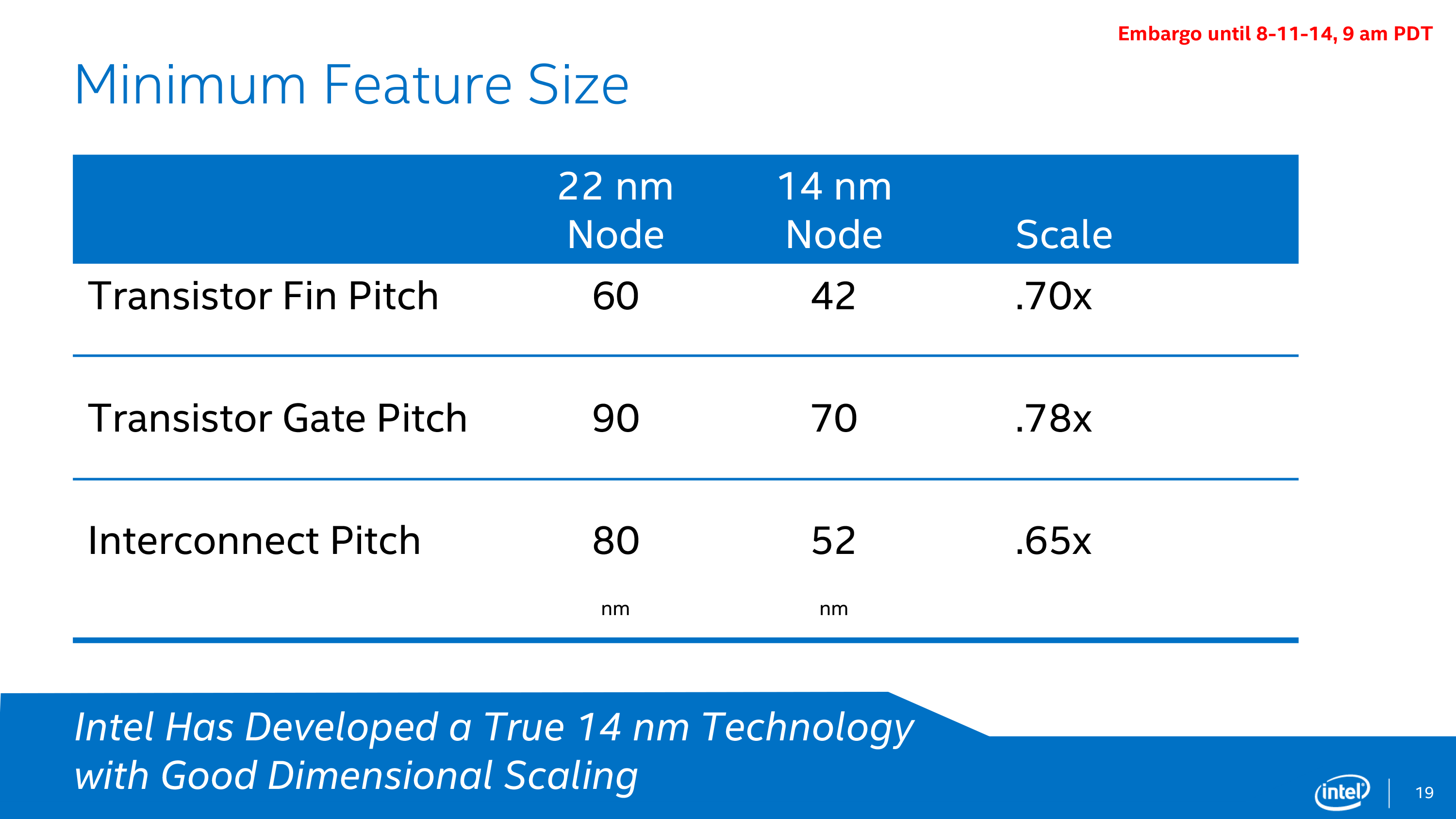
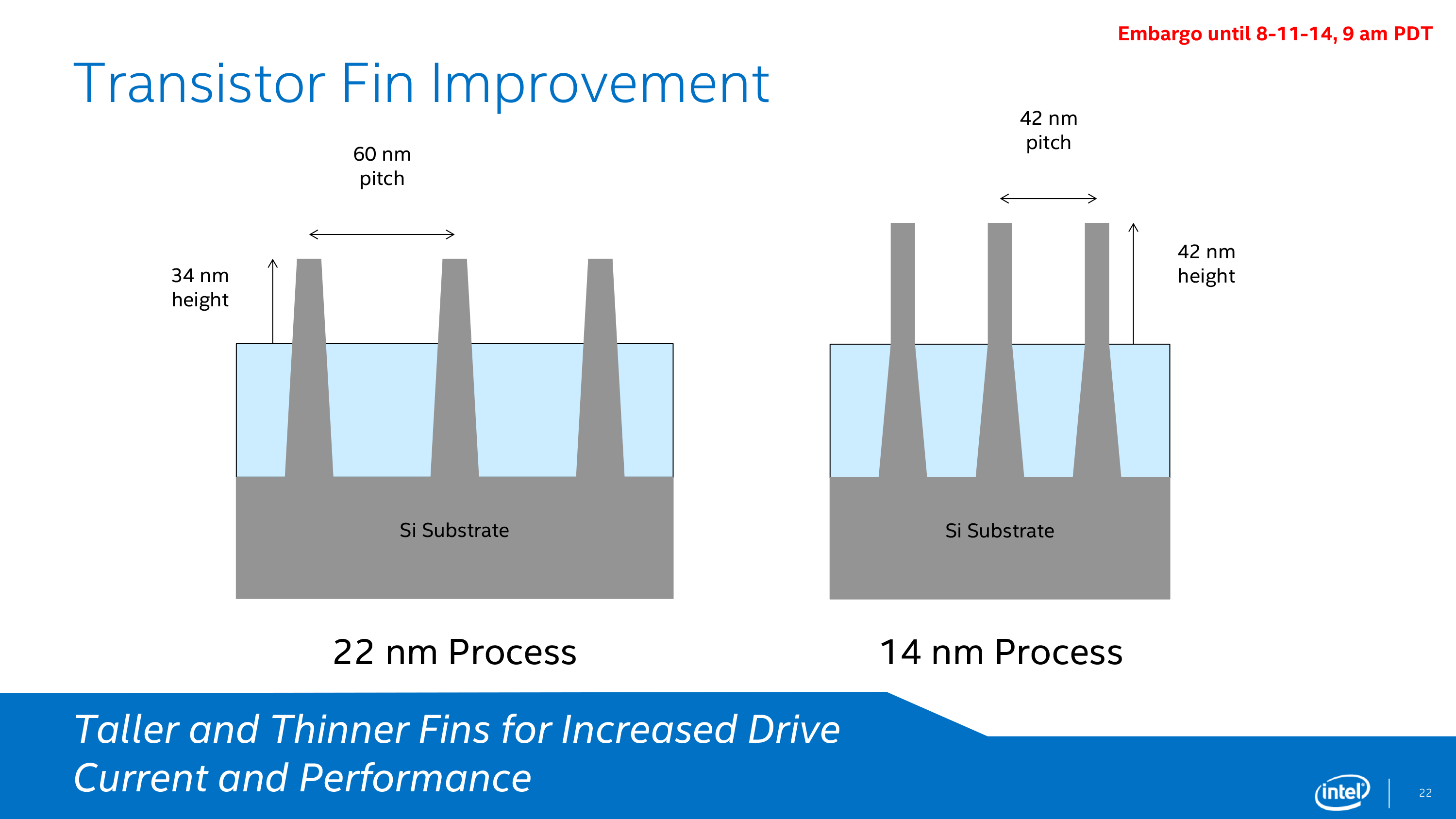
Pretty much since you have multiple measurements for "feature size" like fin, gate, interconnect pitch etc. companies are just naming their process roadmap to show "progress". I don't think even Intel's 14nm process actually has a 14nm "feature size" and if it does I don't know what measurement they are basing it on.
http://images.anandtech.com/doci/8367/14nmFeatureSize.png http://images.anandtech.com/doci/8367/14nmFinfet2.png
All of them use various sub-wavelength techniques like using multiple stencils and masks to create aperture / fresnel lense like effects etc.
Pretty much since you have multiple measurements for "feature size" like fin, gate, interconnect pitch etc. companies are just naming their process roadmap to show "progress". I don't think even Intel's 14nm process actually has a 14nm "feature size" and if it does I don't know what measurement they are basing it on.
http://images.anandtech.com/doci/8367/14nmFeatureSize.png http://images.anandtech.com/doci/8367/14nmFinfet2.png
They are literally tied up at the top.
Phytium is a subsidiary of China Electronics Corporation which is a state owned enterprise.
Phytium is a subsidiary of China Electronics Corporation which is a state owned enterprise.