Alcohol is a direct cause of seven forms of cancer, finds study(theguardian.com)
theguardian.com
Alcohol is a direct cause of seven forms of cancer, finds study
https://www.theguardian.com/society/2016/jul/22/alcohol-direct-cause-seven-forms-of-cancer-study
12 comments
The title of this article is also helpful: «Study ‘proves alcohol causes cancer’. The problem? There wasn’t a study.»
it was a study. the abstract explains its methods, results, and conclusions. it has 44 references.
folks, just go read it for yourself, the DOI is: 10.1111/add.13477
folks, just go read it for yourself, the DOI is: 10.1111/add.13477
This is how I see things going with alcohol. Some of the following assumptions are based on what my parents have told me about their generation (in Canada).
- everybody used to smoke, now it seems crazy to most people
- people also didn't wear seat belts, drove after drinking more frequently (according to my parents anyway) and probably had about 3-4 different vegetables in their diet
- now, in many circles, smoking (regularly) is looked at like a meth addiction
- although we still battle with processed/junk food I'd say the options to eat healthier are here and many people would gasp if they found out you ate only meat and potatoes
Yet, alcohol, in North America, is still widely looked at as "OK (just don't drive)". I think we'll see more studies and campaigns about the health risks of alcohol over the next decade. In 20 years, in certain places, drinking might be looked at like smoking is now.
It's going to be so boring.
- everybody used to smoke, now it seems crazy to most people
- people also didn't wear seat belts, drove after drinking more frequently (according to my parents anyway) and probably had about 3-4 different vegetables in their diet
- now, in many circles, smoking (regularly) is looked at like a meth addiction
- although we still battle with processed/junk food I'd say the options to eat healthier are here and many people would gasp if they found out you ate only meat and potatoes
Yet, alcohol, in North America, is still widely looked at as "OK (just don't drive)". I think we'll see more studies and campaigns about the health risks of alcohol over the next decade. In 20 years, in certain places, drinking might be looked at like smoking is now.
It's going to be so boring.
Alcohol was necessary for civilization, before we figured out other ways to decontaminate water. Smoking tobacco, as far as I know, did not materially advance the human condition.
True. Although nicotine is a stimulant and I'm sure it helped folks get through some of the wars, long working hours and journeys.
OTOH, there are ton of people in Mediterranean countries who drink their 2/3 glasses of wine a day and live to a ripe old age.
Oh I know. I'm a drinker myself. I'm just predicting that our society, becoming more and more health conscious, will start to look down on alcohol. Articles like this are the start.
They also consume a lot of olive oil, tomatoes, seafood and coffee. They are super chill and spend a lot of time with friends outside.
Also, people in the Mediterranean pretty much only drink wine. They are quite moderate drinkers too, never really getting wasted either.
Anyhow, that is what I saw when I was there.
Also, people in the Mediterranean pretty much only drink wine. They are quite moderate drinkers too, never really getting wasted either.
Anyhow, that is what I saw when I was there.
Everything we eat both causes and prevents cancer [1]. The two real questions are: What are the odds? And, where is the good balance? The linked paper says "Current estimates suggest that alcohol-attributable cancers at these sites make up 5.8% of all cancer deaths world-wide." [2] The earlier linked recommendation is basically "keep your average <= 1 drink a day" [3] But, I didn't read the details.
[1] http://www.sciencealert.com/images/art-apr-15/Medical_studie...
[2] http://onlinelibrary.wiley.com/doi/10.1111/add.13477/abstrac...
[3] https://www.theguardian.com/society/2016/jan/08/tough-drinki...
[1] http://www.sciencealert.com/images/art-apr-15/Medical_studie...
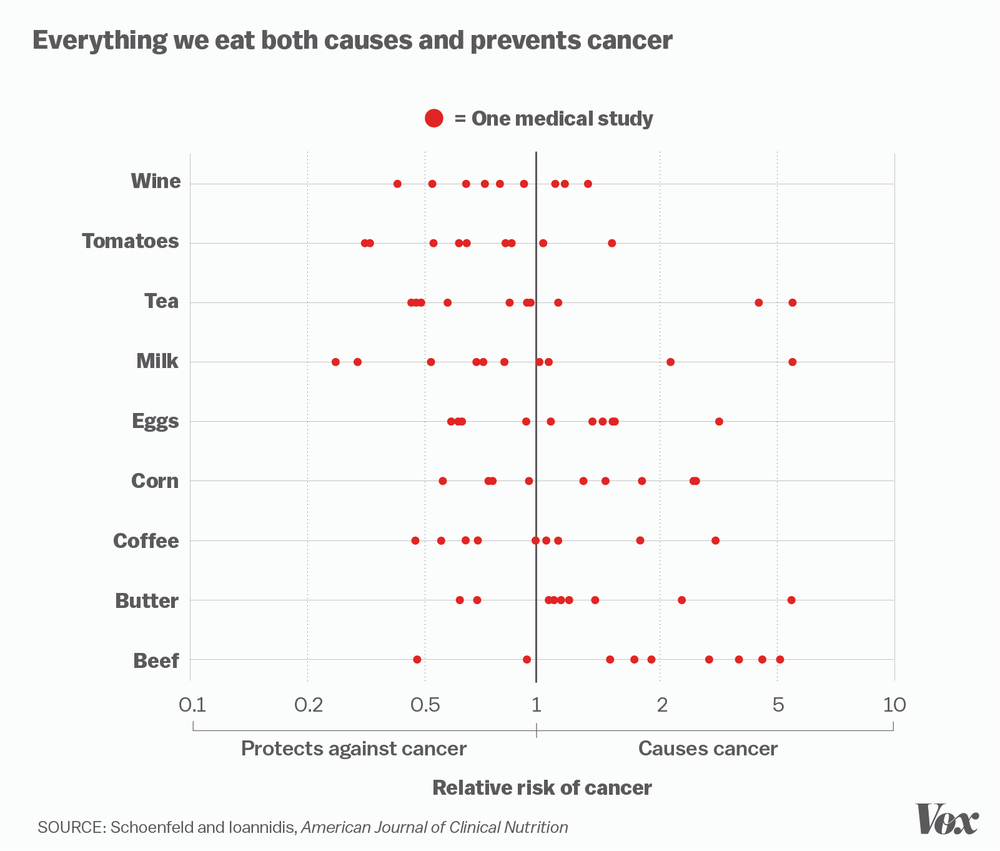
[2] http://onlinelibrary.wiley.com/doi/10.1111/add.13477/abstrac...
[3] https://www.theguardian.com/society/2016/jan/08/tough-drinki...
There are a lot of people (alcoholics, partygoers, etc) and entities (alcohol producers) with a vested interest in ignoring or burying this kind of research. Alcohol is far too entrenched in our society for anyone to successfully campaign against it.
All the news reports I've seen connecting alcohol with cancer come from the UK. Maybe because they have a National Health Service that's trying to minimize national healthcare costs? Or maybe because their researchers are less beholden to industry?
Or maybe that's a false connection.
Or maybe that's a false connection.
Blue zone: «a demographic and/or geographic area of the world where people live measurably longer lives.»
«Characteristics: The people inhabiting Blue Zones share common lifestyle characteristics that contribute to their longevity. ... Buettner in his book provide a list of nine lessons, covering the lifestyle of blue zones people: ... 6. Moderate alcohol intake ...»
https://en.wikipedia.org/wiki/Blue_Zone
«Characteristics: The people inhabiting Blue Zones share common lifestyle characteristics that contribute to their longevity. ... Buettner in his book provide a list of nine lessons, covering the lifestyle of blue zones people: ... 6. Moderate alcohol intake ...»
https://en.wikipedia.org/wiki/Blue_Zone
The English NHS has a useful "Behind the headlines" site, and they've written about this.
http://www.nhs.uk/news/2016/07July/Pages/alcohol-a-direct-ca...
http://www.nhs.uk/news/2016/07July/Pages/alcohol-a-direct-ca...
>An additional limitation to keep in mind is that this data mainly appeared to be from observational studies. These cannot prove cause and effect. The individual studies will likely have varied considerably in the additional health and lifestyle factors they took account of when looking at the links with alcohol. For example, smoking, diet and physical activity are all factors likely to be associated both with level of alcohol consumption and cancer risk.
In other words correlation does not equal causation. If someone who exercises several days per week, has a healthy diet, and drinks a glass or two of wine each night, would that really have the same potential to cause cancer as someone who drinks 2 beers every day, eats fast food, and smokes cigarettes? I'd like to see long term studies done with individuals who have a "healthy" lifestyle vs "unhealthy" with alcohol involved if at all possible.
In other words correlation does not equal causation. If someone who exercises several days per week, has a healthy diet, and drinks a glass or two of wine each night, would that really have the same potential to cause cancer as someone who drinks 2 beers every day, eats fast food, and smokes cigarettes? I'd like to see long term studies done with individuals who have a "healthy" lifestyle vs "unhealthy" with alcohol involved if at all possible.
> The study, published in the scientific journal Addiction, concludes that there is more than simply a link or statistical association between alcohol and cancer that could be explained by something else.
This isn't published to any of the major health journals, rather it's been published in the journal Addiction which probably doesn't have the most balanced view on the role of alcohol in society.
This isn't published to any of the major health journals, rather it's been published in the journal Addiction which probably doesn't have the most balanced view on the role of alcohol in society.
"which probably doesn't have the most balanced view on the role of alcohol in society"
source?
source?
'Addiction' kind of wraps it up.
"Even without complete knowledge of biological mechanisms [of how alcohol causes cancer], the epidemiological evidence can support the judgment" - I think they basically are saying that there is enough correlation to imply causation.
But we all know no such claim can be made until there is "complete knowledge of biological mechanisms".
But we all know no such claim can be made until there is "complete knowledge of biological mechanisms".
Well, you can't claim to KNOW.
But you can claim to be very suspicious.
I think this is BS. Alcohol was consumed in enormous quantities since BC but cancer epidemics is recent thing. I dont doubt it might contribute to some forms of cancer but claim og direct cause is something else.
Over a long enough timespan, the probability that you will experience some form of cancer essentially goes to 1.
We tend to die young, of violence, malnutrition, and disease, a whole lot less often than we ever used to. Aside from the really obvious tumors, even detecting most cancers is a relatively new technique. So my hypothesis is that, historically, people died off before they broke down and developed cancers, or, if they lived long enough, either died with their cancers or because their immune systems were weakened enough that something else got them first.
We tend to die young, of violence, malnutrition, and disease, a whole lot less often than we ever used to. Aside from the really obvious tumors, even detecting most cancers is a relatively new technique. So my hypothesis is that, historically, people died off before they broke down and developed cancers, or, if they lived long enough, either died with their cancers or because their immune systems were weakened enough that something else got them first.
How do you know that? Do you have some data on alcohol consumption since BC, and how broadly it was consumed by the world population (i.e. was it only the tiny fraction of wealthy people)? Do you have some data that shows "cancer epidemics is recent thing"?
Even if you have this data, have you eliminated all the other variables? E.g. longer lifespans may account for higher cancer rates.
Even if you have this data, have you eliminated all the other variables? E.g. longer lifespans may account for higher cancer rates.
Dionysios is the greek god for among other things, wine. He's been divinised for bringing wine to greece. It was invented in the northern caucasus 6 thousand years ago. If you ever read any classical literature or antique philosophy, you'll have a reference for how wine was consumed in the antiquity. And if you want to see how much the antiques lived, see Diogenes Laerteos.
Most literature until modern times was written by, about and for the wealthy. Diogenes Laertius was no where near a common person. Nor was any philosopher for that matter. I'm kind of shocked that you consider antique philosophy a window into how the vast majority of people lived in the past.
Again, show me the data.
Again, show me the data.
Go find the data. I'm not going to make archaeological research to convince you.
Cancer is not a recent thing. Why would you think that? Certain types of cancers are more prevalent now, but that's because you don't typically get them until long after those BC people were dead.
Maybe that's because people are living longer than ever. In the past, maybe something else would take you out, like getting the flu when you're 70
there are also other things that can take you out - like depression for instance; however alcohol is considered to be a depressant - so it doesn't quite help here (I guess the main point here is temperance - but that's a non scientific personal opinion; its a Friday, isn't it?)
Like what the Poet said: "Whatever Gets You Thru the Night, its all right ... "
Like what the Poet said: "Whatever Gets You Thru the Night, its all right ... "
that Poet was John Lennon
We've got better at preventing heart attacks, and so now people are living long enough to get cancer.
After skipping through the presentation for this paper [1], I get the feeling the claims of the article are a tad outlandish:
"The study, [...], concludes that there is more than simply a link or statistical association between alcohol and cancer that could be explained by something else."
But all the presentation uses to back up its claim is statistics and the sample size is small. I assume the presentation doesn't omit any way to draw conclusions that the paper contains. The latter is behind a paywall so I haven't read it.
People in this forum [2] seem to have similar concerns.
[1] http://alcoholaction.co.nz/wp-content/uploads/Cancer-deaths-... [2] https://www.bu.edu/alcohol-forum/critique-188-alcohol-attrib...
"The study, [...], concludes that there is more than simply a link or statistical association between alcohol and cancer that could be explained by something else."
But all the presentation uses to back up its claim is statistics and the sample size is small. I assume the presentation doesn't omit any way to draw conclusions that the paper contains. The latter is behind a paywall so I haven't read it.
People in this forum [2] seem to have similar concerns.
[1] http://alcoholaction.co.nz/wp-content/uploads/Cancer-deaths-... [2] https://www.bu.edu/alcohol-forum/critique-188-alcohol-attrib...
I'm surprised that this is a thing?
I've just taken it for granted alcohol and breathing in small particles causes all types of cancer?
Doesn't everyone know this?
I get people don't realise campfires are the same as cigarettes.
But alcohol, I'd have thought a given. People don't know it gives you cancer?
That said, it's a propaganda piece, so what if it does? Working a job gives you cancer.
The death rate is what concerns me and compared to other issues in society, like drink driving.
I've just taken it for granted alcohol and breathing in small particles causes all types of cancer?
Doesn't everyone know this?
I get people don't realise campfires are the same as cigarettes.
But alcohol, I'd have thought a given. People don't know it gives you cancer?
That said, it's a propaganda piece, so what if it does? Working a job gives you cancer.
The death rate is what concerns me and compared to other issues in society, like drink driving.
I've just taken it for granted alcohol and breathing in small particles causes all types of cancer?
It doesn't. Alcohol and small particles do not 'cause all types of cancer'.
Doesn't everyone know this?
Obviously not, since we hadn't done the required research and analysis before. Now that we have, we have more confidence and detail on what is actually happening.
But alcohol, I'd have thought a given. People don't know it gives you cancer?
They do, generally, and the numbers are quoted in the study. There is now more detail on what people's knowledge is.
That said, it's a propaganda piece,
Why is this a propaganda piece? It's an article about some peer-reviewed research.
so what if it does? Working a job gives you cancer.
And it's useful for people to be able to evaluate the risks they expose themselves to.
The death rate is what concerns me and compared to other issues in society.
That's fine, and without research you won't have any idea what the death rate is.
It doesn't. Alcohol and small particles do not 'cause all types of cancer'.
Doesn't everyone know this?
Obviously not, since we hadn't done the required research and analysis before. Now that we have, we have more confidence and detail on what is actually happening.
But alcohol, I'd have thought a given. People don't know it gives you cancer?
They do, generally, and the numbers are quoted in the study. There is now more detail on what people's knowledge is.
That said, it's a propaganda piece,
Why is this a propaganda piece? It's an article about some peer-reviewed research.
so what if it does? Working a job gives you cancer.
And it's useful for people to be able to evaluate the risks they expose themselves to.
The death rate is what concerns me and compared to other issues in society.
That's fine, and without research you won't have any idea what the death rate is.
Honestly I had never heard of a link between alcohol and cancer before.
Wow, this doesn't surprise me either, but that's not to say there shouldn't be more awareness!
For example, one article from 2011 mentions a link between alcohol and stomach cancer:
"If heavy drinking is a cause of stomach cancer, it may be related to one of the metabolic byproducts of alcohol -- called acetaldehyde. The substance is a known human carcinogen, Duell's team notes."
Note that this is related to heavy drinking. One glass of wine per week can be beneficial to your health, for example.
Liver cancer is also commonly known to be associated with alcoholics.
For example, one article from 2011 mentions a link between alcohol and stomach cancer:
"If heavy drinking is a cause of stomach cancer, it may be related to one of the metabolic byproducts of alcohol -- called acetaldehyde. The substance is a known human carcinogen, Duell's team notes."
Note that this is related to heavy drinking. One glass of wine per week can be beneficial to your health, for example.
Liver cancer is also commonly known to be associated with alcoholics.
The problem is that a lot of studies are bogus (p-hacking, deliberately hysterical to gain media attention , etc) so it's becoming difficult to winnow through it all and find the stuff that's meaningful.
This is actually the fairly troubling reality of medical research in general. People who have financial interests in achieving particular conclusions have managed to weaponize these kinds of studies. There's a very real risk of important research getting lost in the tremendous amount of noise that's being generated.
This is actually the fairly troubling reality of medical research in general. People who have financial interests in achieving particular conclusions have managed to weaponize these kinds of studies. There's a very real risk of important research getting lost in the tremendous amount of noise that's being generated.
Too true. I'm going to err on the side of caution with ethanol. My reasoning is as follows:
Ethanol is a solvent, our brains are mostly fat - this should be a cause for concern. Cell walls are a phospholipid bilayer, which probably, at least partly, explains why ethanol is an irritant to our tissues. Anything that causes irritation over a long enough time can lead to an increase in cell turnover and inflammation. Anything that leads to an increased cell turnover and inflammation has the potential increase the risks of cancer.
Additionally, for all the supposed health benefits of drinking [whatever the fashionable number is this week] glasses of wine, all the experiments I've done by pouring wine on to plants and insects has led to a failure to thrive or death, whereas putting green leafy vegetables on a plant or insect typically leads to the organism thriving, or at worst disinterest.
Also, ethanol can be used as a toxic agent for the purposes of sterilisation. That doesn't sound like the sort of thing I would want to drink.
Additionally, even the organisms that produce alcohol for human consumption, the Saccharomyces yeast organisms, consider ethanol a waste product.
I'm not going to wait for conclusive evidence to prove that alcohol does or doesn't cause an increased risk of some types of cancer.
Ethanol is a solvent, our brains are mostly fat - this should be a cause for concern. Cell walls are a phospholipid bilayer, which probably, at least partly, explains why ethanol is an irritant to our tissues. Anything that causes irritation over a long enough time can lead to an increase in cell turnover and inflammation. Anything that leads to an increased cell turnover and inflammation has the potential increase the risks of cancer.
Additionally, for all the supposed health benefits of drinking [whatever the fashionable number is this week] glasses of wine, all the experiments I've done by pouring wine on to plants and insects has led to a failure to thrive or death, whereas putting green leafy vegetables on a plant or insect typically leads to the organism thriving, or at worst disinterest.
Also, ethanol can be used as a toxic agent for the purposes of sterilisation. That doesn't sound like the sort of thing I would want to drink.
Additionally, even the organisms that produce alcohol for human consumption, the Saccharomyces yeast organisms, consider ethanol a waste product.
I'm not going to wait for conclusive evidence to prove that alcohol does or doesn't cause an increased risk of some types of cancer.
I'm not surprised, but it still amazes me. I have often comment that I didn't understand why, here in Australia, we have cancer warnings on cigarette packages but no similar requirement for alcohol.
The cancer.org[1] website has listed ethanol (drinking alcohol) as a Group A carcinogen for at least the past 8 years, if I recall correctly. You'll find it listed as 'Ethanol in alcoholic beverages' in [1].
The 'Alcohol and breast cancer'[2] entry on Wikipedia cites research that claims A study of 17,647 nurses found that high drinking levels more than doubled risk of breast cancer with 2% increase risk for each additional drink per week consumed. Binge drinking of 4–5 drinks increases the risk by 55%.
Another issue with ethanol consumption is that it's breakdown in the liver is rate limited by the enzyme alcohol dehydrogenase, which causes partial oxidation of ethanol to form acetaldehyde.[3] This rate limited pathway is probably why drinking fewer drinks (less than 1 per day and drinking it slowly) is less harmful.
1. http://www.cancer.org/cancer/cancercauses/othercarcinogens/g...
2. https://en.wikipedia.org/wiki/Alcohol_and_breast_cancer
3. https://en.wikipedia.org/wiki/Acetaldehyde
The cancer.org[1] website has listed ethanol (drinking alcohol) as a Group A carcinogen for at least the past 8 years, if I recall correctly. You'll find it listed as 'Ethanol in alcoholic beverages' in [1].
The 'Alcohol and breast cancer'[2] entry on Wikipedia cites research that claims A study of 17,647 nurses found that high drinking levels more than doubled risk of breast cancer with 2% increase risk for each additional drink per week consumed. Binge drinking of 4–5 drinks increases the risk by 55%.
Another issue with ethanol consumption is that it's breakdown in the liver is rate limited by the enzyme alcohol dehydrogenase, which causes partial oxidation of ethanol to form acetaldehyde.[3] This rate limited pathway is probably why drinking fewer drinks (less than 1 per day and drinking it slowly) is less harmful.
1. http://www.cancer.org/cancer/cancercauses/othercarcinogens/g...
2. https://en.wikipedia.org/wiki/Alcohol_and_breast_cancer
3. https://en.wikipedia.org/wiki/Acetaldehyde
"It’s a comment piece. It doesn’t contain any new research, nor does it contain statistical analysis of previous research. It’s not a meta-analysis or a systematic review. It is a short essay in the ‘For Debate’ section of the journal in which one woman gives her opinion about whether correlation equals causation when it comes to the epidemiological evidence on alcohol and cancer."