The Cobra Effect(en.wikipedia.org)
en.wikipedia.org
The Cobra Effect
https://en.wikipedia.org/wiki/Cobra_effect
11 comments
Would rent control fall under this? Rent control creates artificial pressures for people not to leave housing, which restricts housing from being opened up to people moving in to a region, which causes rents of non-occupied units to rise.
It seems to me that the idea of the bounty wasn't bad, the problem is just that it was too high. If they just decreased the bounty to the point that raising cobras was no longer profitable rather than all the way to zero, people would still turn in the cobras they had rather than releasing them. And they might still catch an occasional cobra for a small bounty, if the opportunity presented.
Alternately, once they realized it wasn't working, announce that the bounty would end in a month, so that the breeders would hustle to kill all their cobras and bring them in.
(Or, to shift a little blame away from the British, maybe if the breeders hadn't been stupid/dickish enough to release a fuckload of live cobras in their neighbors' back yards.)
(Or, to shift a little blame away from the British, maybe if the breeders hadn't been stupid/dickish enough to release a fuckload of live cobras in their neighbors' back yards.)
This immediately made me think of bug bounties and the vulnerability black market.
How long until the money gets good enough for people to start introducing obfuscated vulnerabilities into code in order to further profit from it at a later time? With increasing financial incentive and an open market it might be an increasing risk with opportunistic or disgruntled developers.
How long until the money gets good enough for people to start introducing obfuscated vulnerabilities into code in order to further profit from it at a later time? With increasing financial incentive and an open market it might be an increasing risk with opportunistic or disgruntled developers.
One mitigating factor is that it is easier to git blame a codebase than a cobra.
It's interesting that this appeared on the front page at the same time as the announcement that Amazon would stop selling competing streaming video devices.
Yep, you get more of what you pay for. Apply to, for example, single motherhood:
http://cdn.theatlantic.com/assets/media/img/posts/Screen%20S...
Gang aft agley, indeed.
http://cdn.theatlantic.com/assets/media/img/posts/Screen%20S...
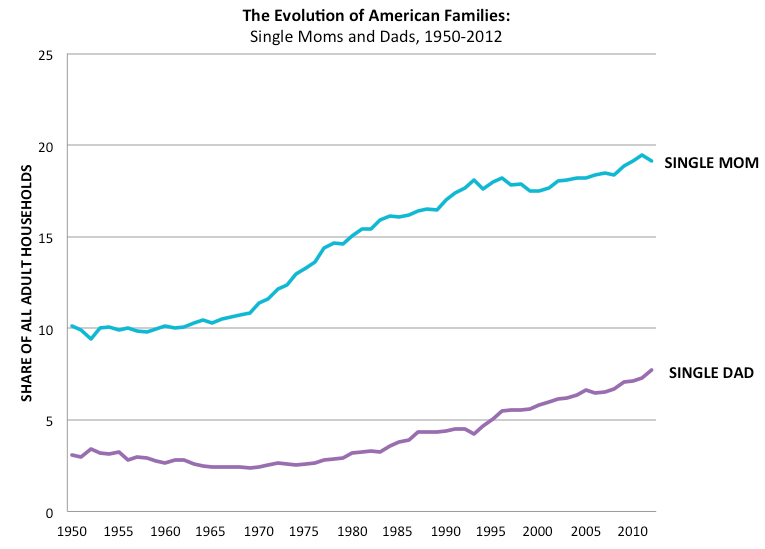
Gang aft agley, indeed.
The typical response to this sort of chart is something like: the welfare state is destroying the family unit!
But I look at this graph and I think: wow, there must have been a ton of people stuck in unhappy marriages before, who could now have better choices.
But I look at this graph and I think: wow, there must have been a ton of people stuck in unhappy marriages before, who could now have better choices.
> But I look at this graph and I think: wow, there must have been a ton of people stuck in unhappy marriages before, who could now have better choices.
But at what cost to society, those around them and perhaps even themselves? There are worse things than being in an unhappy marriage!
But at what cost to society, those around them and perhaps even themselves? There are worse things than being in an unhappy marriage!
I have no idea what the cost to society is. I don't even know if there is a cost. Allowing people to leave bad marriages sounds like a gain to society for me. Do you know the costs?
Unhappy marriage is a poor euphemism for neglect, abuse, beating.
That's true of many unhappy marriage, but not all (unless one stretches 'neglect' and 'abuse' beyond all meaning: if a husband puts on 200 pounds, he couldn't blame his wife for not being attracted to him).
There's a huge difference between abusive and unhappy.
There's a huge difference between abusive and unhappy.
I don't get the graph's message. (I'm not smart)
While the linker wants to make the above point about welfare, the chart appears in the below article describing one facet of income inequality.
http://www.theatlantic.com/business/archive/2013/10/how-amer...
http://www.theatlantic.com/business/archive/2013/10/how-amer...
[deleted]
My best guess is "something something good Christian marriage something something godless liberals something."
It's important to think about this when crafting sales incentive plans... You will often be tempted to motivate a particular behavior but then you realize that behavior is so successful that it's actually caused a new, and potentially worse problem.
Generally these are all good problems to have though. :-)
Generally these are all good problems to have though. :-)
If they set a date where the bounty would end, this wouldn't have happened. The cobra breeders would know their cobras would become worthless in a month, and so collect the bounty while they could.
The rat thing could have prevented by collecting the whole rat instead of just the tail.
The rat thing could have prevented by collecting the whole rat instead of just the tail.
Also known as 'be careful what you measure'.
You want rat tails? Then rat tails you get.
You want rat tails? Then rat tails you get.
See also: nearly every agency of the US government.
More like "See also: any sufficiently large organization".
I know right? Can you imagine how bad it would be if the department of defense wanted some sort of packet switched communication system that would survive a nuclear war? Geez, we really got lucky there.
No... not exactly. It's interesting that you pick that one, because Alan Kay talks at length about this subject (poke around YouTube and you can find clips if you're interested). Most of that tech came about because there was a lot of paranoia, a lot of money, and not a lot of good ideas. So they took the money and threw it at universities and research labs, without very many strings attached. Once it started to look like we were winning, all the funding dried up.
I know, right? Can you imagine how bad it would be if the department of defense blew a big wad of cash for a limited period of time on some sort of packet switched communication system that would survive a nuclear war? Geez, we really got lucky there.
NRA requesting to equip more people with weapons to prevent shootings.
This has been going on for decades, but they still do it because there are no votes for letting house prices fall, and plenty of votes in offering help to first time buyers. The fact that the general taxpayer is footing the bill is just a detail.