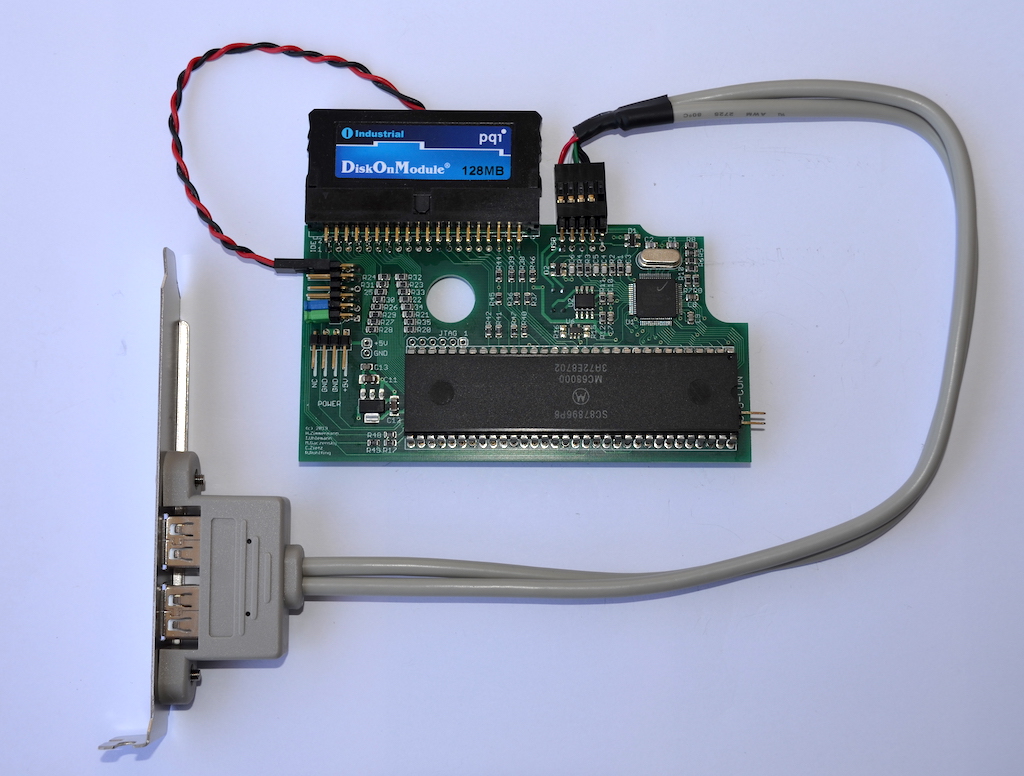
Dhrystone Benchmark. History, Analysis, "Scores" and Recommendations (2002)[pdf]
eembc.org1 pointsby nynyny70 comments
06: 00 B5 push {lr}
… as the start of this weird code(?) sequence. It pushes the link register (i.e., the return address to the caller). 08: 42 40 eors r2, r0
0a: 00 2A cmp r2, #0
This XORs R2 and R0 and compares the result against zero. But that’s just a decoy, as we’ll see. 0c: 00 F0 02 F8 bl #0x14
This calls into… 14: 70 46 mov r0, lr
16: 00 47 bx r0
… which moves the return address to R0, and then returns. Using the addresses in this disassembly (not in the actual boot ROM), the return address is 0x10; but LR and, therefore, R0 will actually contain 0x11 because the LSB signifies Thumb mode. 10: F6 D2 bhs #0
… to… 00: 11 38 subs r0, #0x11
R0 contained 0x11 relative to the start of this code sequence. (The absolute address in boot ROM is of course different.) Now, R0 points to the start of the code sequence. 02: C0 7A ldrb r0, [r0, #0xb]
This loads the byte at offset 0xB in this code sequence. Look above, it is 0x2A. 04: 00 BD pop {pc}
This returns to the caller, using the LR pushed at the beginning. The return value in R0 is 0x2A. 06: 00 B5 push {lr}
However, even then, the code appears unnecessarily convoluted. Easter egg? Back door ;-)?