Rather than filter in brands, I'd rather filter out brands (aka exclude). Maybe just an include/exclude toggle there? A select all UI element, then deselect might also be adequate.
I've actually been employing Emoji Separated Values (ESV), often , here and there when doing some of this kind of work. Granted, it's not standard, but it's been really useful when I've needed it.
*edit Apparently emojis don't fly here, but it was an index finger pointing right.
The killer app for Firefox is it still allows some flexibility in tab management. Sidebery and TreeStyleTab have been my anchors in the FF ecosystem. The experience is so vastly superior for tab hoarders and tab-todo methodology that I really can't imagine using something else. I also use FF on android because it has ublock origin and dark reader addons. This make browsing the web on mobile far better. I actually hold little allegiance to FF as whole, I just haven't found any Chromium based browser that works as well for me.
I think this should be part of required reading for EE101 type classes in college. The hardcover for $25 shipped on amazon, it's really something everyone in electronics should own.
You still have to be able to hook up few wires and you'll need to be able to power your LEDs and understand your power needs there, but the live compilation in web based development platform (that's served by the device, no cloud) makes it really ideal for rapid prototyping and getting up and running quickly. No fussing with Arduino IDE or compile times. It's one of those things that "just works".
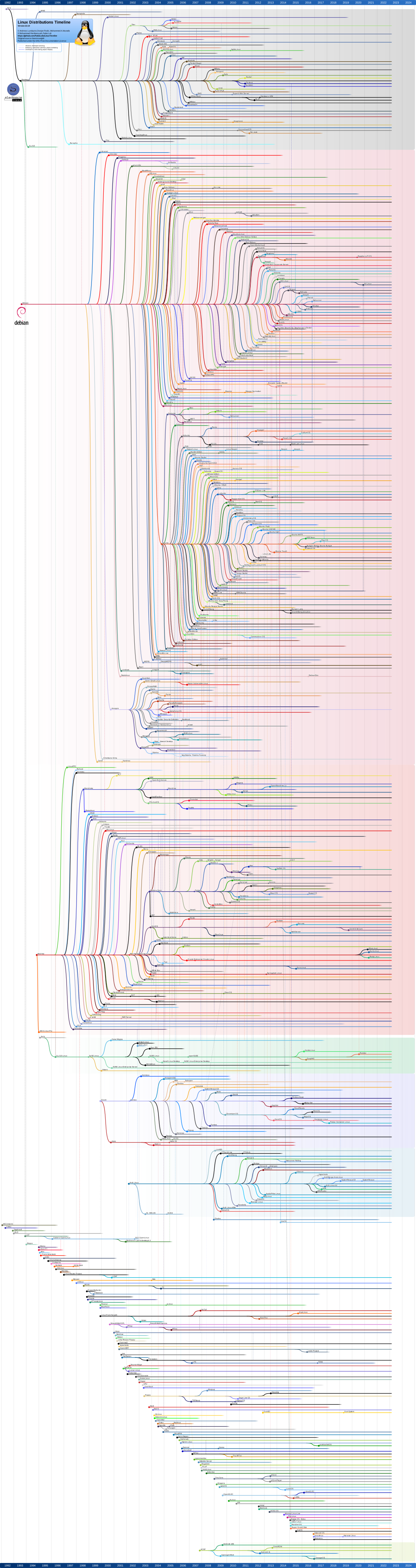
Anyone ever run across anything like this with a simple syntax that can do a timeline with split AND merges? I've always wanted something like the linux timeline [1] as an interactive timeline that can both split and merge.
In many, but not all programs on windows you can paste plain text by using ctrl+shift+v. Outlook desktop is one of the few places where this hotkey does not work.
Before I knew there was a native hotkey combo, I created a autohotkey script that would do that and had a mini-tutorial that showed how.
While I appreciate the sentiment of the topic of fuzziness and AI, this also breaks search for people who are looking for precision. For people who are used to a McMaster-Carr or Digi-Key style search where precision matters in results, the fuzziness introduces ambiguity and hampers repeatability. These are both very important when designing products. Amazon, Home Depot, and Lowes are a bear when trying to find something with very specific specifications, it's quite literally rage inducing to add a more specific keyword to q query and get more (wrong) results in the output.
Findchips advertising and the SaaS tools for sourcing/lifcycle/data aggregation of components is their moneymaker. Hackaday is basically subsidized through The rest of Supply Frame, along with offering marketing partnerships and other tangential marketing type services. There's a lot of things Supply Frame does and Hackaday/Tindy are not major targets of this acquisition.
The biggest play here is competition to Altium's Octopart purchase, especially with all of today's electronic component supply chain woes. The Siemens (Mentor Graphics/PADS/Expedition) + Findchips/SupplyFX data is likely one of the end goals where the value will be derived.