Squeezed: Why Our Families Can’t Afford America(nytimes.com)
nytimes.com
Squeezed: Why Our Families Can’t Afford America
https://nytimes.com/2018/06/27/books/review-squeezed-alissa-quart.html
450 comments
I am Brazillian
Still, sadly that stuff also applies here...
Me and my friends around my age, that were born in solid middle-class families (of the sort that could own only one car, a cheap house or apartment and so on), were taught that the path of life was: go to college, get a job or public sector job (here in Brazil those are popular), marry, have a boring life.
Instead we went to college paid with crazy loans, found no jobs, jumped around from gig to gig trying to repay the loans, people don't want seriosu relationships, only flings, and now I am 30, living back in my parents house, still with no job.
A 30 year old college friend of mine that is excellent designer and know some coding, is living on his parents home with his kid (no wife), to pay the kid bills he found a illegal-ish gig as construction worker, and after he lost that job, he can't find a new one.
My grandparents used to tell me what was their "poor life", where they had to walk to school, work their asses off early, date in front of dad of the bride, eat eggs because other food was expensive...
Now we have a "rich" life, with cars (that belong to parents, I never could afford my own, neither my friends), computer, internet... but can't afford our own house, we can't "work our ass off" because there is no work, eating enough protein in some months have been hard, as food prices inflated way beyond the wage growth and what is affordable now is basically cereals and starchy foods (like potatoes), and your food choice become: eat enough nutrients and baloon in size wildly as all food availble has too much calories comapred to other nutrients, or control your calories, have nutrient deficit...
To me is no surprise people live in slums or invaded areas, one time I rented a apartment with cracked walls, non-working fire alarm, elevator that often had issues (like operating with doors open and stopping 20 centimeters off-level), no garage, and the rent was 4 times the mininum wage, I could only afford living there when my income due to some coding contracts landed me in the top 3% highest earners of the country... made me wonder, where everyone else was living. (or one time I shared a normal 3 bedroom house, with literally 35 persons, most of them already had bachelor degrees, several in STEM, and were there to train in a nearby police academy, hoping such dangerous work was better than having no work at all in their own field)
Still, sadly that stuff also applies here...
Me and my friends around my age, that were born in solid middle-class families (of the sort that could own only one car, a cheap house or apartment and so on), were taught that the path of life was: go to college, get a job or public sector job (here in Brazil those are popular), marry, have a boring life.
Instead we went to college paid with crazy loans, found no jobs, jumped around from gig to gig trying to repay the loans, people don't want seriosu relationships, only flings, and now I am 30, living back in my parents house, still with no job.
A 30 year old college friend of mine that is excellent designer and know some coding, is living on his parents home with his kid (no wife), to pay the kid bills he found a illegal-ish gig as construction worker, and after he lost that job, he can't find a new one.
My grandparents used to tell me what was their "poor life", where they had to walk to school, work their asses off early, date in front of dad of the bride, eat eggs because other food was expensive...
Now we have a "rich" life, with cars (that belong to parents, I never could afford my own, neither my friends), computer, internet... but can't afford our own house, we can't "work our ass off" because there is no work, eating enough protein in some months have been hard, as food prices inflated way beyond the wage growth and what is affordable now is basically cereals and starchy foods (like potatoes), and your food choice become: eat enough nutrients and baloon in size wildly as all food availble has too much calories comapred to other nutrients, or control your calories, have nutrient deficit...
To me is no surprise people live in slums or invaded areas, one time I rented a apartment with cracked walls, non-working fire alarm, elevator that often had issues (like operating with doors open and stopping 20 centimeters off-level), no garage, and the rent was 4 times the mininum wage, I could only afford living there when my income due to some coding contracts landed me in the top 3% highest earners of the country... made me wonder, where everyone else was living. (or one time I shared a normal 3 bedroom house, with literally 35 persons, most of them already had bachelor degrees, several in STEM, and were there to train in a nearby police academy, hoping such dangerous work was better than having no work at all in their own field)
Is it just me or do these articles about economic hardship always seem to use the most unsurprising examples for their prototypical struggling subject. The example they use here is freelance writer. Hasn't that job title always had poor prospects? I remember a similar article posted here about people struggling to find work after the 2008 crash and their example was a person who had been laid off but instead of trying to find a new job they purposely blew through their savings for a couple years and were then surprised when they went to look for work and something didn't immediately materialize.
There are all sorts of aspects to this. In terms of the bigger, longer term trends, I think the dynamic described by Thomas Picketty is the most important aspect. Long term trends towards increased wealth disparity.
On the other hand, at the micro level people actually experience, I think the cultural dynamic is more important. It determines how people feel about the economy.
The people she talks to believed their educations and backgrounds (most of them grew up in middle-class homes) would guarantee some financial stability
Upward mobility is ideologically important to any major, modern political camp. Few deal with downward mobility in any way. Individuals will have a much tougher time politically tolerating being poorer than their parents (or their cohort) than just being poor. Losing is more emotional than winning and the grudge lasts longer than the opposite.
Ideologically, I think most of us would say that social class should not be inherited. Emotionally, few of us can live with downward moves in the economic hierarchy. It creates an unmistakable feeling of having been robbed of one's birthright.
On the other hand, at the micro level people actually experience, I think the cultural dynamic is more important. It determines how people feel about the economy.
The people she talks to believed their educations and backgrounds (most of them grew up in middle-class homes) would guarantee some financial stability
Upward mobility is ideologically important to any major, modern political camp. Few deal with downward mobility in any way. Individuals will have a much tougher time politically tolerating being poorer than their parents (or their cohort) than just being poor. Losing is more emotional than winning and the grudge lasts longer than the opposite.
Ideologically, I think most of us would say that social class should not be inherited. Emotionally, few of us can live with downward moves in the economic hierarchy. It creates an unmistakable feeling of having been robbed of one's birthright.
A lot of things in America are really cheap, but there are a few areas where we are denied cost effective options. I like colleges as an example because you don't need any domain specific knowledge to see the excess.
I went to a cheap state school. The buildings were made of red brick, the paths were paved with brick and replaced every 3 years, and the gardens were meticulously maintained...the place was meant to look like a palace, and this was one of the most cost effective options I could find. If I don't strike it rich, I'll probably never live or work in a place as fancy as where I went to school.
Of course there are ugly colleges too, but the point is that the price of tuition includes a lot that has nothing to do with education, and a lot of this is stuff people wouldn't pay for if given the choice.
Does it make sense to pay for an upper middle class lifestyle when you're a broke 19 year old? Don't worry, the government will give you a loan...
I went to a cheap state school. The buildings were made of red brick, the paths were paved with brick and replaced every 3 years, and the gardens were meticulously maintained...the place was meant to look like a palace, and this was one of the most cost effective options I could find. If I don't strike it rich, I'll probably never live or work in a place as fancy as where I went to school.
Of course there are ugly colleges too, but the point is that the price of tuition includes a lot that has nothing to do with education, and a lot of this is stuff people wouldn't pay for if given the choice.
Does it make sense to pay for an upper middle class lifestyle when you're a broke 19 year old? Don't worry, the government will give you a loan...
It's the concentration of wealth causing this as the economy is being bled dry. the fix is to restore the progressive tax code, income in excess of $5M/yr taxed at 99%. not rocket science, but nearly impossible because politics, so get used to being poor America. currently half of jobs in usa pay less than $18/hr. only going to get worse unless the root cause is addressed.
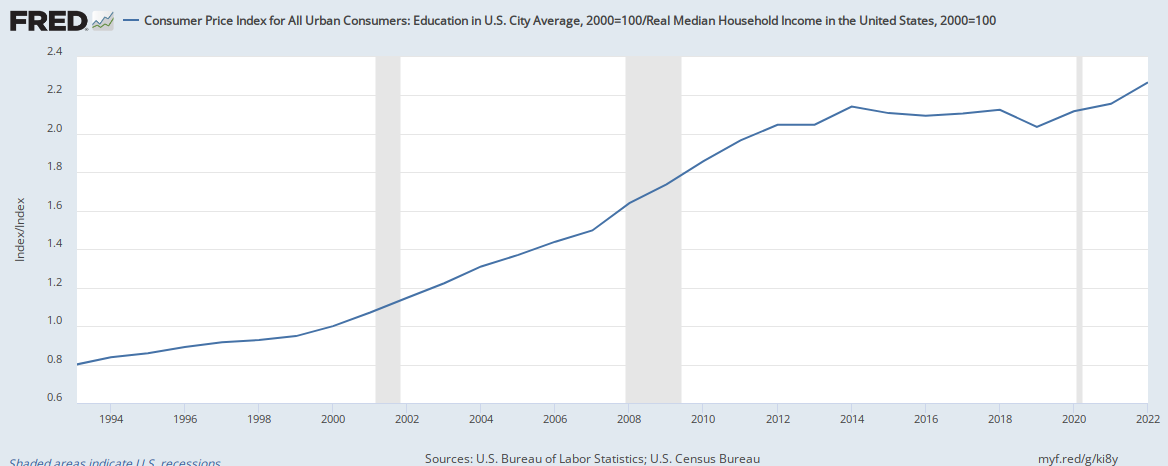
All the explanation you need in two graphs:
https://fred.stlouisfed.org/graph/fredgraph.png?g=ki8y
https://fred.stlouisfed.org/graph/fredgraph.png?g=ki8A
Cost of education over real median household income, and house price index over real median household income. Education is more than twice as expensive as the start of the century, and houses are almost twice as expensive as the start of the century.
https://fred.stlouisfed.org/graph/fredgraph.png?g=ki8y
https://fred.stlouisfed.org/graph/fredgraph.png?g=ki8A

Cost of education over real median household income, and house price index over real median household income. Education is more than twice as expensive as the start of the century, and houses are almost twice as expensive as the start of the century.
High housing prices are a massive tax on both middle class and investment. It all flows to landlords and lenders. Cut housing prices by 1/2 - 2/3 and the middle class has money for other things. We need an Elon Musk for housing.
My total comp this year is ballpark $240K. I'm still paying student loans. I'd like to buy a home, but in my area, there's nothing in a reasonable commmute from work under $750-$800K and anything less is getting bought in cash for some ridiculous amount over asking price.
You might argue that $800K is justified on a $240K income. I have anxiety from the thought that I could lose my job, and the barrier to entry in my field at other companies is so high that I would burn through my savings/investments and not be able to pay mortgage, taxes, + insurance.
You might argue that $800K is justified on a $240K income. I have anxiety from the thought that I could lose my job, and the barrier to entry in my field at other companies is so high that I would burn through my savings/investments and not be able to pay mortgage, taxes, + insurance.
Honestly as a Dutch man with a family but only one income (the norm about 40 years ago), we are are also really at the edge. And I have a relatively decent income (1.5-2 times modal as we call it). And where does all that money go? Well, more than 25% goes to interest on our mortgage. We get some of that back but from tax money so it's a cigar from our own box.
Whatever we earn more as a family is taken away by the banks by allowing us to loan more, which increases housing prices, which increases the interest they receive. Our economy is very much rigged to keep everybody working near full time to be able to live.
Whatever we earn more as a family is taken away by the banks by allowing us to loan more, which increases housing prices, which increases the interest they receive. Our economy is very much rigged to keep everybody working near full time to be able to live.
This raises two questions in my mind:
I admittedly come from a very privileged background (in terms of both an upper-middle-class family and genetics), but how have so many people found themselves in places where it's so hard to make ends meet? My parents paid for college (like I said, admittedly privileged) and the State of North Carolina actually gave me free tuition and paid me a stipend to get my Master's degree (free/cheap government education is a benefit which you don't have to be privileged to get, at least not as privileged). I chose the "wrong" programs from a job prospects / earnings perspective - Sociology and Public Administration. I still managed to fall into a career as a data scientist. I'm not paid a bay-area salary, but then the suburbs of Raleigh/Durham don't have a bay-area cost of living either. My wife and I have a bigger house than we need, drive two old (2005 & 2009) but functional cars, have two kids, take a reasonably nice week-long vacation each year, and give quite a bit away, all on one salary. We've both made sacrifices to be debt free other than the mortgage, which helps. Most of my close friends went to very reasonably-priced state schools (e.g., NC State University), got the "right" degrees, and are now gainfully employed and able to support a family. Do I just live in that much of a bubble? Are my and my friends' experiences really that out of the ordinary in America in 2018?
Second, is it just because I'm young? This article suggests a lot of programmers/engineers end up being un-hireable by middle age, and struggle to find another career to make ends meet. Does that match the experience of a lot of folks here? From my perspective, most of the middle aged programmers/engineers I know have just moved on to become software architects, managers of development teams, CTOs, consultants, etc. - in other words, they're doing even more lucrative work facilitated by their years of experience.
I admittedly come from a very privileged background (in terms of both an upper-middle-class family and genetics), but how have so many people found themselves in places where it's so hard to make ends meet? My parents paid for college (like I said, admittedly privileged) and the State of North Carolina actually gave me free tuition and paid me a stipend to get my Master's degree (free/cheap government education is a benefit which you don't have to be privileged to get, at least not as privileged). I chose the "wrong" programs from a job prospects / earnings perspective - Sociology and Public Administration. I still managed to fall into a career as a data scientist. I'm not paid a bay-area salary, but then the suburbs of Raleigh/Durham don't have a bay-area cost of living either. My wife and I have a bigger house than we need, drive two old (2005 & 2009) but functional cars, have two kids, take a reasonably nice week-long vacation each year, and give quite a bit away, all on one salary. We've both made sacrifices to be debt free other than the mortgage, which helps. Most of my close friends went to very reasonably-priced state schools (e.g., NC State University), got the "right" degrees, and are now gainfully employed and able to support a family. Do I just live in that much of a bubble? Are my and my friends' experiences really that out of the ordinary in America in 2018?
Second, is it just because I'm young? This article suggests a lot of programmers/engineers end up being un-hireable by middle age, and struggle to find another career to make ends meet. Does that match the experience of a lot of folks here? From my perspective, most of the middle aged programmers/engineers I know have just moved on to become software architects, managers of development teams, CTOs, consultants, etc. - in other words, they're doing even more lucrative work facilitated by their years of experience.
A large part of the problem is the psychology of being middle class. No one wants to be poor, or to think that they are poor, they affiliate themselves with the middle class. The social definition of what is middle class has been broadened to include people who would otherwise fit in the poor definition. Thinking themselves to be middle class, they try to act it and over spend and never save. A more stringent definition used to be something along the line of being a professional that would allow you to be able to afford to retire early and have the funds to get into politics or some other service. Poor people will continue to be bled dry, while the middle class shrinks and everyone refuses to accept they are technically poor and they need to act with purpose to improve their situations.
> some sharp points about how workers are expected to “deny their biology” and “how little American businesses and legislators care about care,”
These are two wonderful, succinct statements that perfectly describe the American experience.
These are two wonderful, succinct statements that perfectly describe the American experience.
People often lump freelance/contingent work and the "gig economy" together, but they're actually two different things. Yes, both are often used to avoid the cost of taxes and benefits, or to gain flexibility and not have to lay off regular workers if the business doesn't thrive. However, freelance and contingent work has generally been about hiring people who chose to work under those terms, to accept the uncertainty and some of the costs in return for gaining their own kind of flexibility or a higher hourly wage. The gig economy to a large degree seems to rely on a pool of involuntarily unemployed (or under-employed) people who would very much prefer to have a more regular job with a more regular paycheck if only they could find one. If the economy, or economic policy, changed so that there were more decent jobs available, the freelancers and contractors would go on as they always have but the gig workers would all bail and the gig-economy companies would have to make some serious adjustments to stay in business (if that would even be possible in such a different labor environment).
I can tell the ages of people posting on here from their comments.
I love Berlin because of the nightlife and culture. 20s.
I love Berlin because of the free schooling. 30s and 40s.
I love Berlin because of the free healthcare. 50s+
I love Berlin because of the nightlife and culture. 20s.
I love Berlin because of the free schooling. 30s and 40s.
I love Berlin because of the free healthcare. 50s+
> Quart describes her own experience of slipping into the “falling middle-class vortex” after the birth of her daughter seven years ago, a time when she and her husband were freelance writers facing new child care costs and hospital bills.
TBH, couple of "freelance writers" deciding to have a child sounds like recipe for financial disaster right from the bat. I understand that "freelance writer" is a broad term, but most of the writers I know are very far from affording a child or two.
I understand that having a child, unlike, say, buying a sports car, is a luxury a lot of people around the world decide to indulge in even if they don't really afford it. But if you spend money and resources on something you can't really afford, at least be honest with yourself about it.
TBH, couple of "freelance writers" deciding to have a child sounds like recipe for financial disaster right from the bat. I understand that "freelance writer" is a broad term, but most of the writers I know are very far from affording a child or two.
I understand that having a child, unlike, say, buying a sports car, is a luxury a lot of people around the world decide to indulge in even if they don't really afford it. But if you spend money and resources on something you can't really afford, at least be honest with yourself about it.
> They are people on the brink who did everything 'right'
One of my favorite lessons of software engineering: it doesn't matter how right you think you are.
One of my favorite lessons of software engineering: it doesn't matter how right you think you are.
TFA is a rather thin "review" of the book, almost completely unsubstantive.
> “It’s not your fault.” Based on the diligent people she meets, it’s hard to disagree.
Sorry, but one can be diligent and still have made wrong choices. And the irony is thick. The author found herself in this boat through years of being a freelance writer, and now in heavy debt from culinary school.
I haven't read the book but I very much doubt I would find it compelling. I do agree, some and maybe most of the blame doesn't lie on the middle class's shoulders (except for lack of civic engagement), but it doesn't seem like this book is going to get to the heart of it.
I also laugh at this quote from TFA:
> Even lawyers, a traditionally risk-averse bunch who tend to choose their profession for its stability, are getting caught in the vise between increasing law school tuitions and decreasing job prospects. Precarity, Quart suggests, can translate into solidarity.
Even lawyers? It is well known that law schools are pumping out too many and too low qualified grads. The information about job prospects is available. Those who went into tier 3 law schools thinking that they would come out the other end successfully have made their own bed. Yes indeed much fault lies with the law schools themselves, but let's not absolve the students of blame here.
> “It’s not your fault.” Based on the diligent people she meets, it’s hard to disagree.
Sorry, but one can be diligent and still have made wrong choices. And the irony is thick. The author found herself in this boat through years of being a freelance writer, and now in heavy debt from culinary school.
I haven't read the book but I very much doubt I would find it compelling. I do agree, some and maybe most of the blame doesn't lie on the middle class's shoulders (except for lack of civic engagement), but it doesn't seem like this book is going to get to the heart of it.
I also laugh at this quote from TFA:
> Even lawyers, a traditionally risk-averse bunch who tend to choose their profession for its stability, are getting caught in the vise between increasing law school tuitions and decreasing job prospects. Precarity, Quart suggests, can translate into solidarity.
Even lawyers? It is well known that law schools are pumping out too many and too low qualified grads. The information about job prospects is available. Those who went into tier 3 law schools thinking that they would come out the other end successfully have made their own bed. Yes indeed much fault lies with the law schools themselves, but let's not absolve the students of blame here.
Is it worth reading or is it just about how things are more expensive and we don't make enough?
Death of the American dream was a decent doc about this subject. All of this has been engineered into place over a long period of time.
Stretched would be more accurate.
Should have been entitled, why people on the coasts can't afford America.
Where did the money go?
thats why we need anarcho-capitalism
i would love to participate in this discussion. unfortunately i cannot, because although i do not have to complain about money, unfortunately my financial situation is not so amazing it would be smart to throw away money on a NYT subscription.
There is opportunity everywhere. The middle class is fading more from a lack of individual drive to succeed. My parent went from middle class to absolute broke. They lost their home and lived with their parent for several years while rebuilding what they lost. Now they own a better home and are doing very well. They are a one income family (my father works and has no college degrees) with 5 kids still living with them.
Funny how the word "immigration" never appears in these articles. Any intellectually honest assessment of the waning American middle class needs to consider the overwhelming post 1965 demographic changes.
Regardless of your personal feelings on the matter, adding tens of millions of very poor people to a population over the course of decades is, as a mathematical certainty, going to reduce the median wealth of the population.
Then add to that dynamic effects such as increased demand for housing and other necessities, higher taxes to cover increased costs of health, education, welfare, and so on, and it's no wonder the fading middle class is getting squeezed.
Regardless of your personal feelings on the matter, adding tens of millions of very poor people to a population over the course of decades is, as a mathematical certainty, going to reduce the median wealth of the population.
Then add to that dynamic effects such as increased demand for housing and other necessities, higher taxes to cover increased costs of health, education, welfare, and so on, and it's no wonder the fading middle class is getting squeezed.
Now, on a single high 5 figure salary, I'm 15 minutes biking to work and live in one of the nicest parts of the city. We have two kids in free day care. My wife works part time, and she is finishing a year off of 60% paid maternity leave. She really doesn't earn much after taxes, but we save all her income - more than 15k per year.
Salaries are lower here and things are getting more expensive for sure. But for 400k+ EUR, we should be able to buy a place for a family of four and bet set for a long time.